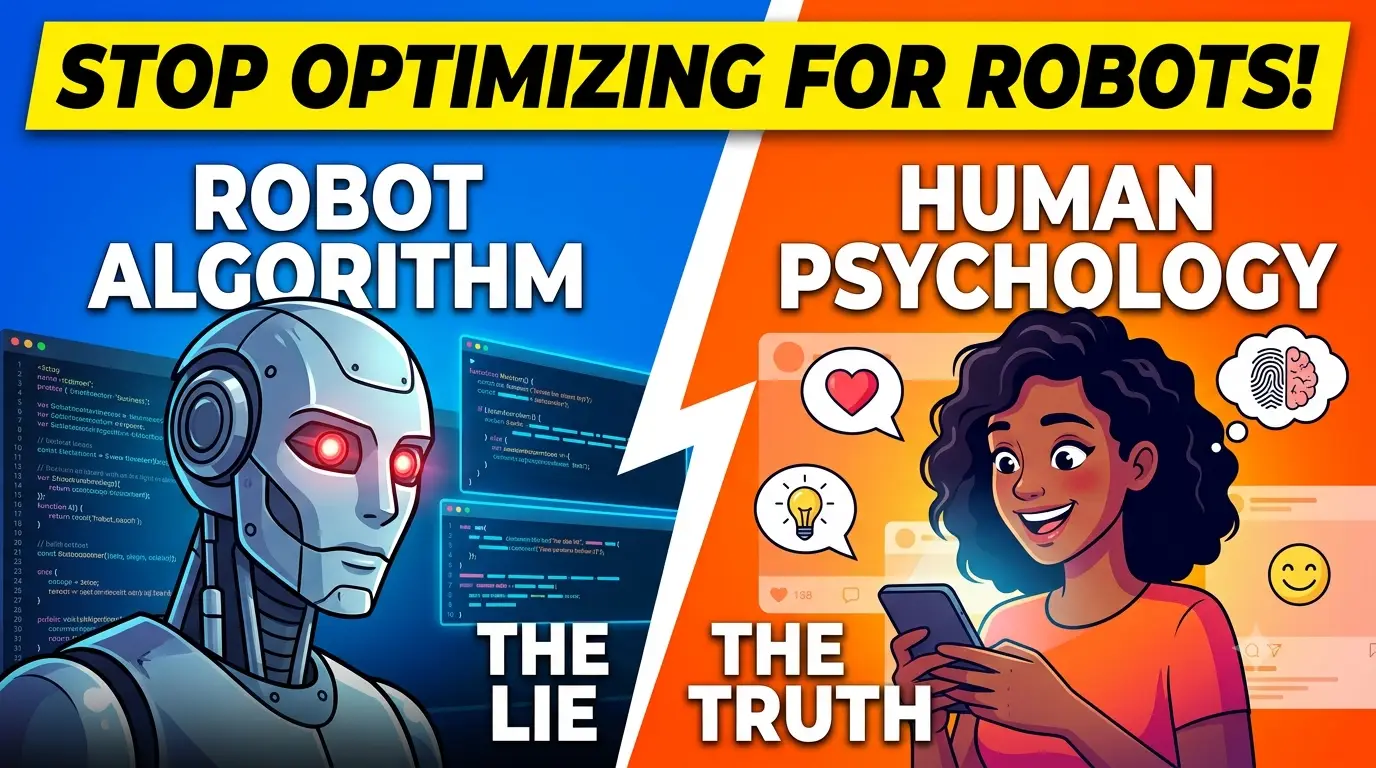
You just spent 45 minutes crafting the perfect description. You researched the exact keywords. You filled every tag slot with precision-targeted phrases. You checked every SEO box the internet told you to check.
Your video got 312 views.
Meanwhile, a creator in your niche filmed themselves talking into a webcam for 12 minutes with a title that reads "this is getting out of hand" and a description that says "watch this lol." That video has 480,000 views.
You have been told that YouTube is a search engine. You have been told that the algorithm needs specific signals to rank your content. You have been told that tags, descriptions, and keyword density are the difference between 300 views and 300,000 views.
You have been told a lie.
The algorithm does not watch your video. The algorithm does not read your description. The algorithm does not care about your tags. The algorithm is a mirror. It reflects what real human beings do when they encounter your content. And if you are optimising for the mirror instead of the person looking into it, you are optimising for the wrong thing entirely.
The Great Misunderstanding: YouTube Is Not a Search Engine (For Most Creators)
Here is a truth that the SEO-optimisation industry does not want you to hear: for the vast majority of creators, search is a secondary traffic source.
YouTube's own data shows that over 80% of watch time comes from browse features — the homepage, suggested videos, and notifications. These are not search-driven. They are driven by predictive algorithms that try to match viewers with content they will enjoy based on past behaviour.
The browse algorithm does not read your tags. It does not parse your description. It looks at one thing: would a real human being click on this, watch it, and enjoy it? And it determines that by watching what real human beings do — not by scanning your metadata.
This is why the creator with the minimal description and the organic title outperforms the SEO-maximised creator. The algorithm showed both videos to a test audience. The test audience clicked on one and ignored the other. The algorithm amplified the one people actually wanted to watch. Everything else is noise.
"I used to spend two hours writing descriptions with exactly 200 words, five keyword-rich paragraphs, and a timestamp table of contents. My views were flat for 18 months. I stopped writing descriptions entirely. I put one sentence. My views went up 40% in two months. The description was never helping. It was just making me feel productive while avoiding the real problem — my content was not psychologically engaging."
— UK creator, 890K subscribers — commentary
The algorithm is a mirror, not a gatekeeper
The Three Signals That Actually Matter
YouTube's recommendation system is sophisticated, but its core is simple. It evaluates every video on three primary signals — and none of them come from your tags or descriptions.
1. Click-Through Rate (CTR) — The Decision Signal
When a viewer is shown your thumbnail and title, do they click? This is the first and most important gate. If your CTR is low, the algorithm stops showing your content to new audiences. CTR is not about keywords. It is about psychological impulse.
A high-CTR thumbnail and title combination triggers an automatic, almost subconscious response in the viewer's brain. It creates a curiosity gap that the brain needs to close. It activates the same neural circuitry as an unanswered question or an incomplete pattern.
The creators who consistently get high CTR are not better at SEO. They are better at psychological triggering. They understand that a thumbnail is not a information-delivery mechanism — it is an emotional recruitment tool.
2. Average View Duration (AVD) — The Satisfaction Signal
Once the viewer clicks, does the content hold their attention? This is the signal that the algorithm weights most heavily. A video with a 60% AVD will always be promoted over a video with 30% AVD — regardless of how many keywords the low-retention video targets.
Retention is not an SEO problem. It is a pacing, structure, and psychological engagement problem. Every second a viewer chooses to stay is a vote of confidence that the algorithm registers and amplifies.
3. Session Time — The Ecosystem Signal
After watching your video, does the viewer stay on YouTube? Do they watch another video? Do they watch a video from a different creator? YouTube's ultimate goal is total platform engagement, not individual video performance.
Videos that lead to longer platform sessions are rewarded with disproportionate distribution. This is why "watch next" optimisation — structuring your content so viewers naturally want to continue watching YouTube after your video ends — is one of the highest-leverage activities you can do. And it has absolutely nothing to do with your tags.
The Sterile Content Problem: When Optimisation Kills Soul
There is a more insidious cost to algorithm-friendly optimisation. It does not just waste your time. It makes your content worse.
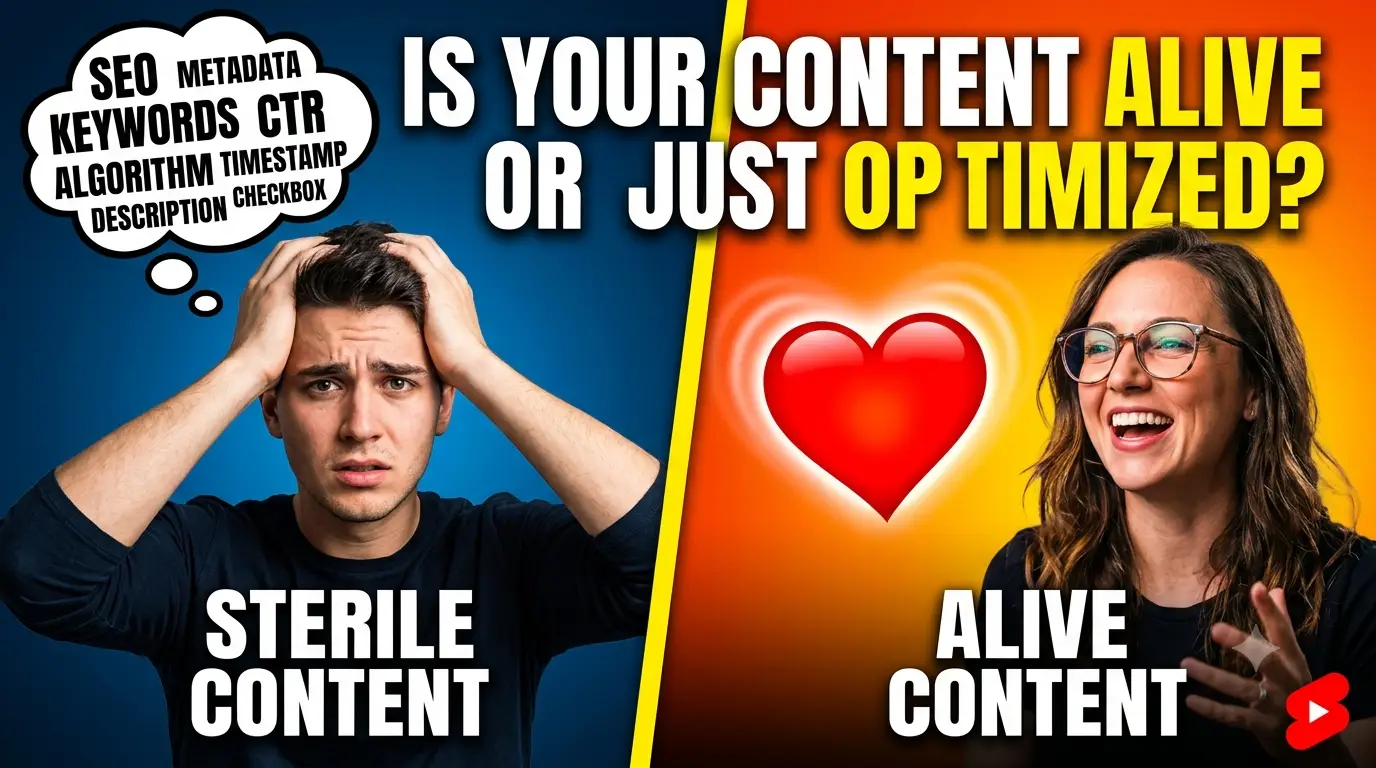
When you optimise for metadata, you naturally start writing titles that sound like search results. You start structuring videos that check every engagement box. You start creating content that is technically correct but emotionally sterile.
The video has the right keywords. The thumbnail follows the formula. The description includes timestamps. But the video lacks tension. It lacks surprise. It lacks the unpredictable quality that makes human beings feel something.
The algorithm is exceptionally good at detecting this. Videos that check every SEO box but fail to generate genuine emotional response get deprioritised — because the algorithm measures human behaviour, and humans do not engage with content that feels manufactured.
"I spent 2023 trying to reverse-engineer the algorithm. I studied every YouTube SEO course. I filled every metadata field with precision. My videos got more organised but less watched. I was making content that passed every "algorithm test" except the one that actually mattered — did it make people feel something? When I stopped optimising for robots and started optimising for emotional reaction, my views doubled in three months. The algorithm rewarded me for being human, not for being efficient."
— Canada creator, 1.1M subscribers — documentary
What Actually Drives Human Behaviour on YouTube
If metadata does not drive performance, what does? The answer is grounded in behavioural psychology — specifically, the mechanisms that trigger human attention, emotional response, and decision-making.
Curiosity Gaps: The Open Loop
Human brains are wired to seek closure. When we encounter an incomplete pattern, an unanswered question, or a mystery, our brains experience a low-grade neurological discomfort that persists until the gap is closed. This is the single most powerful psychological mechanism available to YouTube creators.
A curiosity-gap title does not explain what the video is about. It creates a question that the viewer needs to answer by watching. "I Tried the 2022 Strategy for 30 Days — Here Is What Died" is more effective than "Why Your YouTube Strategy Is Failing" because it creates an open loop that the title does not close.
The thumbnail should amplify the gap, not close it. If your thumbnail + title combination answers every question before the viewer clicks, you have given them no reason to click.
Emotional Anticipation: The Dopamine Loop
Humans are not rational decision-makers when it comes to content consumption. We click based on anticipated emotional payoff. We watch a video because we predict — consciously or subconsciously — that it will make us feel something: surprise, anger, joy, curiosity, awe.
The most effective thumbnail and title combinations do not describe content. They trigger an emotional prediction. The viewer thinks "watching this will make me feel X" — and if X is a feeling they want, they click.
This is why sterile, descriptive titles fail. "How to Improve Your YouTube CTR" triggers a weak emotional prediction (mild curiosity at best). "The One Number That Proves Your Thumbnail Is Failing" triggers a stronger prediction (concern + curiosity). The second title is not better because of keyword density. It is better because of emotional anticipation.
Social Proof: The Herd Signal
Viewers are heavily influenced by the behaviour of other viewers. A video with high view count, visible comments, and an engagement rate that signals community activity triggers a subconscious "safety in numbers" response. The algorithm knows this and amplifies videos that already show social proof signals.
This creates a feedback loop: the algorithm shows your video to a small test audience → if they engage, it shows it to more people → more engagement → more social proof → the algorithm amplifies further. The loop is driven entirely by human behaviour. Metadata has no seat at this table.
"I stopped writing tags two years ago. I write a one-sentence description. My title takes 30 seconds. I spend all my optimisation energy on one thing — making sure the first 30 seconds of my video creates an emotional reaction. That is it. My channel has grown 300% in two years. The algorithm does not need to read about your video. It needs to see that people watch it."
— UK creator, 650K subscribers — technology reviews
How Virality Labs Scores What the Algorithm Actually Measures
Most optimisation tools focus on metadata. They scan your description for keyword density. They suggest tags based on search volume. They optimise your video for a version of YouTube that stopped existing years ago.
Virality Labs takes a fundamentally different approach. We ignore metadata entirely. We score what the algorithm actually measures — human psychological response.
Emotional Resonance Score
Upload your script or concept. Virality Labs analyses the emotional triggers embedded in your content — not your keywords, not your tags, but the psychological mechanisms that will drive a viewer to click, watch, and stay. The platform identifies whether your content activates curiosity gaps, emotional anticipation, surprise responses, or social proof triggers — the only signals that actually move the algorithm needle.
Click Impulsivity Index
Your thumbnail and title are scored on their ability to trigger an automatic click response — the subconscious impulse that makes a viewer click before their rational brain has time to talk them out of it. This is not about keyword matching. It is about visual and linguistic patterns that have been proven, across millions of viewing sessions, to trigger the click response in human brains.
Psychological Retention Projection
Virality Labs predicts viewer retention based on pacing psychology — not keyword optimisation, not metadata signals. The platform analyses your script's tension curve, information density per second, and emotional arc to project exactly where viewers will disengage and why.
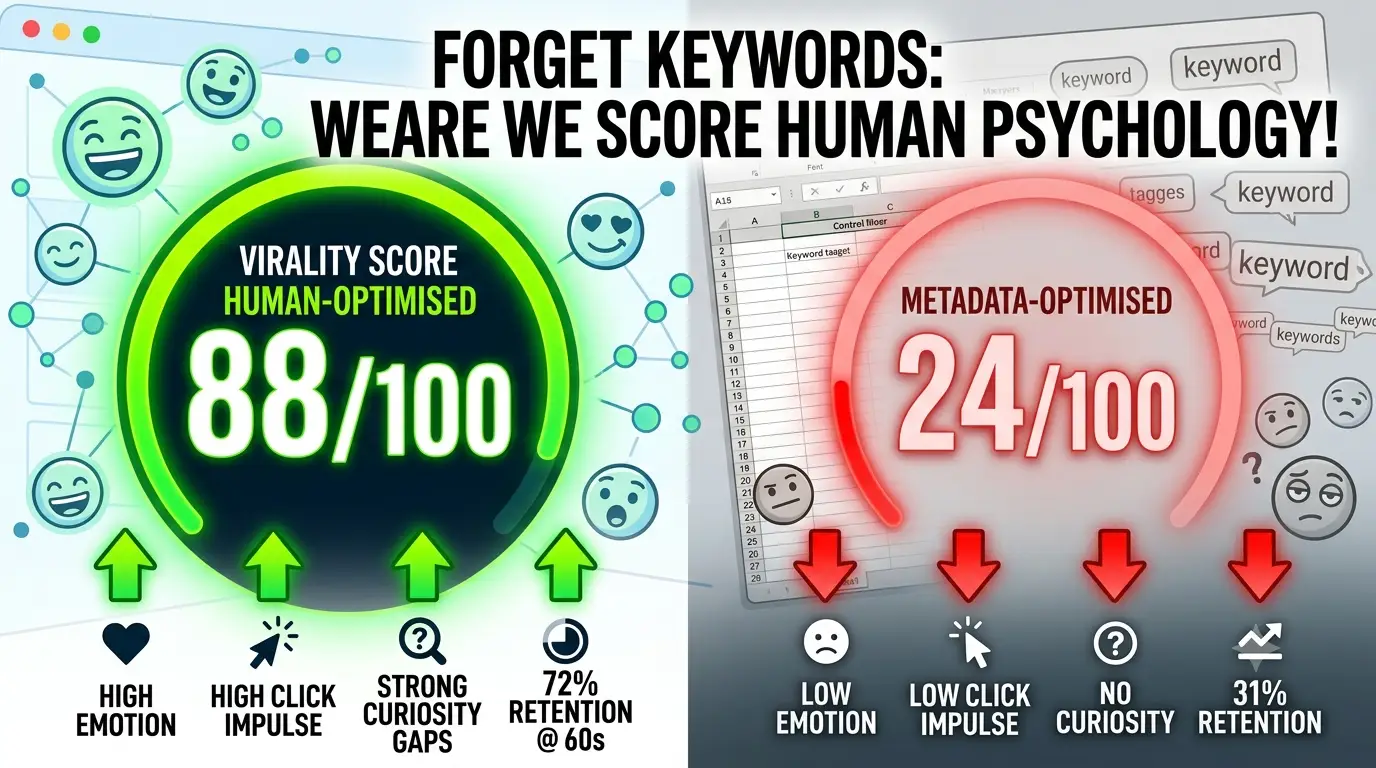
Emotional resonance: high. Click impulsivity: high. Curiosity gaps: present. Retention projection: 72% at 60s. The algorithm will amplify this video because humans will watch it.
Emotional resonance: low. Click impulsivity: low. Curiosity gaps: absent. Retention projection: 31% at 60s. The algorithm will deprioritise this video because humans will ignore it.
The 80/20 Rule of YouTube Optimisation
Most creators spend 80% of their optimisation time on activities that contribute less than 6% of their performance — tags, descriptions, keyword research, metadata formatting. And 20% of their time on activities that contribute 84% of their performance — thumbnail psychology, title curiosity gaps, retention pacing, emotional structure.
Here is the inversion that separates creators who grow from creators who stagnate:
- Instead of writing better descriptions, write better hooks. The description gets
2.3 seconds of attention. The hook determines whether the viewer stays for 2 minutes or 20. - Instead of researching keywords, research psychological triggers. Keywords rank you in search. Psychological triggers rank you in browse — where
82% of watch time comes from . - Instead of filling tag slots, fill curiosity gaps. Tags have a 0.003% impact on views. A well-structured curiosity gap can double your CTR.
- Instead of formatting metadata, format emotional pacing. Metadata does not keep anyone watching. A well-paced emotional arc does.
"I deleted every tag from my last 50 videos. Nothing changed. I removed all my descriptions. Nothing changed. Then I rewrote my titles to create genuine curiosity gaps — no keywords, no SEO, just psychology. My CTR went from 4.2% to 11.8%. The algorithm did not care about my tags. It cared about whether humans clicked. I was optimising for the wrong system for two years."
— Canada creator, 470K subscribers — personal development
The Bottom Line
The "algorithm-friendly" approach to YouTube is a lie that costs you time, creativity, and growth. It convinces you that success comes from pleasing a machine. But the machine is only watching what humans do.
Every hour you spend on tags, descriptions, and keyword optimisation is an hour you could have spent creating a thumbnail that triggers an emotional response, writing a title that creates an open loop, or structuring an intro that holds attention through psychological pacing.
The algorithm does not have preferences. It does not have opinions. It does not reward compliance with best practices. The algorithm rewards human behaviour. Nothing else.
You can keep coding for a machine that does not read your code. Or you can start engineering for the human brain — which is the only thing the algorithm has ever been measuring.
Stop optimising for robots. Discover your video's human psychology score in under 60 seconds — for free.