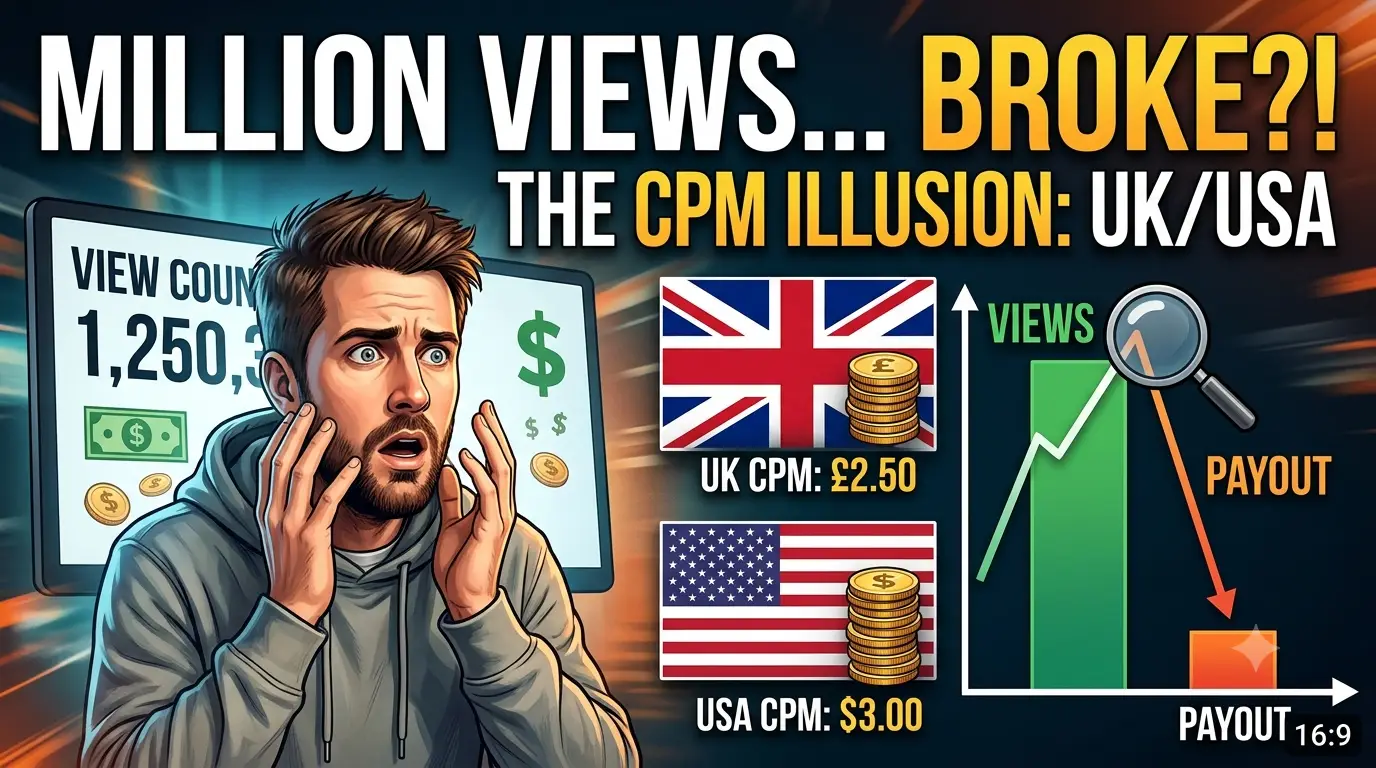
The numbers on the dashboard look incredible. Half a million views in seven days. Comments are flooding in. Your channel is finally taking off.
Then you open your YouTube Studio revenue page. The number makes you blink. You refresh the page. It does not change. £187.
Not per day. Total. For half a million views.
You did the maths. You worked out the RPM. It came to roughly £0.37 per thousand views. That is less than a coffee. That is not a business. That is a betrayal.
And the worst part? You are not alone. Thousands of creators in the UK, Canada, and even parts of the US are trapped in the same paradox — growing views, shrinking payouts. The more content you produce, the less each view seems to be worth.
This is not a glitch. This is not a temporary ad-rate dip. This is the CPM Illusion — and it is silently determining which creators build sustainable businesses and which creators burn out wondering why their success never translated into income.
The Mathematics of Misery: Why 500,000 Views Does Not Equal 500,000 Views
Here is the uncomfortable truth that YouTube does not want to put on a billboard: views are not a currency. Advertiser demand is.
When an advertiser runs a campaign on YouTube, they are not buying random views. They are buying specific demographics. A financial services company launching a pension product is not interested in showing their ad to a 16-year-old watching a gaming stream. They want 35-to-55-year-old professionals with disposable income in London, Toronto, or New York.
The advertiser bids for that specific audience. They pay a premium for it — sometimes £20, £30, or even £50 per thousand impressions. Meanwhile, an advertiser selling a mobile game will buy cheap inventory at £0.50 per thousand impressions, targeting broad, low-intent audiences.
Your CPM — the amount advertisers pay per thousand impressions on your videos — is not determined by your content quality. It is determined by the demographic profile of your audience. And if your audience is young, low-income, or outside the regions that premium advertisers care about, your CPM will be low regardless of how many views you generate.
"I hit a million views in a month. My RPM was £0.42. I made £420. My friend with 90,000 subscribers in the finance niche made £3,400 on 150,000 views. I was working ten times harder for eight times less money. The views were a vanity metric. The audience demographic was the only number that actually mattered."
— UK creator, 720K subscribers — gaming commentary
Why Your Audience Demographics Are Costing You Thousands
Every viewer who watches your content carries a "value tag" that advertisers use to determine how much they are willing to pay to reach them. These are the factors that determine your channel's effective CPM:
Geography — The Single Largest CPM Lever
Advertisers pay dramatically different rates for viewers in different countries. A viewer in the United States is worth roughly 10x a viewer in India — not because the US viewer is inherently more valuable, but because advertisers are willing to pay more to reach them.
But even within Western countries, there is a hierarchy. Viewers in central London are worth more than viewers in rural Scotland. Viewers in Manhattan are worth more than viewers in rural Ohio. The more granular the advertiser targeting, the more they pay — and the more your specific audience composition matters.
This is why two channels with the same subscriber count and similar view counts can have wildly different revenues. Channel A's audience is 60% US/UK urban professionals. Channel B's audience is 70% developing-world casual viewers. Same views. 5x revenue difference.
Age and Income — The Tier-1 Demographic Premium
The highest-paying advertising categories — finance, insurance, SaaS, higher education, legal services — all target audiences aged 25-54 with above-average disposable income. If your audience skews younger or lower-income, these advertisers simply will not bid on your inventory.
This is the silent tax on gaming, entertainment, and meme channels. You can generate millions of views, but if your audience is predominantly under 21, the premium advertiser categories that pay £10+ CPM will never touch your content. You are left with the £0.50 CPM categories — mobile games, cheap consumer goods, and throwaway brand campaigns.
Viewer Intent — The RPM Decider
Not all views are created equal — and not just because of demographics. Viewer intent is the hidden multiplier that determines whether a view generates revenue or generates system load.
A viewer who actively searches for "best investment ISA UK 2026" is a high-intent viewer. They are actively looking for financial information. They are in a purchase-adjacent mindset. Advertisers will pay a premium to reach them because they are closer to a buying decision.
A viewer who stumbles onto a "reaction to viral video" is a low-intent viewer. They are killing time. They are not in a purchase mindset. Advertisers will pay the minimum to reach them because they are unlikely to convert.
Your RPM is not just a function of who watches. It is a function of why they watch. High-intent content commands premium ad rates. Low-intent content commands basement rates. The difference can be 20x on the same platform with the same view count.
The Audience You Build Determines the Business You Run
This is where the CPM Illusion becomes a strategic trap. Most creators optimise for the wrong metric. They chase views. They chase virality. They chase the algorithm's short-term dopamine loop without realising that every view they attract is building an audience profile that determines their revenue ceiling.
If you spend two years building an audience of 16-to-22-year-old entertainment seekers, you have built a massive audience with a £0.50 RPM ceiling. The only way to increase revenue is to get more views — but you are already maxing out your audience. You are trapped in a volume game with diminishing returns.
If you spend two years building an audience of 28-to-45-year-old professionals interested in business or finance, you have built a smaller audience with a £10+ RPM ceiling. You need 20x fewer views to make the same money. You are playing a value game with compounding returns.
Audience: 25-54 UK/US professionals. Intent: high (topic search / active learning). Niche: finance / business / SaaS. RPM projection: £8-15. Revenue per 100K views: £800-1,500.
Audience: 13-21 global entertainment seekers. Intent: low (passive browsing / reaction). Niche: gaming / memes / general entertainment. RPM projection: £0.30-0.80. Revenue per 100K views: £30-80.
Your audience is an asset. Its demographic composition is the balance sheet.
How to Escape the Low-CPM Trap Without Losing Your Audience
If you are already trapped in a low-CPM niche, do not panic. You do not need to delete your channel and start over. But you do need a strategic transition — and the first step is understanding that your content topics determine your audience demographics determine your CPM.
Step 1: Audit Your Actual RPM by Content Category
Go into YouTube Studio and look at your revenue by video. Sort by RPM. Which topics generate the highest revenue per thousand views? Which topics generate the lowest? You will almost certainly find that different content categories on the same channel attract different audiences with different CPM profiles.
A gaming channel that occasionally posts "how much I spend on my setup" or "the business of gaming" content may find that those videos have 3x-5x higher RPM than the standard gameplay content. That is not random. That is a signal. Your audience includes people interested in higher-CPM topics — and you are not serving them enough.
Step 2: Expand Your Content Portfolio Up the CPM Ladder
The most successful creators who have escaped the low-CPM trap did not abandon their audience. They added content layers that naturally attract higher-value viewers without alienating their existing base.
- A gaming creator starts a monthly "business of gaming" series covering industry economics and creator earnings.
- An entertainment commentator introduces a "behind the deal" format analysing the business side of the entertainment industry.
- A lifestyle creator expands into personal finance content — budgeting, investing, career growth — that retains the personal voice while attracting a higher-value demographic.
Each of these content expansions attracts a different viewer — older, higher-income, higher-intent — who brings a higher CPM with them. Over six to twelve months, the channel's overall RPM shifts upward. The creator makes more money from the same total views.
Step 3: Forecast the Demographic Value of a Topic Before You Film It
This is the step that almost no creator takes — and it is the step that separates hobbyists from business owners. Before you invest 10, 20, or 40 hours into a video, you should know the economic value of the audience it will attract.
A topic like "best high-interest savings accounts UK 2026" will attract viewers aged 28-50 with disposable income. The CPM for that video will likely be £12-20. A topic like "trying the weirdest snacks from around the world" will attract viewers aged 13-25 killing time. The CPM will likely be £0.50-1.50.
Both videos might perform well. Both might get views. But one generates 20x more revenue per thousand views than the other. The choice of topic is not just a creative decision. It is a financial decision with direct revenue consequences.
"I started as a reaction channel. I had 200K subscribers and was making about £400-600 a month. I started posting one finance video per week alongside my reaction content. Within six months, my overall RPM went from £0.90 to £4.20. My revenue quadrupled without my view count changing much. The finance videos had half the views but ten times the CPM. They pulled up the entire channel's economics."
— Canada creator, 340K subscribers — business & personal finance
Why Virality Labs Predicts Revenue, Not Just Views
Every other analytics tool shows you what happened after you published. They tell you your RPM after the video is already filmed, edited, and uploaded. By then, the economic outcome is already determined. You cannot reshoot your audience demographics.
Virality Labs takes a fundamentally different approach. We forecast the demographic and economic value of a video topic before you write a single word of the script.
Audience Demographic Projection
Upload your topic or script concept. Virality Labs analyses the language, framing, and subject matter to project the age range, income bracket, geographic distribution, and intent level of the audience the content will attract. This is not guesswork — it is based on millions of viewing sessions across the UK, USA, and Canadian creator ecosystem.
CPM & RPM Forecaster
Based on the projected audience demographic and intent profile, Virality Labs predicts the likely CPM and RPM range for the video — before you invest a single hour in production. You will know, before you film, whether a topic is a £0.50 RPM video or a £15 RPM video.
Topic Economic Score
Every topic receives a composite economic score that combines projected views, CPM, RPM, and total revenue potential. This is the number that tells you whether a video idea is worth your time — not just in views, but in actual income.
Projected audience: 30-50 UK/US professionals. Estimated CPM: £12-18. Estimated RPM: £8-12. Revenue projection for 100K views: £800-1,200. Verdict: film this video.
Projected audience: 14-22 global casual viewers. Estimated CPM: £0.80-1.50. Estimated RPM: £0.40-0.90. Revenue projection for 100K views: £40-90. Verdict: skip or pivot the angle.
The Revenue Math That Changes Everything
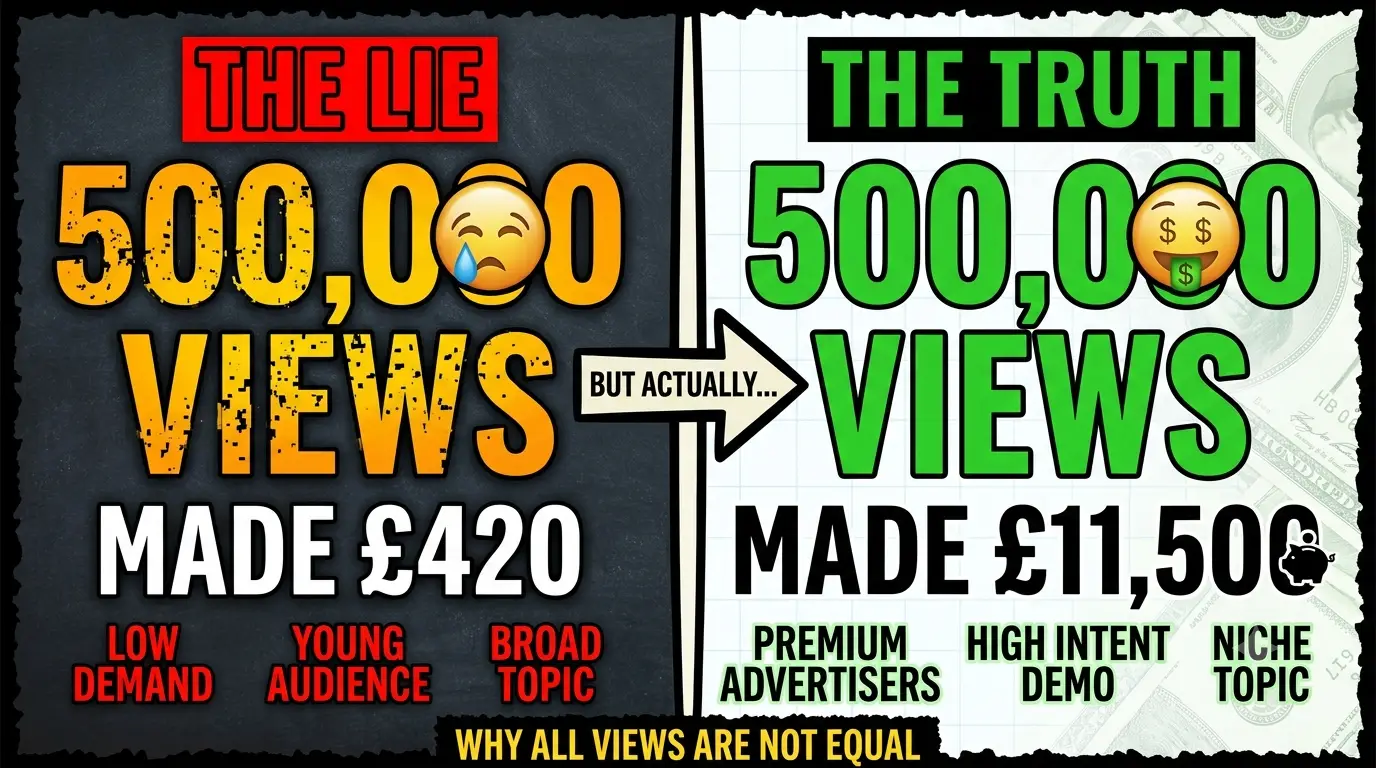
Let us put real numbers on this. Here are two creators, both publishing weekly, both generating 500,000 views per month.
Creator A makes reaction and entertainment content. Their RPM is £0.50. Their monthly revenue is £250. They need 2 million views a month to make £1,000. They are trapped in a volume game where growth requires exponentially more views just to maintain income.
Creator B makes finance and business content. Their RPM is £10. Their monthly revenue is £5,000 on the same 500,000 views. They can take a month off and still earn more than Creator A working full-time. They are playing a value game where every view compounds their income.
The difference is not effort. The difference is not talent. The difference is understanding that views are not currency. Audience demographics are currency.
Creator B did not work harder. Creator B worked smarter — by choosing topics that naturally attract higher-value viewers. By understanding that the CPM Illusion is not a mystery. It is a predictable economic outcome of the audience you choose to build.
"When I started, everyone told me to pick a niche and stick with it. My niche was personal finance. I watched friends in gaming hit a million subscribers before I hit 200K. They were posting daily. I was posting weekly. Then the revenue reports came in. I was making more on 200K subscribers than they were on a million. They were winning the popularity contest. I was winning the business. I would make the same choice again every time."
— US creator, 1.2M subscribers — investing & personal finance
The Inversion: Small Audiences, Big Revenue
The CPM Illusion creates a counterintuitive truth that most creators never internalise: a smaller, well-targeted audience is financially superior to a larger, low-value audience.
A channel with 50,000 subscribers in the high-CPM finance niche can easily generate £5,000-10,000 per month. A channel with 500,000 subscribers in the low-CPM entertainment niche might generate the same revenue. The first channel has 10% of the audience size and produces a fraction of the content — but earns the same income.
This is not an argument against growth. It is an argument against indiscriminate growth. Every subscriber you gain changes the demographic composition of your audience. Every video you publish attracts a specific viewer profile. If you are not intentional about which viewers you attract, you are passively accepting the lowest common denominator — and the lowest CPM that comes with it.
The Compounding Effect of High-CPM Content
High-CPM content does not just earn more per view today. It creates a compounding advantage over time:
- Higher revenue per view means you can reinvest more into production quality, tools, and data — making your next video even better.
- Higher-value audience means your community includes professionals, decision-makers, and potential business partners — not just passive consumers.
- Higher advertiser demand means your channel becomes a premium inventory source — attracting direct brand deals and sponsorship opportunities that pay 10-50x standard AdSense rates.
- Higher revenue stability means you are not dependent on viral spikes to pay your bills — consistent, predictable income from a loyal, high-value audience.

The Bottom Line
500,000 views feel like success. Your brain releases dopamine when you see the number climb. But dopamine does not pay your rent. £0.37 RPM does not build a business.
The CPM Illusion convinces you that more views are always better. They are not. More valuable views are better. More views from the right demographic, with the right intent, in the right geography — those are better. Everything else is a vanity metric dressed up as progress.
The creators who build sustainable businesses on YouTube are not the ones who chase viral numbers. They are the ones who understand that every view carries an economic weight — and they choose to create content that attracts the heaviest views, not the most views.
You can keep optimising for the number that looks good on a screenshot. Or you can start optimising for the number that looks good in your bank account.
Know your video's true earning potential before you film. Get your free CPM & RPM forecast in under 60 seconds.