Scroll back through your own upload history. Go on — actually do it.
Eighteen months ago there's a video sitting there at 340,000 views. Next to it, one at 512,000. You remember that week. You remember refreshing Studio in your bedroom at 1AM in Manchester or Austin or Chicago, watching the graph climb so fast it felt like the numbers were broken. Brands emailed you. Other creators studied your format.
Now scroll forward. Your last upload: 2,100 views. The one before it: 1,800. On a channel with 180,000 subscribers.
And somewhere, quietly, in a part of your brain you don't like visiting, a darker thought has started forming: "Did I get blacklisted? Did the algorithm put me on some list? Is my channel just... dead?"
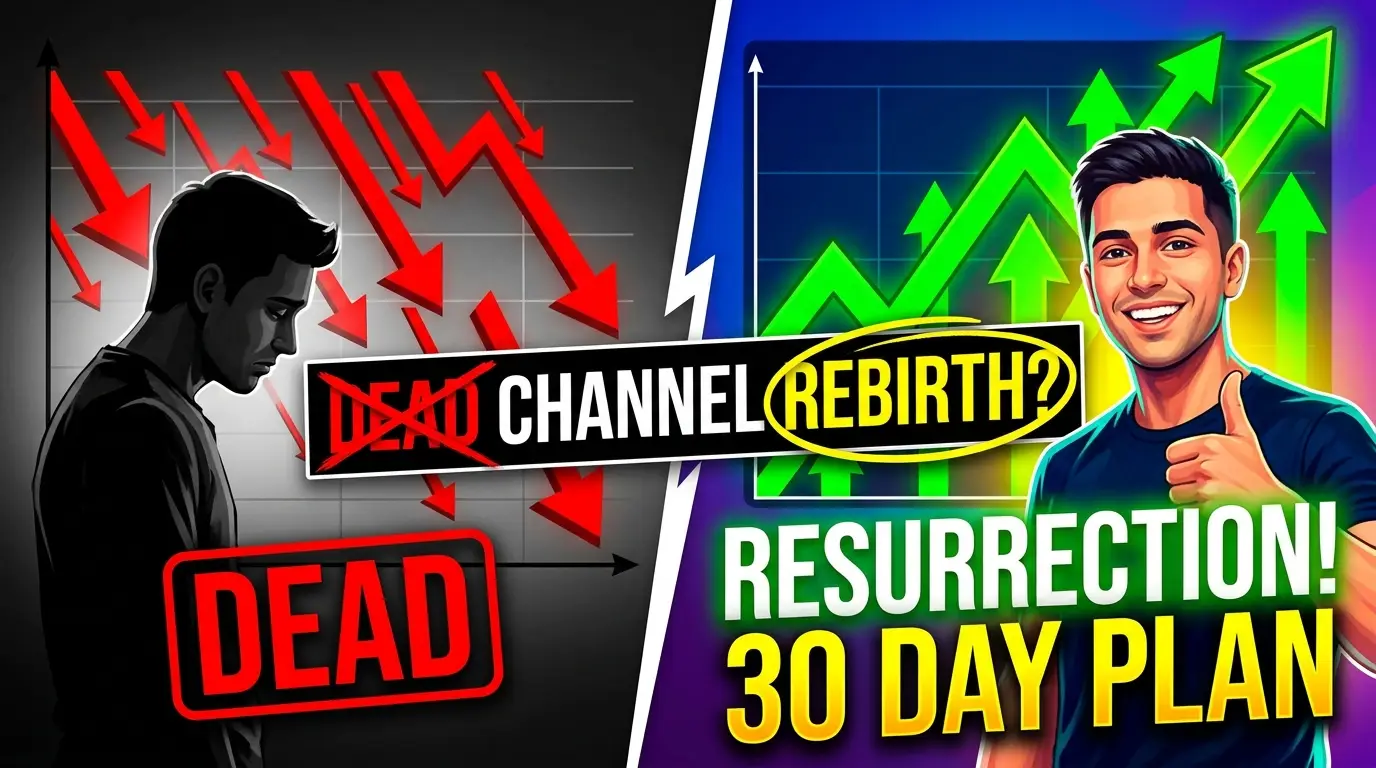
Here's the truth, and I need you to hear it before anything else: your channel is not dead. It is in cardiac arrest. There's a difference. A dead channel stays dead. A channel in cardiac arrest still has a pulse — faint, buried under layers of algorithmic neglect — and channels in cardiac arrest get resuscitated all the time. Not with luck. Not by "waiting it out." With a defibrillation protocol.
This article is that protocol. Thirty days. Specific moves, in specific order. And one tool — virality-labs.com — that creators are increasingly using as the jolt that restarts the whole system. Let's go.
The Dead Subscriber Trap: Your Subscriber Count Is Lying to You
The first thing you need to understand — the thing YouTube will never show you on a nice dashboard card — is that a large chunk of your subscriber count is fiction.
Those 180,000 subscribers? They were accumulated across years, trends, formats, and possibly an entire different version of your channel. Maybe they subscribed for a series you stopped making two years ago. Maybe they came from one viral video whose audience never matched your core niche. Maybe they subscribed back when YouTube aggressively pushed subscription prompts, watched one video, and never opened your channel again.
Here's why this kills you: when you upload, YouTube's very first test batch is drawn heavily from your existing subscriber base. If those subscribers don't click — because they're inactive accounts, because they've lost interest, because they subscribed for a topic you no longer make — your click-through rate craters. And a cratered CTR on the first test tells the algorithm one thing:
"Even this creator's own audience doesn't want this. Do not widen distribution."
That's the trap. The metric you celebrate — subscriber count — is the same metric that's dragging your reach into the ground. A smaller channel with 8,000 hyper-reactive subscribers will routinely outperform a 200,000-subscriber graveyard, because the small channel's test batches respond enthusiastically and earn wider distribution. Yours respond with silence.
This is also why "low view ratio subscribers" is the single most diagnostic stat in this entire situation. Views-per-subscriber below roughly 2% per upload is the clinical sign of a dead or dying channel. If that's you, you're not imagining it. It's measurable, and it's the first thing we check when diagnosing channels at virality-labs.com.
"I had a quarter of a million subscribers and I was getting fewer comments than friends of mine with 9,000. My notifications were silent. It genuinely felt like my audience had died overnight — like everyone I made videos for had quietly left the building without telling me."
— UK creator, 240K subscribers, Tech reviews
The Algorithmic Death Spiral: How Channels Actually Die
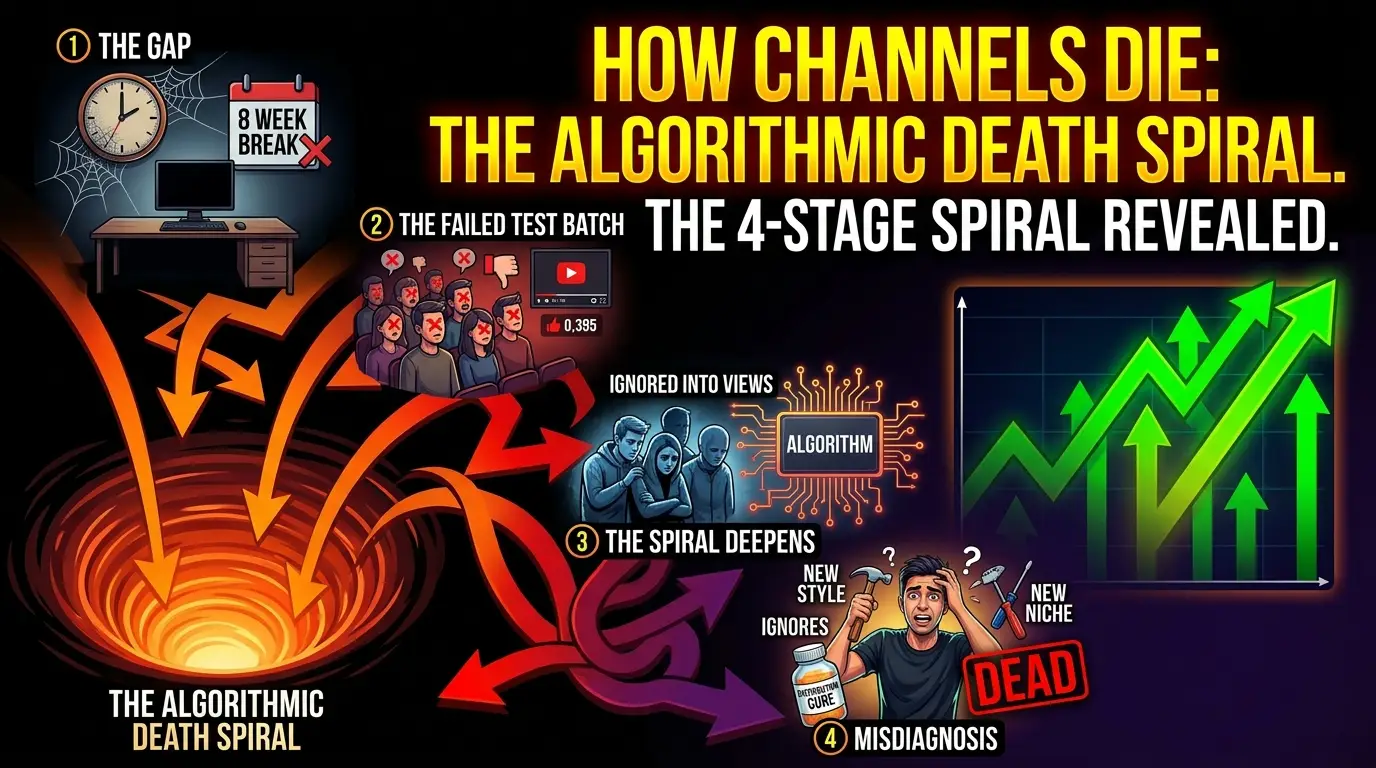
No healthy channel wakes up dead one morning. It dies through a predictable four-stage spiral — and understanding which stage you're in determines whether resurrection is even possible. Here's the spiral:
Step 1 — The Gap
Life happens. Burnout, illness, a new job, a creative rut — you take eight weeks off. Or maybe you never fully stop, but your quality or consistency wobbles. Either way, the steady stream of positive signals from your audience gets interrupted. Nothing dramatic happens yet. That's the danger.
Step 2 — The Failed Test Batch
You return with a video you're proud of. But your test batch — drawn from subscribers who've now been cold for months — responds weakly. Low CTR, low early watch time. The algorithm reads this as confirmation that interest in your channel has decayed. Distribution stays narrow.
Step 3 — The Spiral Deepens
Narrow distribution means your video is only ever shown to the coldest, least interested slice of your remaining audience. Weak response again. Each upload now trains the algorithm harder that your channel produces low-engagement content. Your channel-level authority score decays further with every rotation.
Step 4 — Misdiagnosis
Views keep falling, so you conclude the problem is your content. You change your style. New thumbnails. New intro. Maybe a whole new niche. But you're treating a distribution disease with a content prescription — so nothing improves, and now you've also confused the few viewers you had left.
The Paralysis: Should You Fix This Channel or Start Over?
Once you accept the channel is in cardiac arrest, a new question takes over your brain at 2AM: "Should I just delete everything and start a fresh channel?"
It feels clean. A blank slate. No dead subscribers dragging you down, no damaged channel authority, no painful history staring at you from the analytics page. And yes — sometimes starting over is right. But let's price out what "starting fresh" actually costs:
- Zero head start: no subscriber base, no watch-history relationships, no search equity for your name or brand.
- Twelve to eighteen months of typical grinding to reach the audience size you already have right now.
- Monetization reset: new channel means re-qualifying for the Partner Program from zero.
- Every existing video — hundreds of hours of work — becomes orphaned archive content.
- And the kicker: statistically, most creators who start over end up repeating the exact mistakes that killed the original channel, because the misdiagnosis (Step 4) travels with them.
Now compare that with the cost of fixing what you have. Your channel still holds assets that a new channel would kill for: an established URL, years of accumulated watch-time history, brand recognition, back-catalogue search traffic, and — critically — a subscriber base where some percentage is still reactive. The job isn't to abandon those assets. It's to find them.
| Factor | Starting Fresh | Fixing Existing Channel |
|---|---|---|
| Time to old view counts | 12–18 months of rebuilding | 30–90 days of targeted resurrection |
| Existing subscribers | Start at zero | Reactivation pool — even 5% reactive beats zero |
| Back catalogue | Orphaned, dead weight | Search traffic keeps trickling while you rebuild |
| Monetization | Full Partner Program reset | Revenue continues during recovery |
| Brand & social equity | Rebuild from scratch | Retained instantly |
| Risk of repeating old mistakes | High — misdiagnosis travels with you | Low — data-driven diagnosis corrects course |
| Verdict | Only if channel identity must fully change | Almost always the smarter play |
The Diagnostic Question
The 30-Day Resurrection Blueprint
Here's the protocol. It works because it attacks the spiral in reverse order: first stop the bleeding (stop feeding the algorithm failure data), then rebuild signal quality, then force a re-test. Creators who run this properly — with real data behind each step — routinely see their first meaningful distribution breakthrough inside 30 days.
Days 1–7: Stop the Bleeding & Diagnose
Do not upload this week. Every upload from a dead-signal state is another failed test that deepens the spiral. Instead, run a full forensic audit. Segment your audience: who actually engaged in the last 90 days versus who's been silent for a year? Identify which of your historical videos still pull search traffic — those reveal which topics your surviving reactive audience cares about. This is step one for a reason: everything after depends on knowing who is still listening. Doing this manually takes weeks; running your channel through virality-labs.com does the segmentation in minutes and shows you exactly which core audience segments remain reactive.
Days 8–14: Rebuild Around the Survivors
Now you know your living audience. Build your comeback topic list around them, not around your old greatest hits and not around random trends. The goal of the next upload is not views — it's a passed test. You need a video so precisely matched to what your reactive segment clicks and watches that the test batch can't help but respond strongly. This is where guesswork kills recoveries. Virality Labs generates exact high-scoring topic blueprints engineered around your surviving segments — titles, thumbnail concepts, and hooks scored before you film a single frame.
Days 15–21: The Relaunch Upload
Publish your comeback video only when its pre-upload signal scores are strong — hook score, CTR potential, trend alignment, pacing. Treat it like a channel launch, because functionally it is one. Announce it to whatever live channels you still have (community tab, email list, other platforms) to concentrate maximum reactive engagement into the first 48 hours. You are trying to hand the algorithm a test result it cannot ignore.
Days 22–27: Force the Re-Test
One passed test is a fluke to the algorithm. Two or three in sequence is a trend. Follow the relaunch with tightly-themed follow-ups in the same proven territory while signals are hot. Consistency here isn't about volume — it's about giving YouTube repeated evidence that your channel now generates engagement wherever it's shown.
Days 28–30: Read the Data & Lock In
Compare CTR and early retention against your pre-collapse baseline. If distribution widened even partially, the re-test worked — scale what's working. If not, the blueprint gets adjusted with new data rather than abandoned. This iterate-on-evidence loop is exactly why recovered channels stay recovered: you're no longer uploading into the dark.
Get your channel's resurrection blueprint — find your living audience and your first comeback topic in minutes.
How Virality Labs Acts as Your Defibrillator
Let's be blunt about what actually happened to your channel. The algorithm didn't blacklist you. It did something worse and more mundane: it stopped testing you, because every recent test returned dead results. Resurrection therefore requires exactly one thing — a sequence of tests so strong that the algorithm is forced to start widening distribution again. That's a defibrillation problem, and it's precisely what virality-labs.com was built to solve.
Where YouTube Studio shows you a corpse and calls it analytics, Virality Labs runs the electrical charge:
- Core Audience Autopsy: identifies which of your subscriber segments are still reactive — who clicks, who watches, who engages — and which segments are clinically dead and dragging your test batches down.
- Distribution vs. Content Diagnosis: pinpoints whether your collapse is a distribution disease, a packaging disease, or both — ending the Step 4 misdiagnosis cycle permanently.
- High-Scoring Topic Blueprints: generates exact comeback video concepts — topic framing, title formulas, and thumbnail direction — scored against what your surviving audience demonstrably responds to.
- Pre-Publish Signal Scoring: every comeback video gets its Viral Score checked before upload, so you never again burn a precious test slot on a video destined to fail.
- Trend Pulse Matching: aligns your relaunch content with what is actively surging in your niche right now, refreshed every 5 hours, giving the algorithm active demand to serve your video into.
- The 30-Day Recovery Timeline: a ranked, week-by-week action plan built from your actual channel data — not generic advice recycled from a 2019 blog post.
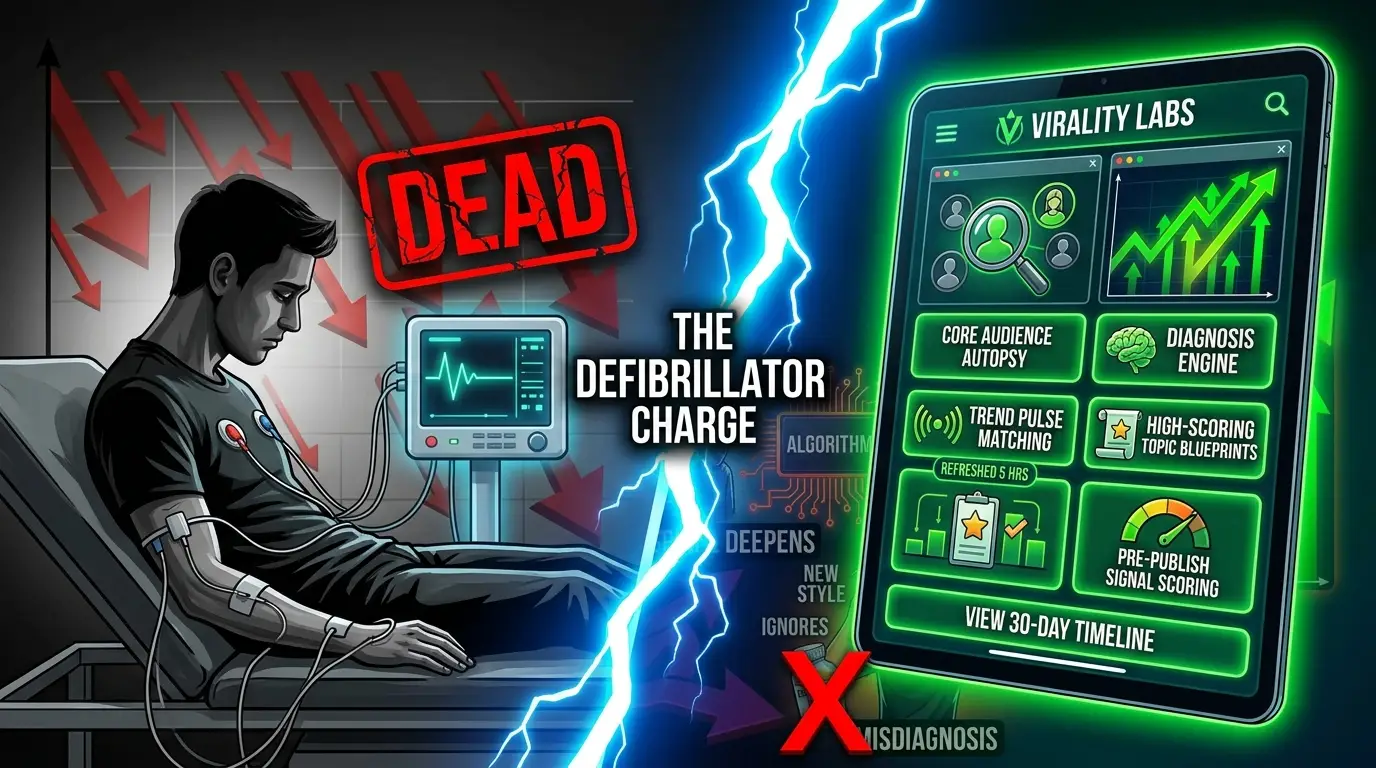
Test batches drawn from dormant subscribers. Distribution locked at minimum. Every upload deepens the spiral.
Relaunch uploads scored above threshold pre-publish. Reactive segments identified and targeted. Algorithm resumed widening distribution.
Real Resurrection Story
The Bottom Line: Flatline Is a State, Not a Sentence
Let's recap what you now know that most stranded creators never figure out:
- Your subscriber count is partly fiction, and dead subscribers are actively suppressing your reach.
- Your channel died through a predictable spiral — and if you caught it before total identity collapse, it is reversible.
- Starting over usually costs more than fixing, and carries the risk of importing your original mistake.
- Resurrection is not luck. It is diagnosis → targeting survivors → high-signal relaunches → forced re-testing.
Every week you spend improvising — uploading into the void, redesigning thumbnails blind, wondering if you're banned — is a week the spiral rotates deeper. And every week you wait is a week someone in your exact niche is claiming the audience you built.
So here is the honest closing push, because you deserve directness at this point: go to virality-labs.com today. Run your channel through the autopsy tonight. Find out which of your subscribers are still alive, get your first high-scoring comeback blueprint, and start Day 1 of the protocol tomorrow morning instead of someday.
Your past glory wasn't an accident, and your current flatline isn't a verdict. It's a solvable engineering problem — and the defibrillator is already plugged in and waiting at virality-labs.com. Thirty days from now you'll either be reading another article like this one... or watching your graphs climb at 1AM again. Choose the second one.
Resurrect your channel — get your free dead-channel diagnosis and 30-day blueprint at virality-labs.com.