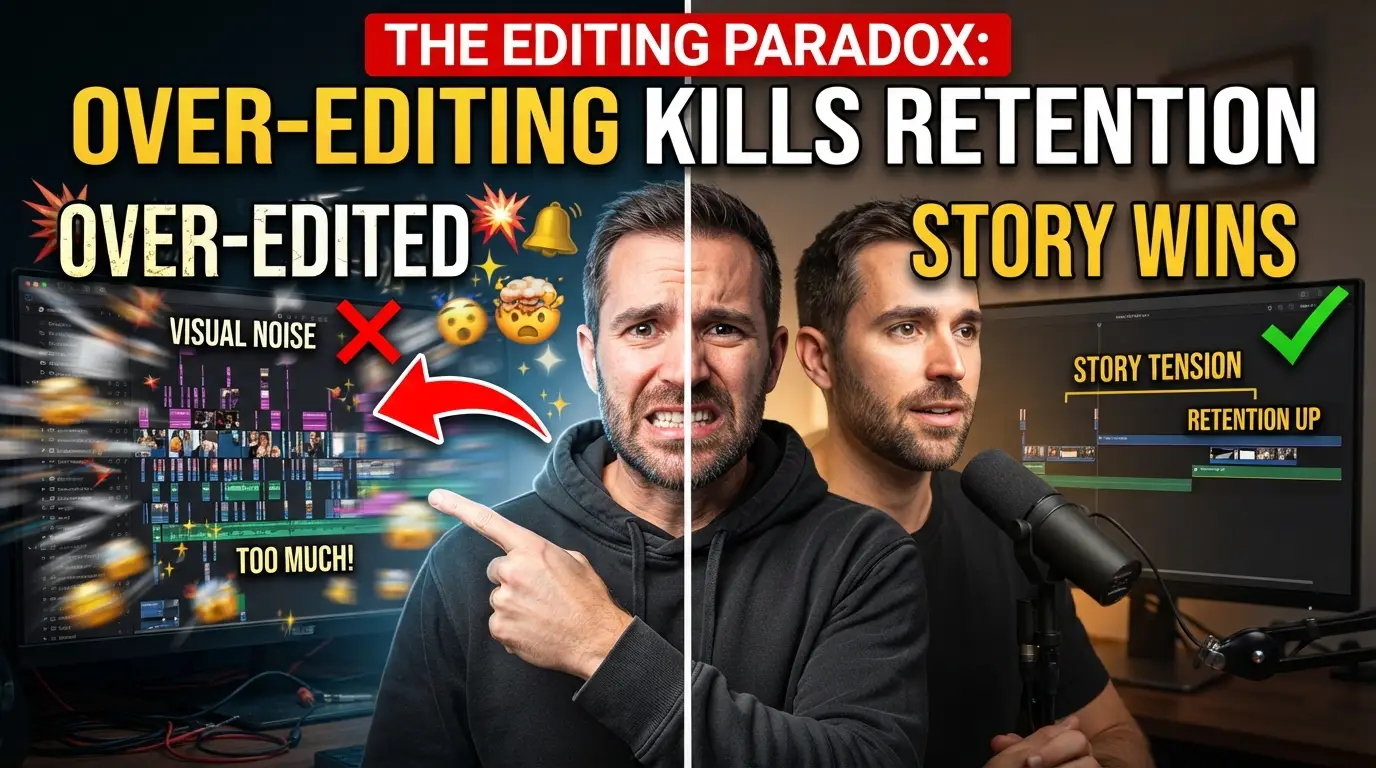
It is 2:47 AM. Your eyes are burning. You are on your third coffee, nudging a keyframe five pixels to the left for the fourteenth time. The zoom curve has to be perfect. The sound effect needs to hit exactly on the beat. One more transition. One more glow effect.
This video is going to be perfect. You can feel it.
You upload it. You watch the comments roll in. "This feels like an AI slideshow." "Too much going on." "Can you just... talk to us?" Your retention graph shows viewers bailing at the exact moments you spent hours polishing.
This is the editing paradox: the more you polish, the less they watch. And it is a trap that is quietly destroying the growth of editors across Canada and the USA — because the skill you are proudest of is the exact thing holding your channel back.
The Over-Editing Trap: When Polish Becomes Noise
Here is the uncomfortable truth every editor needs to hear: your editing skill is not the problem. Your editing volume is.
When you add a transition, a sound effect, or a motion graphic, you are making a promise to the viewer. You are saying: "this is important, pay attention." But when every second of the video is important, nothing is important. The viewer's brain stops treating your effects as signals — they become static. Noise.
And noise is exhausting. The same viewer who swipes past an overstimulating TikTok feed will click away from your video for the exact same reason: there is no space to breathe, and no reason to care.
"I came from an advertising background where more polish meant more value. I'd spend 200 hours on a video nobody could watch without getting a headache. The video that changed my channel was edited in four hours — barely any effects. My audience could finally hear ME. It got 6x more views than anything I'd over-produced."
— USA video editor, 780K subscribers
Over-Editing Is a Symptom, Not a Skill
Here is the part that stings. Editors do not over-edit because they love effects. They over-edit because they do not trust their story. When you are insecure about the substance, you compensate with surface. Every added graphic, every "cinematic" transition, every sound effect is a hedge — a way of hoping the polish distracts the audience from the fact that the story underneath is sagging.
Your audience notices. Not consciously — but deeply. They cannot see the story hole, so they blame the video: "it feels fake," "it's overstimulating," "it doesn't feel like you." Those comments are not complaints about your editing. They are reviews of your narrative structure.
Why Flashy Editing Masks a Weak Underlying Story
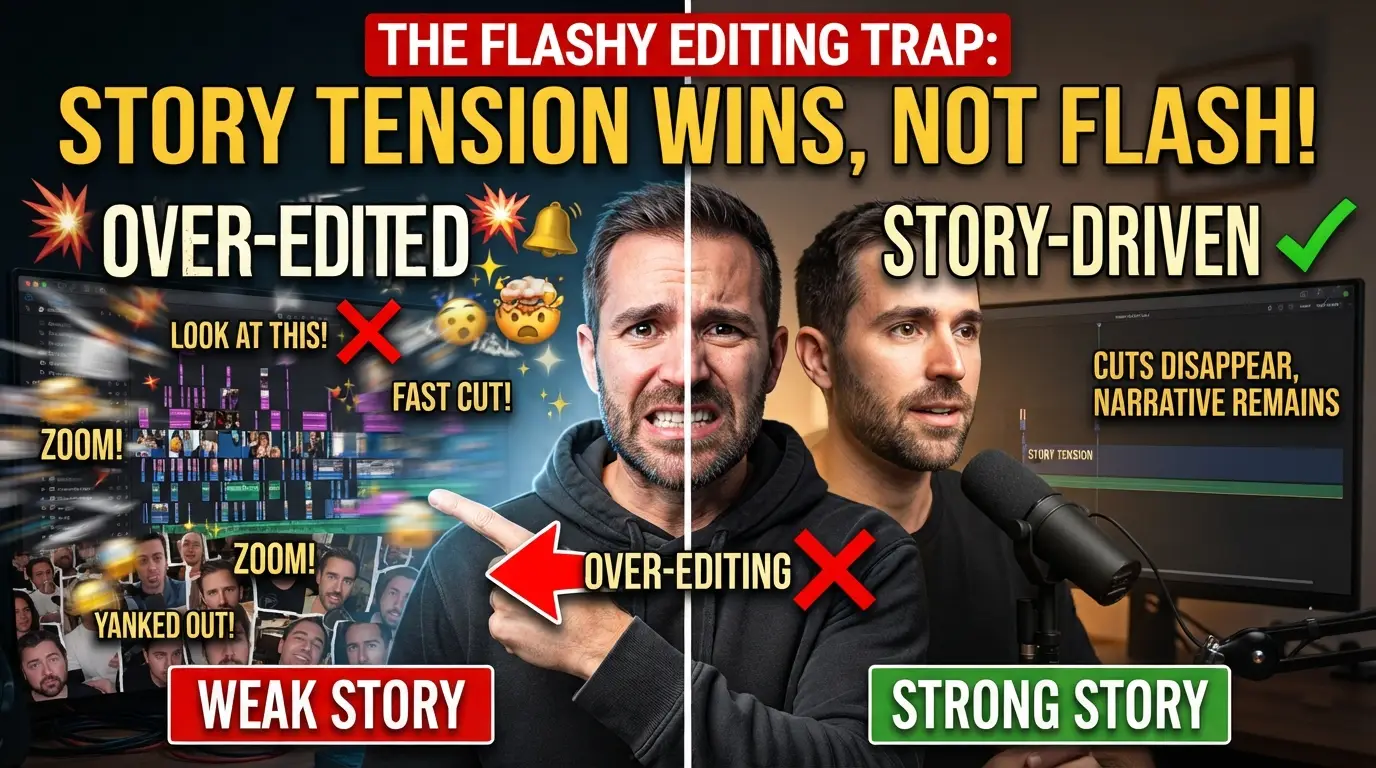
Pacing is not about how many cuts you make per second. It is about story tension — the rising and releasing of dramatic pressure that keeps a viewer's brain locked on your video. Editing should serve the tension, not replace it.
Think about the videos that actually hold you. The best documentaries, the best long-form creators, the most-watched YouTube videos of 2026 — their editing is rarely "flashy." It is invisible. The cuts disappear because the story is doing the work. You do not notice the edit because you are too busy wondering what happens next.
Now think about an over-edited video. The effects are all you notice. Every transition announces itself. Every zoom screams "look at me." The viewer is constantly being yanked out of the story to admire the craft — and every time they are yanked out, a little bit of them decides to leave.
| Editing Style | Viewer Experience | Retention Result |
|---|---|---|
| Invisible editing | Story does the work; cuts disappear | Strong — viewers stay for the narrative |
| Moderate polish | Effects highlight key moments | Healthy — pacing feels intentional |
| Over-editing | Constant visual noise and flash | Weak — viewers call it fake and leave |
The research is consistent across niches. Videos with rapid-fire effects and constant scene changes retain fewer viewers past the first minute than videos with calm, story-driven pacing — even when the over-edited video looks more "professional." Flash does not hold attention. Suspense does.
The Production Cost Trap: How Over-Editing Stalls Your Growth
Let's talk about the cost nobody adds up. A video that takes you three weeks to edit is not just an expensive video. It is a growth tax — and it compounds across your entire channel.
YouTube rewards consistency. The algorithm, and more importantly your audience, responds to a steady cadence of uploads. When you spend 200 hours on one video, you are making a quiet decision: fewer videos, less data, slower feedback, slower growth. Every week your channel goes silent while you polish keyframes is a week your competitors are learning, iterating, and compounding.
- Turnaround time: A 3-week editing cycle caps you at ~17 uploads a year. A 4-day cycle gets you 90. The difference in growth is not linear — it is exponential.
- Feedback loops: The fewer videos you publish, the slower you learn what your audience actually wants. Over-editing starves your channel of data.
- Burnout: Nights of keyframes do not just exhaust you. They make you resent the craft — and that resentment bleeds into the content.
- Opportunity cost: The hours you spend on a flourish nobody notices are hours you could spend on the next story, the next thumbnail, the next idea.
The creators who grow fastest in the USA and Canada are not the best editors. They are the ones who ship — because every shipped video teaches them something that polish never will.
"My turnaround went from 30 days to 6 when I stopped obsessing over every frame. My growth didn't slow down — it tripled. The audience never once said "where did the effects go." They said "it finally feels like you're talking to me.""
— Canada lifestyle creator, 1.9M subscribers
The Personality Disconnect: Why Over-Polish Feels Fake
Here is the most underrated damage over-editing does: it removes you.
Your audience does not subscribe for your transitions. They subscribe for your point of view — your voice, your humor, your honesty, your way of seeing the world. Every layer of flashy editing you add sits between the viewer and that voice. The more production value you stack, the more the content feels manufactured and the less it feels human.
This is why so many over-produced channels feel hollow despite looking incredible. The creator is buried under their own craft. The audience senses it instantly. They came for a person, and they got a production.
Invisible cuts, restrained effects, personality front and center. 74% retention through the first 3 minutes. Viewers feel like they're sitting with you.
Constant zooms, flashes and sound effects. 19% retention through the first 3 minutes. Viewers feel overstimulated and disconnected.
What Pacing Actually Means: Tension, Not Cuts Per Second
Let's redefine the word every editor misuses. Pacing is not editing speed. Pacing is the distribution of story tension across time — the rhythm of rising stakes, released payoff, and withheld answers that keeps a viewer leaning forward.
A slow scene can be high-tension. A fast montage can be dead air. What matters is not how often you cut — it is whether the viewer's brain is always asking "what happens next?" When that question lives in every section of your video, the editing becomes invisible, and retention follows naturally.
Editing is a magnifying glass, not a spotlight
Three Storytelling Frameworks for YouTube
If you want to know how much you should edit your video, stop counting cuts and start mapping tension. These three frameworks are the ones data-driven creators in the USA and Canada use to build story-first videos:
1. The Question-Loop Structure
Open with a question the viewer needs answered, then keep the loop open for the entire video. Every section should answer one small question and immediately raise a bigger one. The edit only needs to serve the next question. If a cut or effect does not sharpen the question, cut it.
2. The Payoff-Gap Structure
Set up a promise early, then make the audience wait for it. The tension lives in the gap between what you've promised and what you've shown. Editing should stretch that gap, not fill it with noise. Every added second of suspense is earned; every flashy distraction breaks the spell.
3. The Reversal Structure
Build expectations, then flip them. The most retentive videos are the ones where the viewer thinks they know what's coming — and then the story turns. The calmest, most understated moments are often the setup for the biggest reversals. Over-editing this kind of scene destroys its power by signalling the turn before it lands.
How Virality Labs Isolates Story From Noise
Here is where this stops being theory. You can read about story tension all day — but you are still editing in the dark, guessing whether your video's structure holds. That is the gap Virality Labs exists to close.
Virality Labs isolates content structure from visual noise. When you run your video through the platform, it separates the two things you keep conflating:
Story Structure vs. Visual Production
- Content structure analysis: Virality Labs maps your script and shot sequence onto proven narrative frameworks — question loops, payoff gaps, reversals — and shows you exactly where your story sags.
- Pacing profile: The platform tells you where tension rises and falls, and where viewers will drift — before you ever spend an hour on an effect.
- Noise-to-signal ratio: It flags sections where visual density is high but narrative tension is low — the over-edited sections that are actively leaking retention.
- Edit-time recommendation: You get a clear answer to "how much should I edit this video?" based on what the structure actually needs, not on your editing instincts.
The insight is simple and brutal: a stronger narrative arc beats a flashy effect every single time. Virality Labs shows you where to invest your hours — in the story, not in the keyframes — so you stop spending 200 hours polishing a video that should have been restructured in an afternoon.
Hundreds of hours saved
Map your story before you edit
Write a one-line summary of the tension in each section of your video. If any section has no tension, that is a story problem — not an editing problem. Fix the story first.
Run your plan through Virality Labs
Paste your script and shot outline. Get your pacing profile and noise-to-signal ratio before you spend a single hour editing.
Edit to the tension map
Let your effects follow the story. Restrained editing where tension is high, bold moments only where you are delivering a payoff.
Cut your production time in half
When the story is strong, you do not need the polish to carry it. A 6-day editing cycle beats a 21-day cycle for growth, data, and your sanity.
Compare projected vs actual retention
After publishing, compare your real retention curve to Virality Labs' projection. Every upload refines your instinct for what your specific audience stays for.
The Bottom Line
The editing paradox is real. The skill you are proudest of — your ability to polish a video to perfection — is the same skill that is pushing your audience away. Not because editing is bad, but because over-editing is a substitute for story, and your viewers can feel the difference.
You can keep spending nights on keyframes and watching your retention drop. You can keep telling yourself the next video just needs more polish. You can keep letting overstimulated, disconnected viewers quietly click away.
Or you can run your next video through Virality Labs, isolate your content structure from the visual noise, and see exactly where your story sags — before you spend a single hour on an effect.
A stronger narrative arc beats a flashy effect every time. And now you have a tool that proves it before you publish.
Stop editing in the dark. Find out where your story actually sags — and save hundreds of hours of useless editing — free.