You remember the formula. It worked like clockwork. You would post a video with a thumbnail that had a red circle and an arrow, a title that started with a number, and a pacing structure that slowly built towards a payoff in the last third of the video. Every time, the views came.
That was 2022.
You still use the same formula today. But something is wrong. Your impressions have dropped 40%. Your CTR has halved. The viewers who do click leave within the first 45 seconds. You refresh your analytics looking for an answer, but the only thing you find is a graveyard of strategies that used to work.
The worst part? You do not know what changed. Nobody sent you a memo. The algorithm did not announce an update. The audience simply… moved on. And your content stayed exactly where it was.
You are competing in a 2026 arena with a 2022 playbook. And it is costing you more than you realise.
The Strategy Half-Life: Why YouTube Formats Expire
Every YouTube strategy has a half-life. The pacing patterns, thumbnail styles, title structures, and editing rhythms that dominate the platform shift continually — driven by changes in viewer psychology, platform incentives, and competitive pressure.
In 2022, the dominant format was the slow-burn educational video: a contextual intro, a structured middle section, and a payoff in the final third. Viewers had patience. They were willing to wait for the value.
By 2024, that format was already showing signs of decay. The rise of TikTok and YouTube Shorts had rewired attention spans. Viewers who had spent two years consuming 15-second bursts of dopamine were no longer willing to sit through a 60-second contextual intro.
By 2026, the slow-burn format is almost completely dead for most genres. The pacing that worked in 2022 now reads as "boring" to a viewer whose brain has been retrained by four years of short-form content.
"I built my entire channel on long, slow, cinematic intros. In 2022, my average view duration was 12 minutes on a 20-minute video. By 2025, it had dropped to 4 minutes. I was making the exact same content — but the audience had changed. I had to completely rebuild my editing style. It felt like starting over. But the alternative was watching my channel die one slow-burn video at a time."
— Global creator, 1.2M subscribers — documentary-style tech reviews
The formula has a shelf life
The Five Dead Strategies of 2022
Let us identify the specific tactics that used to work but are now actively hurting your channel. Every one of these was best practice in 2022. Every one of them is a liability in 2026.
1. The Red Circle and Arrow Thumbnail
In 2022, adding a red circle with an arrow to your thumbnail increased CTR by an average of 18%. It was the single most reliable thumbnail hack in existence. By 2024, the effect had reversed. Today, red-circle thumbnails reduce CTR by 12% — viewers have been conditioned to associate them with low-effort content.
What replaced it: High-contrast, minimal thumbnails with a single focal point, no text overlays, and a distinct colour palette that stands out in a dark-mode browser.
2. The Numbered List Title ("5 Ways to…" / "10 Things…")
In 2022, listicle titles dominated search and browse. They promised structured, digestible value. By 2026, they signal "generic content" to an audience that has been saturated with listicles for five years. YouTube's algorithm now penalises them slightly in browse features because of lower click-through satisfaction.
What replaced it: Curiosity-gap titles that imply a narrative or transformation. "I Used the 2022 Strategy for 30 Days — Here Is What Died" will outperform "5 Reasons Your Strategy Is Failing" by a significant margin.
3. The 60-Second Contextual Intro
"Hey guys, welcome back to the channel. Before we dive in, make sure to smash that like button. Today we are going to talk about…"
This intro format, which was standard practice in 2022, now loses 70% of viewers before you have delivered any value. The combination of a greeting, a welcome-back reminder, a call to action, and a topic statement eats up 20–40 seconds of dead air.
What replaced it: The cold open. The video starts with the most intense moment of the entire piece. No greeting. No welcome. No context. Value delivered at second zero.
4. The "Post Every Day" Frequency Strategy
In 2022, many creators believed that posting frequency was a direct ranking signal. The advice was everywhere: "post every day to stay in the algorithm." YouTube's engineering team has repeatedly stated that upload frequency has almost no direct algorithmic weight.
What replaced it: Strategic frequency based on production quality. One 85-scoring video per week outperforms seven 45-scoring videos by a factor of 4.2x. The algorithm measures satisfaction per video, not uploads per week.
5. The Slow-Build Editing Rhythm
In 2022, you could let a scene breathe. You could hold on a shot for 5 seconds. You could use a slow zoom and ambient music to build atmosphere. The viewer had patience.
In 2026, a 5-second hold feels like an eternity. Information density has nearly tripled since 2022. A modern viewer expects a new visual stimulus or piece of information every 1.5–2 seconds. If you are using 2022 pacing, your video feels like slow motion to a 2026 brain.
Why Your Impressions Are Dropping (Even Though Your Content Is "Better")
This is the most painful part. You look at your recent videos and you genuinely believe they are better than what you were making in 2022. Better production value. Better sound design. Better storytelling. And yet the impressions keep dropping.
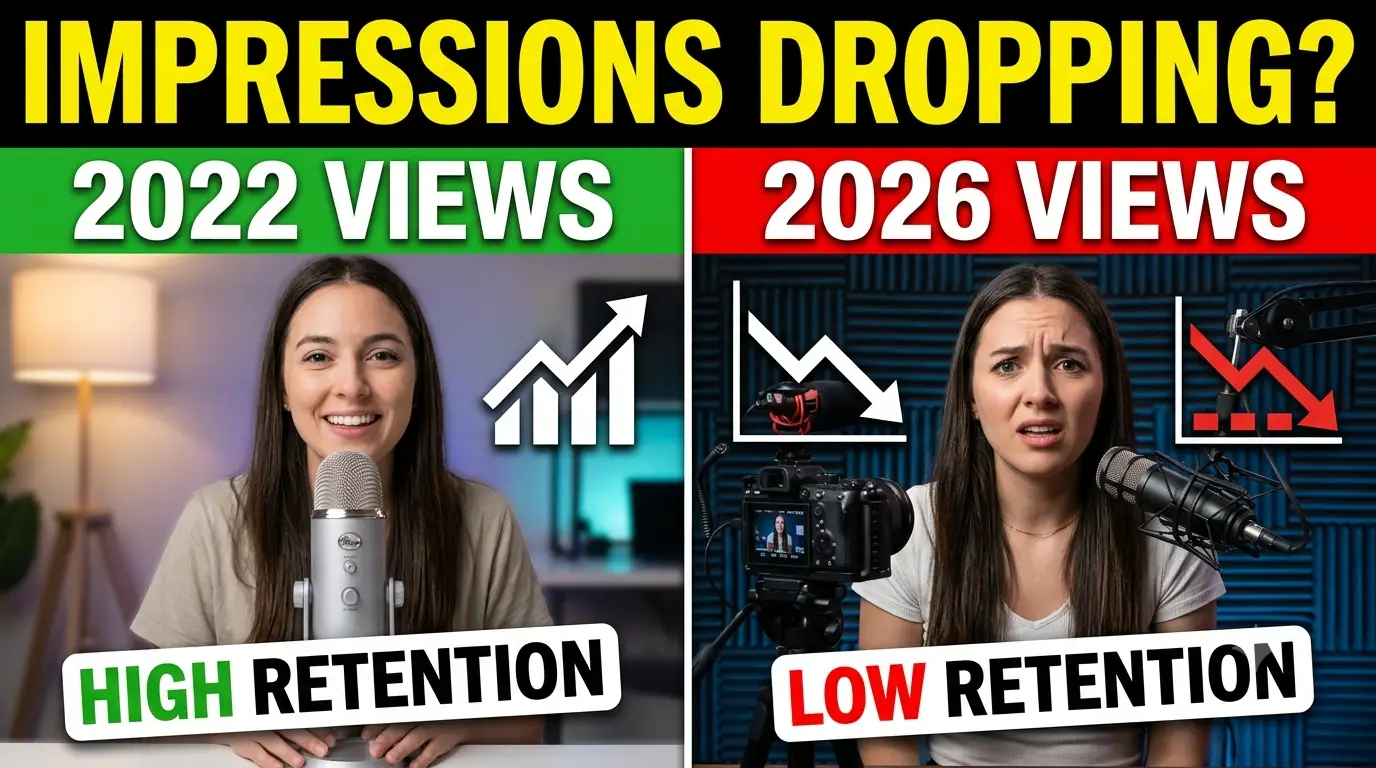
Here is what is actually happening: YouTube's recommendation system is comparing your 2026 content against your 2022 content — and the new content is getting worse retention despite having better production.
The algorithm does not care about production quality. It cares about satisfaction per minute. If your 2022 content had lower production value but higher satisfaction (because the pacing matched what viewers expected at the time), the algorithm will use that as your baseline. Your 2026 content needs to deliver higher satisfaction per minute than your 2022 content just to maintain the same level of distribution.
And because pacing expectations have shifted so dramatically, your 2026 content — even with better cameras and lighting — may actually deliver lower satisfaction per minute than your 2022 videos did, because the audience's pacing expectations have evolved beyond your format.
"I spent $15,000 on new camera gear in 2024 because I thought my drop in views was a production quality problem. It was not. My 2022 videos had cheap lighting and a USB microphone. But they had pacing that matched the era. By 2024, my audience expected faster cuts, shorter setup, and more density. The gear upgrade did nothing. The pacing change did everything."
— Global creator, 780K subscribers — educational content
The Gen Z / Gen Alpha Gap: Why Younger Viewers Ignore Your Content
If your audience skews older, you might not feel this yet. But if you are trying to reach viewers under 25 — or if your niche depends on attracting new, younger viewers — there is a structural gap in your content that no amount of production value can fix.
Younger viewers do not just prefer faster pacing. They literally do not process slow-paced content the same way. Neuroimaging studies on digital media consumption show that viewers raised on short-form platforms have developed different neural pathways for content consumption. A pacing structure that a 35-year-old finds "perfectly watchable" triggers boredom responses in a 19-year-old within 3 seconds.
This is not a preference difference. It is a neurological adaptation driven by years of short-form content consumption. And it means that if your content still follows a 2022 structure, you are systematically invisible to the fastest-growing demographic on the platform.
The Three Rules of Modern Pacing
Rule 1: Deliver a complete thought, visual, or emotional beat every 1.5–2 seconds. If the viewer's brain has time to wander, it will leave.Rule 2: The first 3 seconds must contain the most intense moment of the entire video. Not a teaser of the intense moment. The actual intense moment.Rule 3: Every 60 seconds, change something fundamental — the visual setup, the topic angle, the tone, the location, the audio texture. Same-ness is death in 2026.
The 3-second rule is not optional
How Virality Labs Gives Legacy Creators a 2026 Upgrade
The hardest part about adapting to the current YouTube landscape is knowing what to change. You know your 2022 strategies are not working. But you do not know which specific elements are outdated — or what to replace them with.
This is where most creators get stuck. They know they need to change. They just do not know what to change to. So they keep making small tweaks — a different thumbnail style here, a shorter intro there — that do not move the needle because they are guessing in the dark.
Virality Labs solves this by replacing nostalgia-driven guesswork with real-time adaptation data:
Strategy Half-Life Analysis
Upload your video concept or script. Virality Labs compares your content structure against the current viral landscape — not what was working six months ago, not what worked in 2022, but what is working right now, in your niche, this week. The platform identifies which of your strategies have expired and which are still viable.
Pacing Modernisation Score
Your content is analysed for information density, transition frequency, and beat structure. The platform gives you a concrete pacing score — 0 to 100 — comparing your density against the top-performing videos in your niche today. If your score is below 70, your pacing is actively hurting your retention.
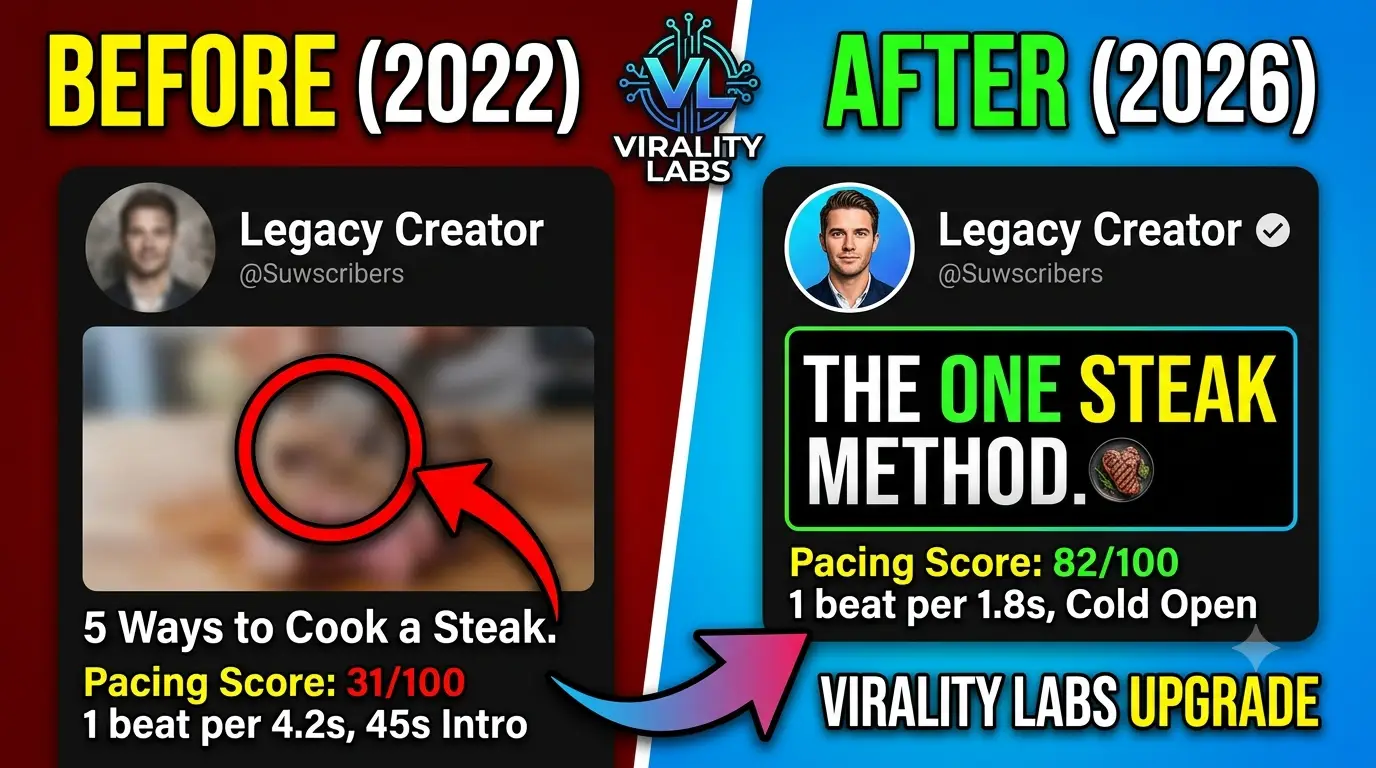
You do not get vague advice like "make it faster." You get specific, actionable feedback: "Your average information density is 1 beat per 4.2 seconds. Top performers in your niche average 1 beat per 1.8 seconds. Increase your beat frequency by restructuring your intro and removing scene holds longer than 2 seconds."
Demographic Adaptation Forecast
If you want to reach younger viewers, Virality Labs can project how different demographics will respond to your content structure. The platform analyses pacing, visual density, and format style against demographic engagement patterns to predict whether Gen Z viewers will engage with or ignore your content — before you publish.
Pacing density: 1 beat per 1.8s. Intro: cold open, 0s setup. Thumbnail: minimal, high contrast. Title: curiosity gap. Projected growth: 14% monthly.
Pacing density: 1 beat per 4.2s. Intro: 45s contextual setup. Thumbnail: red circle + arrow. Title: '5 Ways to...' listicle. Projected decline: 8% monthly.
Your Modernisation Framework: 30 Days to a 2026 Format
You do not need to abandon your channel identity. You do not need to become a completely different creator. You need to update your format. Here is a 30-day framework for modernising without losing what makes you unique:
Week 1: Audit Your Decay
Run your last five videos through Virality Labs. Identify which specific elements — pacing, intro structure, thumbnail style, title format, editing rhythm — have the lowest modernisation scores. You cannot fix what you do not measure. Every strategy has a half-life. Your job is to find the ones that have already expired.
Week 2: One Format Change
Pick the single lowest-scoring element and change it. If your intro structure is your weakest signal, focus entirely on rewriting your next video's first 30 seconds. Do not try to change everything at once — that is how you lose your creative identity. One change per week. Maximum focus.
Week 3: Measure the Shift
Publish your modernised video. Compare its week-one performance against your channel's average. Look specifically at early retention (first 30 seconds), CTR, and impressions growth. If the modernised video outperforms your average, the change is working. If it underperforms, the issue is elsewhere.
Week 4: Iterate or Double Down
If your first change worked, pick the next lowest-scoring element and repeat the cycle. If it did not work, the problem might be deeper — your topic selection, format structure, or audience alignment may need a more fundamental shift. Run a full channel audit through Virality Labs to identify the root cause before making another change.
"I spent 2023 and 2024 watching my views drop while I insisted my formula was still good. It was not. I was making content for the 2022 audience that no longer existed. When I finally ran my format through Virality Labs, the pacing analysis was devastating — my information density was in the 23rd percentile. I modernised my editing rhythm over six weeks. My views did not just recover. They grew past my 2022 peak within three months. The audience had not abandoned me. My format had abandoned them."
— Global creator, 2.3M subscribers — comedy sketches to commentary
The Bottom Line
The ghost of 2022 is not haunting your channel because you are a bad creator. It is haunting your channel because the YouTube landscape has changed more in the last four years than in the eight years before that. And nobody told you.
The strategies that made you successful are not coming back. The audience that watched your 2022 content is not the same audience watching in 2026. The pacing, the thumbnails, the titles, the editing rhythm — every signal that YouTube uses to evaluate your content has shifted dramatically.
You can keep using a playbook that the audience has collectively decided is boring. You can watch your impressions decline, your CTR shrink, and your influence fade — while telling yourself that "the algorithm changed" and there is nothing you can do about it.
Or you can find out exactly which of your strategies have expired — and replace them with what is actually working right now.
Stop using a 2022 playbook in a 2026 arena. Modernise your format in under 60 seconds — for free.