You scripted it. You filmed it. You spent three evenings editing it down to something you're actually proud of. You hit publish — and then you watched the view counter sit at 47 for four days.
Not 47,000. Not even 4,700. Forty-seven. The same number as your cousin's birthday post.
If you're a creator in the USA, UK, Japan or Canada, this isn't a rare horror story. It's the default experience for the vast majority of people who make genuinely great content. And it is crushing.
The thought that follows is almost universal: "Maybe I'm just not good enough." You compare yourself to the creators hitting a million views on videos that look far less polished than yours. The gap between effort and outcome starts to feel personal. Like a verdict.
It isn't. And this article is going to prove it to you.
What the "Ghost Town Effect" Actually Is
The Ghost Town Effect is what happens when a video exists — but no one ever finds it. It's not deleted. It's not banned. It's just... invisible. Sitting in the dark corner of YouTube's library, accumulating dust instead of views.
It happens because YouTube's algorithm is not a discovery engine for good content. It is a performance prediction engine. When your video goes live, YouTube doesn't watch it and judge it on quality. It runs a rapid A/B test on a tiny initial audience — usually a few hundred of your existing subscribers and a handful of cold viewers — and measures how they respond.
Specifically, it measures:
- Click-through rate (CTR) — did the thumbnail and title make people click?
- Average view duration — did people stay, or did they leave in the first 30 seconds?
- Engagement velocity — were early viewers liking, commenting, and sharing?
- Satisfaction signals — did people finish the video? Did they go on to watch more?
If those early signals are strong, the algorithm widens distribution. Your video gets pushed to suggested feeds, search results, and homepage slots. Views compound. Momentum builds.
If those early signals are weak — even slightly — the algorithm stops pushing. Distribution collapses. You end up in the Ghost Town: technically live, practically invisible.
A Note for Japanese Creators
The Real Reason Quality Doesn't Guarantee Views
This is the part that no one in the creator economy wants to say out loud: YouTube cannot measure quality.
It cannot watch your video and assess whether your editing is good, whether your research is thorough, or whether your delivery is confident. What it can measure is behaviour. And behaviour is a proxy for quality — but only if the right people see your video in the right context with the right packaging.
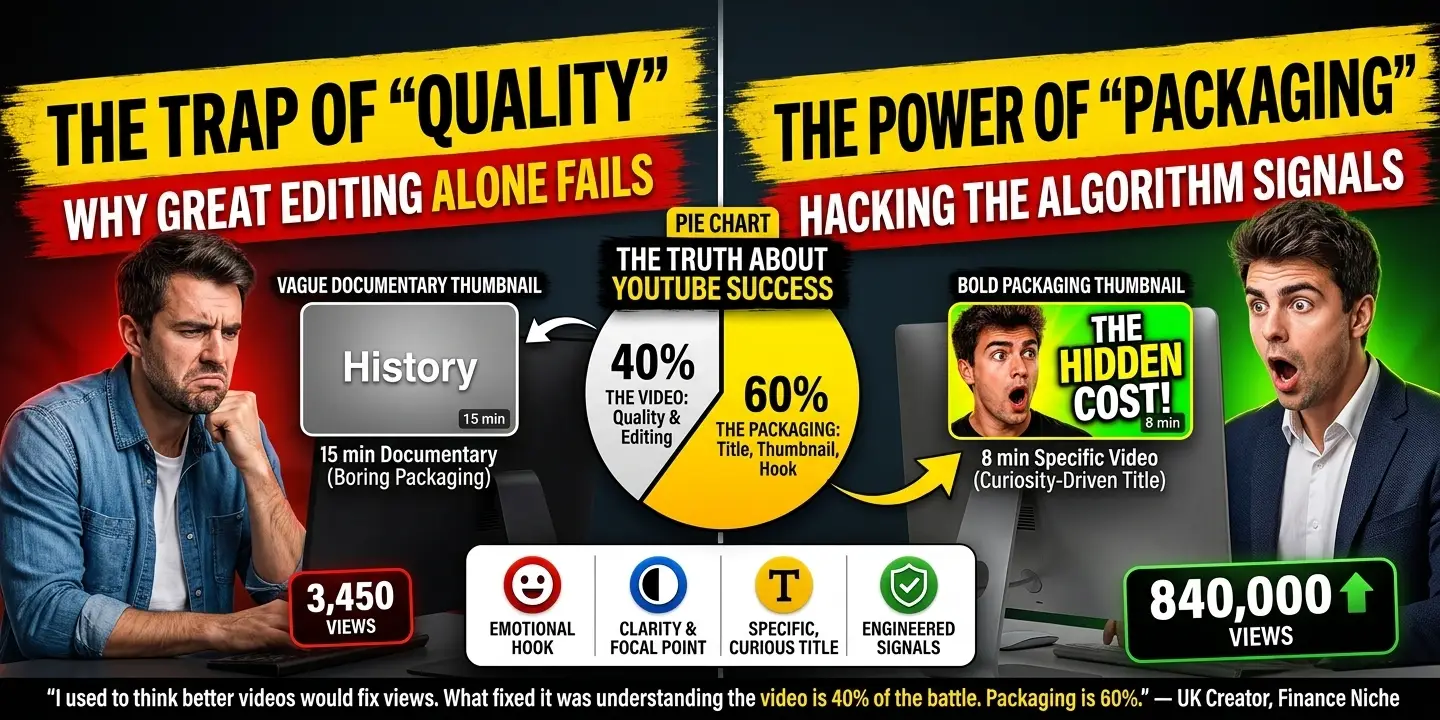
A brilliantly-edited 15-minute documentary with a vague thumbnail and a generic title will always lose to a mediocre-but-well-packaged 8-minute video with a bold, specific, curiosity-driven title and a high-contrast thumbnail with a clear focal point.
The algorithm does not reward effort. It rewards engineered signals.
"I used to think making better videos would fix my views. It didn't. What fixed my views was understanding that the video is 40% of the battle. The packaging — title, thumbnail, hook — is the other 60%."
— UK creator, 840K subscribers, Finance niche
The 4 Pain Points That Are Killing Your Channel Right Now
Pain Point #1: The Algorithm Is Unpredictable — Or So You Think
The most common complaint from creators in the USA, UK, Japan and Canada isn't about quality. It's about unpredictability. "Sometimes a video does great. Sometimes identical content tanks. I can't figure out why."
This feels like randomness. But it's not. What looks like inconsistency is almost always the result of unmeasured variation in your signals. Slightly different thumbnail contrast. A hook that takes 8 seconds longer to get to the point. A title that's off-trend by two weeks. These micro-variations compound into wildly different outcomes.
The algorithm is actually brutally consistent. It rewards strong signals every single time. The problem is that most creators are flying blind — they don't know which signals are weak until after the damage is done.
| What Creators Believe | What Is Actually Happening |
|---|---|
| "The algorithm is random" | Unmeasured signal variation creates inconsistent outcomes |
| "My niche is too small" | Under-optimised packaging suppresses discovery in any niche |
| "I need more subscribers first" | Weak early signals prevent subscriber growth — it's circular |
| "YouTube shadowbanned me" | Low signal scores trigger automatic distribution restriction |
Pain Point #2: High Production Value Doesn't Distribute Itself
You bought the camera. You spent hours colour-grading. You wrote a script, revised it, recorded a voiceover. Your video looks professional. And it got 45 views.
This is one of the most demoralising experiences in the creator economy because it violates a deeply held belief: that quality is rewarded.
Production value improves viewer satisfaction after the click. But getting the click — and getting YouTube to serve your video to people who might click — is entirely a packaging and signal problem. A 4K cinematic masterpiece with a dull thumbnail is invisible. A shaky phone video with a magnetic title and a bold thumbnail gets distributed.
Pain Point #3: You're Uploading Into a Black Box
Here is the core problem that the entire creator industry has normalised but shouldn't have: you upload first, and you learn last.
You do all the work. You hit publish. And then — only then — does YouTube begin to generate data about how your video performs. By the time you see that your hook retention is 38%, that your CTR is 2.1%, that viewers are leaving at the 45-second mark — the algorithm has already made its decision. You can't go back.
Creators in the USA, UK, Canada and Japan are collectively spending millions of hours producing content that gets buried not because it's bad, but because nobody measured the signals before the upload. The work happens in the dark. The verdict comes too late.
Canadian Creator Reality Check
Pain Point #4: The Feedback Loop Is Too Slow to Learn From
Even creators who use YouTube Analytics religiously face the same structural problem: the feedback is backward-looking, video-by-video, and slow to aggregate into learnable patterns.
You make a video. It underperforms. You study the analytics. You form a hypothesis. You apply it to the next video. You wait a week. Repeat. This iteration cycle takes months to produce enough data to identify what's really working.
Most creators give up long before they accumulate enough reps to find their signal. Not because they're not good enough — but because the learning loop is too slow and too painful.
The Moment Everything Changed: From Guessing to Engineering
The top-performing creators in every market — USA, UK, Japan, Canada — don't treat upload day as a prayer. They treat it as a launch. And a launch, by definition, happens after the work of preparation is done.
What separates the 1% from everyone else is not talent. It's not connections. It's not luck. It is a pre-publish workflow. A systematic check that answers the question: before this video goes live, do I know its algorithmic signals are strong?
For most of YouTube's history, this was only possible through experience, gut instinct, and years of trial and error. In 2026, it's measurable in under 60 seconds.
Hook Strength Analysis
AI analyses your first 30 seconds for bold claims, curiosity gaps, pattern interrupts, and retention signals. A weak hook that loses viewers in the first 20 seconds is the single most common cause of collapsed distribution — and one of the fastest things to fix.
Thumbnail CTR Scoring
Your thumbnail is assessed for focal point clarity, emotional signal strength, contrast ratio, and text overlay effectiveness. Thumbnails scoring below 45/100 on CTR potential will suppress distribution even with a perfect video underneath.
Title & Keyword Alignment
Your title is scored against proven click-through formulas and cross-referenced against currently trending search terms in your niche and market. A title that's off-trend by even two weeks loses algorithmic surface area.
Trend Pulse Matching
Your video's topic framing is matched against what's actively surging in your niche right now — refreshed every 5 hours. Low trend alignment means YouTube has fewer active searches to serve your video into.
Retention Pacing Scan
Audio and visual information density is measured across your video's timeline. Sections with long low-density gaps are flagged as drop-off risk zones before a single real viewer ever sees them.
Ranked Fix Generation
Every weak signal is ranked by its estimated impact on distribution. You see exactly what to fix, in what order, before you upload — so you're engineering views, not hoping for them.
Run a full pre-publish signal check on your next video — 30 free credits, no card needed.
What a "Ghost Town" Video Looks Like — vs. What a Distributed One Looks Like
Here is a real-world example of the gap. Two videos in the same niche, same creator, same production quality. One got 412 views. One got 87,000. The difference was not the content. It was the signals.
| Signal | Ghost Town Video | Distributed Video |
|---|---|---|
| Hook Score | 29/100 — starts with "Hey guys, welcome back" | 81/100 — opens mid-action with a bold data claim |
| Thumbnail CTR | 1.8% — low contrast, creator face only | 9.4% — high contrast, bold number overlay, clear focal point |
| Title Appeal | 38/100 — descriptive but no curiosity gap | 86/100 — curiosity gap + specific outcome + time frame |
| Trend Alignment | 22% — topic framing is 6 weeks behind trend | 79% — framed around currently surging keyword cluster |
| Pacing Score | 44/100 — slow intro, filler at mid-point | 77/100 — tight pacing, re-hook at 6-minute mark |
| Final Viral Score | 31/100 → Algorithm restricts distribution | 84/100 → Algorithm widens distribution |
The creator didn't reshoot a single frame. They rewrote the hook, updated the thumbnail, and reframed the title. That's it. The work was the same. The signals were transformed.
Distribution restricted immediately post-upload. Video plateaued at 412 views within 72 hours.
Strong hook, high-CTR thumbnail, trend-aligned title. Algorithm widened distribution to 87,000 views in the same timeframe.
Why "Just Post More Often" Is Terrible Advice
Every creator in the USA, UK, Japan and Canada has heard this. "Consistency is key. Just post more. Volume wins."
Volume is not a strategy. It is a gamble at scale. Posting more videos with weak signals doesn't compound your growth — it compounds your disappointment. And it trains the algorithm to associate your channel with low-engagement content, which makes it harder for future videos to break through.
The creators who dominate their niches are not always the ones who post the most. They are the ones who post the most optimised. One video per week with a Viral Score above 70 will outperform three videos per week scoring below 40 — every time.
"I went from posting four times a week to once a week. My views tripled. Because I stopped rushing to publish and started making sure every video I released had strong signals before it went live."
— USA creator, 2.1M subscribers, Personal Development niche
For UK Creators Specifically
The Shift: From Hoping to Engineering
Here is the mental model shift that changes everything for creators who stop getting Ghost Townd:
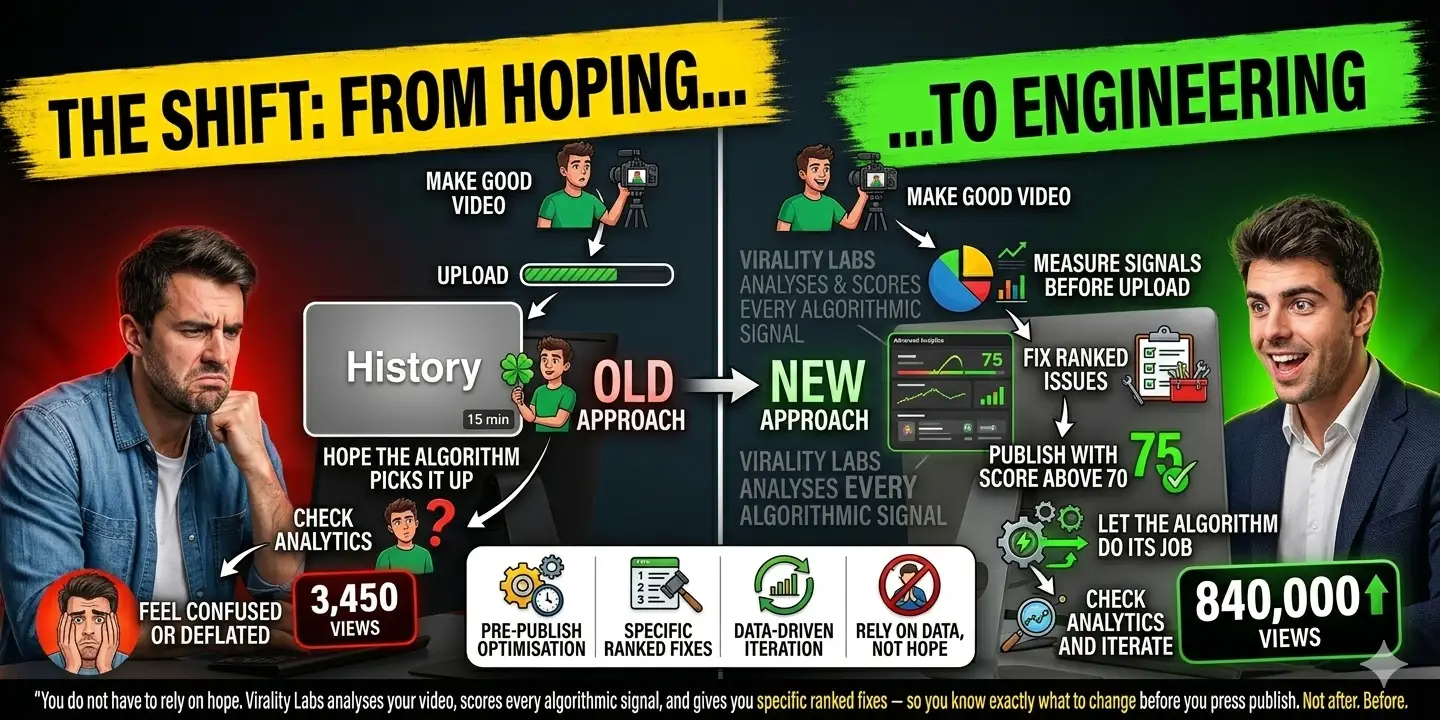
Old approach: Make a good video → upload → hope the algorithm picks it up → check analytics → feel confused or deflated → repeat.
New approach: Make a good video → measure signals before upload → fix ranked issues → publish with a score above 70 → let the algorithm do its job → check analytics and iterate with data.
The video is still the foundation. Nothing replaces genuine value, authentic voice, and hard work on the content itself. But the packaging, the signals, the pre-publish optimisation — those are the difference between your video being found and your video being invisible.
You do not have to rely on hope. Virality Labs analyses your video, scores every algorithmic signal, and gives you specific ranked fixes — so you know exactly what to change before you press publish. Not after. Before.
The Last Thing You Should Do Before Hitting Publish
Before your next video goes live — whether you're in London, Los Angeles, Tokyo or Toronto — run a signal check. Not after. Not when the views stop. Before.
It takes under 60 seconds. It gives you a Viral Score from 0–100. It tells you exactly what is weak, exactly why, and exactly how to fix it. And it shifts your entire relationship with YouTube from one of anxious hope to one of informed confidence.
The Ghost Town Effect is real. But it's not permanent. And it is not a verdict on your talent. It is a solvable engineering problem — and the data to solve it is available to you right now.
Score your video before publishing. Catch every weak signal before it costs you views.