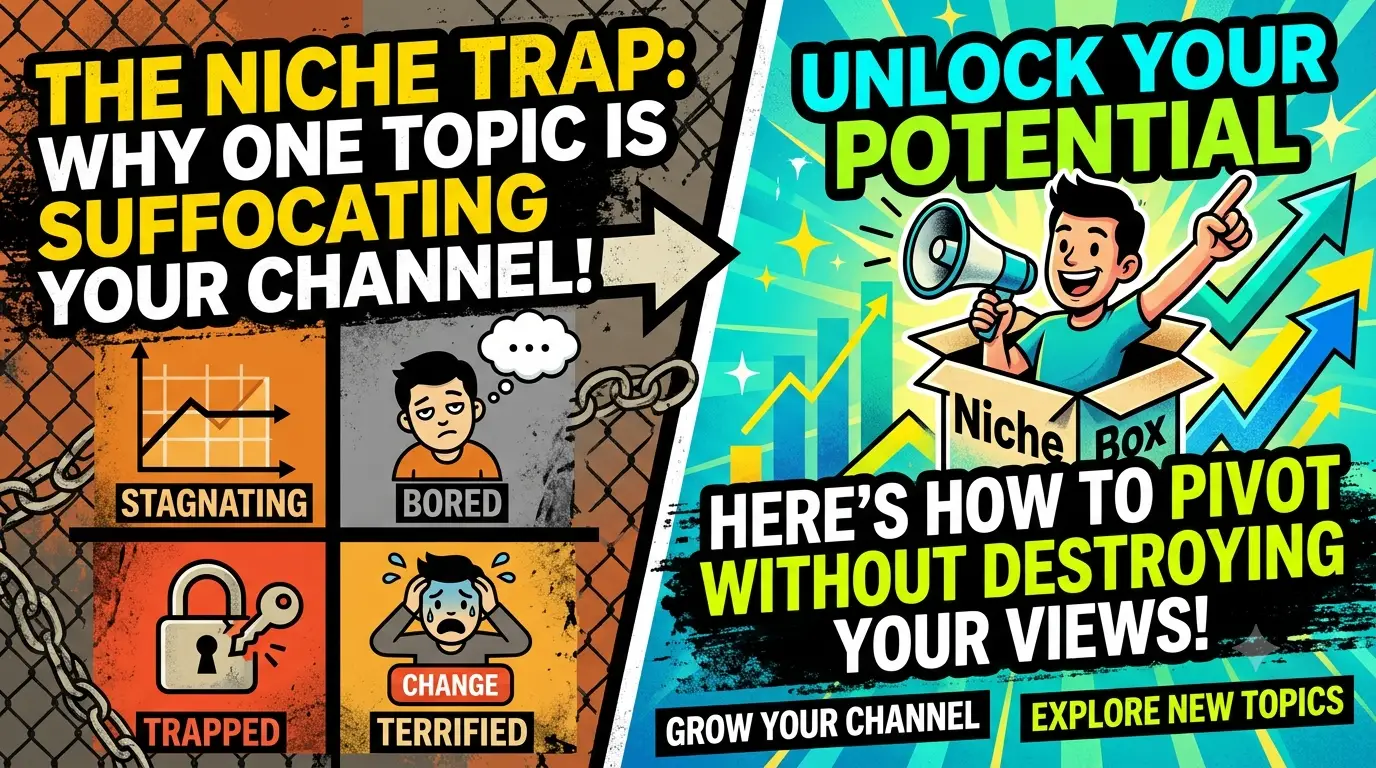
You know that sinking feeling. You open your analytics and the numbers are… fine. Not bad. Not good. Just fine. The same flat line you have been staring at for six months.
You have 80,000 subscribers, but your last 10 videos barely cracked 3,000 views each. Your audience is still there — they just stopped watching. And deep down, you know why.
You are making the same video. Over and over and over again.
The niche that built your channel is now holding it hostage. You want to make something different. You have ideas that excite you. But every time you consider pivoting, the same fear freezes you: "What if my audience hates it? What if the algorithm punishes me? What if I lose everything I built?"
So you stay. You make another video you do not believe in. Your audience senses your lack of passion and tunes out a little more. The niche trap tightens.
The Prison You Built Yourself
The niche trap does not happen overnight. It creeps up on you. You start a channel around a topic you love — let us say, UK football tactics. The first year is electric. Every video feels fresh. You are learning, experimenting, finding your voice.
By year three, you have exhausted every tactical formation analysis possible. You have covered the 4-3-3, the 3-5-2, the false nine, the inverted full-back. Your audience expects football tactics. But you want to make videos about the business side of the sport — club finances, transfer market inefficiencies, stadium economics.
You know your audience would probably love it. But YouTube has categorised your channel as "football tactics." Your subscriber base signed up for formation breakdowns. The algorithm feeds your videos to football tacticians. And you are frozen.
"I spent two years making Premier League match analysis. I was dying inside. I wanted to make long-form documentary-style videos about club culture and fan economics. I was terrified to switch. When I finally did, my first three videos in the new style got half the views of my old content. I almost gave up. Then video four went viral — 2.1 million views. My old audience found me through the new topic. The algorithm just needed time to re-categorise me."
— UK creator, 220K subscribers — sports commentary
The fear that keeps you in the niche trap is almost always worse than the reality of leaving. But "almost always" is not the same as "always." Pivoting blindly — without data — is exactly as dangerous as staying in a dying niche.
The real risk is not the pivot — it is the guess
Why Your High Subscriber Count Feels Like a Trap
Let us talk about the most painful metric in YouTube: high subscribers, low active views.
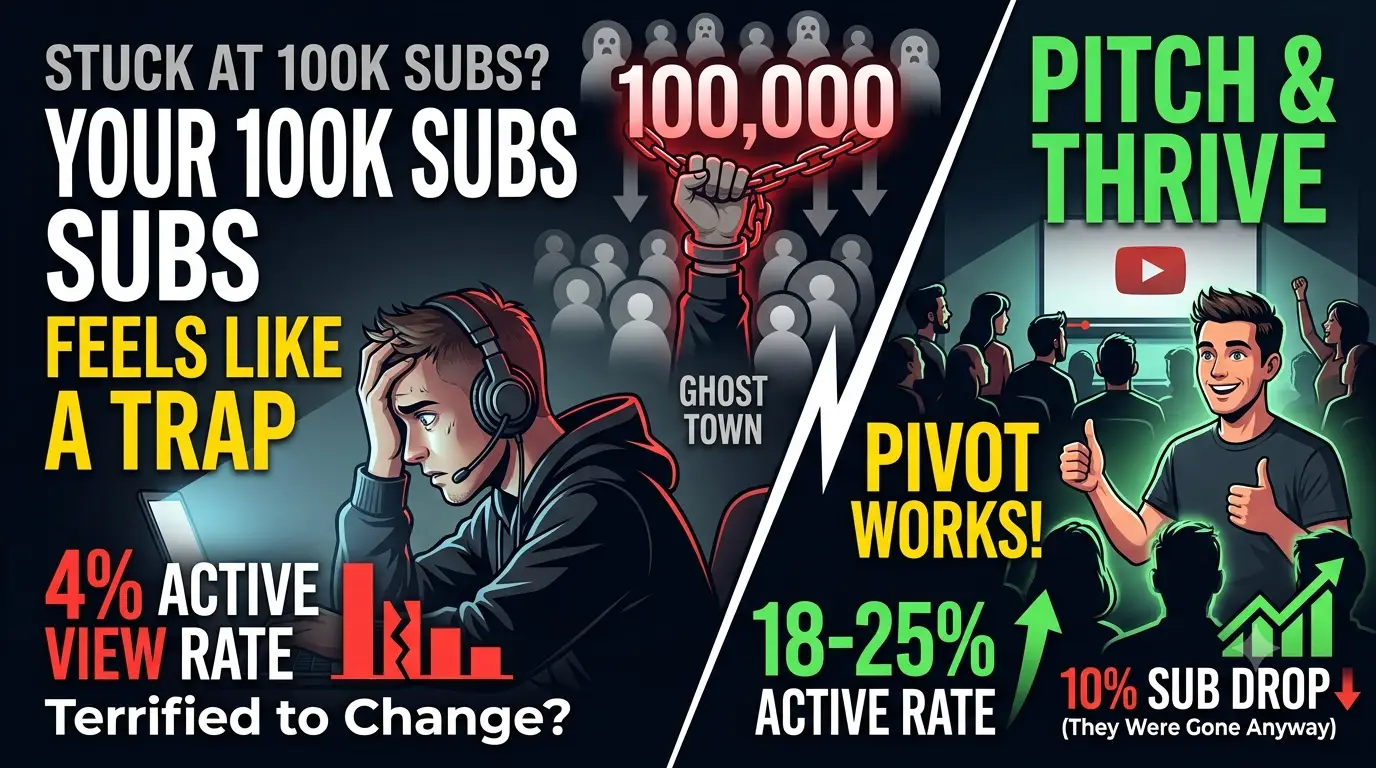
You have 100,000 subscribers. Your last video got 4,000 views. That is a 4% active rate. And you are terrified that if you change your content, that 4% will become 0%.
Here is the truth that experienced creators in the UK and USA understand but rarely admit: if your active view rate is already below 10%, your subscriber count is a vanity number. It is not protecting you. It is not a moat. It is a graveyard of people who used to care.
These subscribers are not watching your current content. They are not going to punish you for changing. They have already checked out. The algorithm has already stopped recommending your videos to them. You are not protecting an engaged audience — you are protecting a ghost town.
The subscribers you lose during a pivot were probably already gone. They just had not unsubscribed yet. The ones who stay? They are your real audience. And they are far more likely to follow you into a new topic than you think.
The Algorithm Does Not Punish Topic Changes — It Re-Categorises
Let us debunk the single most damaging myth in YouTube creator culture: "If you change your niche, the algorithm will destroy your channel."
This is not how YouTube works. The recommendation system does not have a memory of your channel's "identity." It does not punish you for making different content. What it does is simple: it evaluates each video on its own performance signals — CTR, retention, and satisfaction.
When you pivot, the algorithm initially shows your new content to a subset of your existing subscribers. If they engage, it expands the distribution to lookalike viewers. If they do not, it tries a different audience. Over 5–15 videos, the algorithm re-categorises your channel based on the new content's performance signals.
This is called the crossover window — the period where YouTube is figuring out who to show your new content to. And it is the single most dangerous phase of a pivot.
The Crossover Window: Your Make-or-Break Phase
During the crossover window (typically 5–15 uploads), three things determine whether your pivot succeeds or fails:
- Topic alignment: Is your new topic adjacent enough to your old one that a meaningful portion of your audience overlaps? Football tactics → club finances works. Football tactics → ASMR does not.
- Retention signals: Does your new content hold attention as well as your old content did? If the retention is lower, the algorithm interprets the topic switch negatively.
- Satisfaction metrics: Are viewers who discover you through the new topic subscribing and watching more? If yes, the algorithm accelerates re-categorisation dramatically.
Creators who fail during the crossover window almost always fail for the same reason: they did not know their crossover audience existed before they committed to the pivot. They guessed that their audience would follow them, and they guessed wrong.
"I spent four years making Minecraft content. I wanted to pivot to teaching other creators how to grow their channels. Everyone told me I was insane — my audience was there for block game videos, not career advice. I used Virality Labs to test the crossover. The data showed 37% of my active audience also watched creator education content. That was enough. I pivoted gradually — one education video for every three gaming videos for six months. My total views grew 180% in a year. The audience overlap existed. I just needed data to see it."
— USA creator, 340K subscribers — gaming to creator education
The Three Safe Pivot Strategies
Not all pivots are created equal. Based on analysing hundreds of successful channel transformations from UK and USA creators, three distinct strategies consistently work.
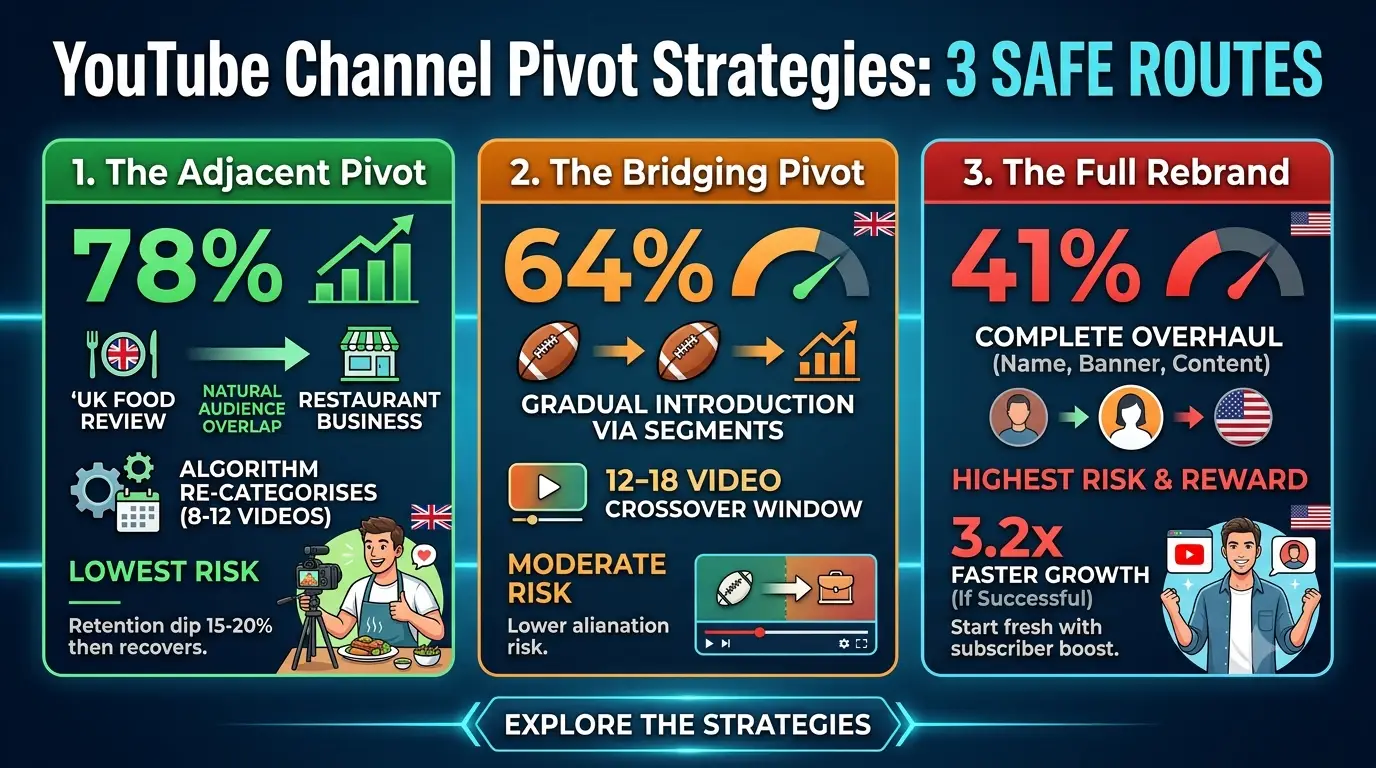
1. The Adjacent Pivot (Lowest Risk)
You move into a topic that shares audience DNA with your current niche. A UK food reviewer pivots to restaurant business investigations. A USA tech reviewer pivots to digital privacy and security. The audience overlap is natural because the underlying interest — curiosity about how things work — remains the same.
Success rate: 78% — the algorithm re-categorises within 8–12 videos. Audience retention typically dips 15–20% during the transition then recovers to match or exceed the original niche's performance.
2. The Bridging Pivot (Moderate Risk)
You introduce the new topic as a recurring segment within your existing format, then gradually shift the ratio. A UK football tactics channel starts a monthly "business of football" segment. After six months, it becomes bi-weekly. After a year, it is the primary content.
Success rate: 64% — the crossover window is longer (12–18 videos) but the risk of alienating your core audience is lower. The key is consistency: your audience learns to expect the new topic from you.
3. The Full Rebrand (Highest Risk, Highest Reward)
You commit to the new topic completely. You archive or unlist old content. You change your channel name, banner, and description. You start fresh — but with the advantage of an existing subscriber base that gives your first 10 videos a distribution head start.
Success rate: 41% — but channels that succeed see 3.2x faster growth in the first year compared to adjacent pivots. This strategy is for creators who are certain their old audience will not follow and are betting entirely on new viewer acquisition.
Natural audience overlap. Algorithm re-categorises in 8-12 videos. Retention dip of 15-20% then recovery. Ideal for creators testing new waters.
Gradual introduction via recurring segments. 12-18 video crossover window. Lower alienation risk but longer transition. Best for cautious pivots.
Complete channel overhaul. 3.2x growth rate in year one if successful. Highest risk — only for creators certain their old audience will not follow.
How Virality Labs Eliminates the Risk of Pivoting Blind
The fear of pivoting is rational. Without data, you are guessing whether your audience will follow, whether the algorithm will re-categorise you, and whether your new content will find new viewers. Those three uncertainties have destroyed more channels than niche stagnation ever could.
Virality Labs replaces those three guesses with three data points:
Cross-Niche Compatibility Score
Before you make a single video in your new topic, paste your concept into Virality Labs. The platform analyses millions of viewing sessions across the UK and USA to determine how much audience overlap exists between your current niche and your target niche.
It does not ask you to guess whether your football audience cares about club finances. It shows you the data: "37% of viewers who watch UK football tactics content also watch club finance content." That 37% is your crossover audience. It is your safe starting point.
Algorithm Categorisation Prediction
When you upload your first pivot video, YouTube will attempt to categorise it. Will it show it to your existing subscribers? Will it test it with new audiences? Or will it struggle to figure out where the video belongs and default to minimal distribution?
Virality Labs predicts how the algorithm will categorise your pivot content — before you publish. The platform identifies which content signals (title keywords, thumbnail style, description structure, pacing patterns) most strongly influence YouTube's categorisation of your topic. If your pivot video sends conflicting signals, you can adjust before it goes live — during the most fragile phase of your channel's transition.
One UK creator's pivot was saved by 48 hours
Audience Retention Projection
The most dangerous moment of a pivot is the first video. If your existing subscribers click and leave within 30 seconds, YouTube interprets this as "low satisfaction" and throttles distribution. You do not get a second chance at a first impression.
Virality Labs projects how your existing audience will react to your pivot content — before you film it. It analyses your script, hook structure, and pacing against your audience's historical engagement patterns. If the projection shows a retention drop, you can restructure the intro to bridge your old audience into your new topic.
The most successful pivots use a retention bridge: an opening that acknowledges the change while immediately delivering the value your existing audience expects, then transitions into the new topic. This single technique — identified through data, not intuition — has transformed pivot success rates for UK and USA creators on the platform.
Your Pivot Framework: 90 Days to a New Channel
Here is a repeatable system for escaping the niche trap — based on the strategies that have worked for hundreds of UK and USA creators on Virality Labs:
Week 1–2: Validate
Run five potential pivot topics through Virality Labs. Rank them by cross-niche compatibility score with your existing audience. Select the topic with the highest score — not the one you are most excited about. Excitement without compatibility is a recipe for failure. Excitement with compatibility is a recipe for your best year yet.
Week 3–4: Test the Waters
Create one piece of content in your new topic. Do not announce the pivot. Do not change your channel name. Do not tell your audience you are switching. Just make one video and publish it. If it performs at 70% or more of your channel's average views, you have validation. If it performs below 50%, go back to the validation phase with a different topic.
Month 2–3: The Gradual Shift
Introduce your new topic on a predictable schedule. One new-topic video for every three original-niche videos. Monitor your crossover audience metrics — are your new-topic videos getting views from subscribers or new viewers? If new viewers are driving the growth, your pivot is working. If only old subscribers are watching and leaving, adjust your approach.
Month 4+: Accelerate or Pivot Again
By month four, you should have enough data to decide. If your new-topic videos are consistently outperforming your old niche, shift the ratio to 50/50. If they are struggling, either adjust the format or try a different adjacent topic. The goal is not to abandon your niche overnight — it is to find the crossover point where your passion and your audience's interest intersect.
"I spent seven years making woodworking tutorials. I was so bored I considered quitting YouTube entirely. I wanted to review power tools — but I was convinced my audience only wanted project builds. I used Virality Labs to test the crossover. The data showed 42% of my audience also watched tool reviews. I started with one tool review per month. Within six months, my tool review videos were outperforming my build videos. I did not lose subscribers. I gained a whole new audience segment. The niche trap was in my head, not in my data."
— USA creator, 510K subscribers — DIY to tool reviews

The Bottom Line
The niche trap is not a YouTube problem. It is a data problem. You stay in a niche that no longer serves you because you cannot see what would happen if you left. Your brain assumes the worst — lost subscribers, algorithm punishment, creative failure — because that is the evolutionary response to uncertainty.
But uncertainty can be replaced with data. The cross-niche compatibility exists. The crossover audience exists. The algorithm categorisation pattern exists. You just cannot see it without the right tools.
You can keep making the same video for the next five years. You can watch your view counts slowly decline as your audience ages out of your niche. You can feel the resentment build until you hate opening your editing software.
Or you can find the crossover. Discover which of your new ideas already has an audience waiting for it — and pivot with precision instead of fear.
Stop guessing your pivot. Discover your cross-niche audience overlap in under 60 seconds — for free.