For most of YouTube's history, creators operated on a guess-and-check loop. Upload a video. Wait 72 hours. Check the analytics. Realise something was wrong. Make a note. Try again next week.
The feedback loop was slow, expensive (in time), and backward-looking. By the time you knew a video underperformed, the algorithm had already made its decision. The damage was done.
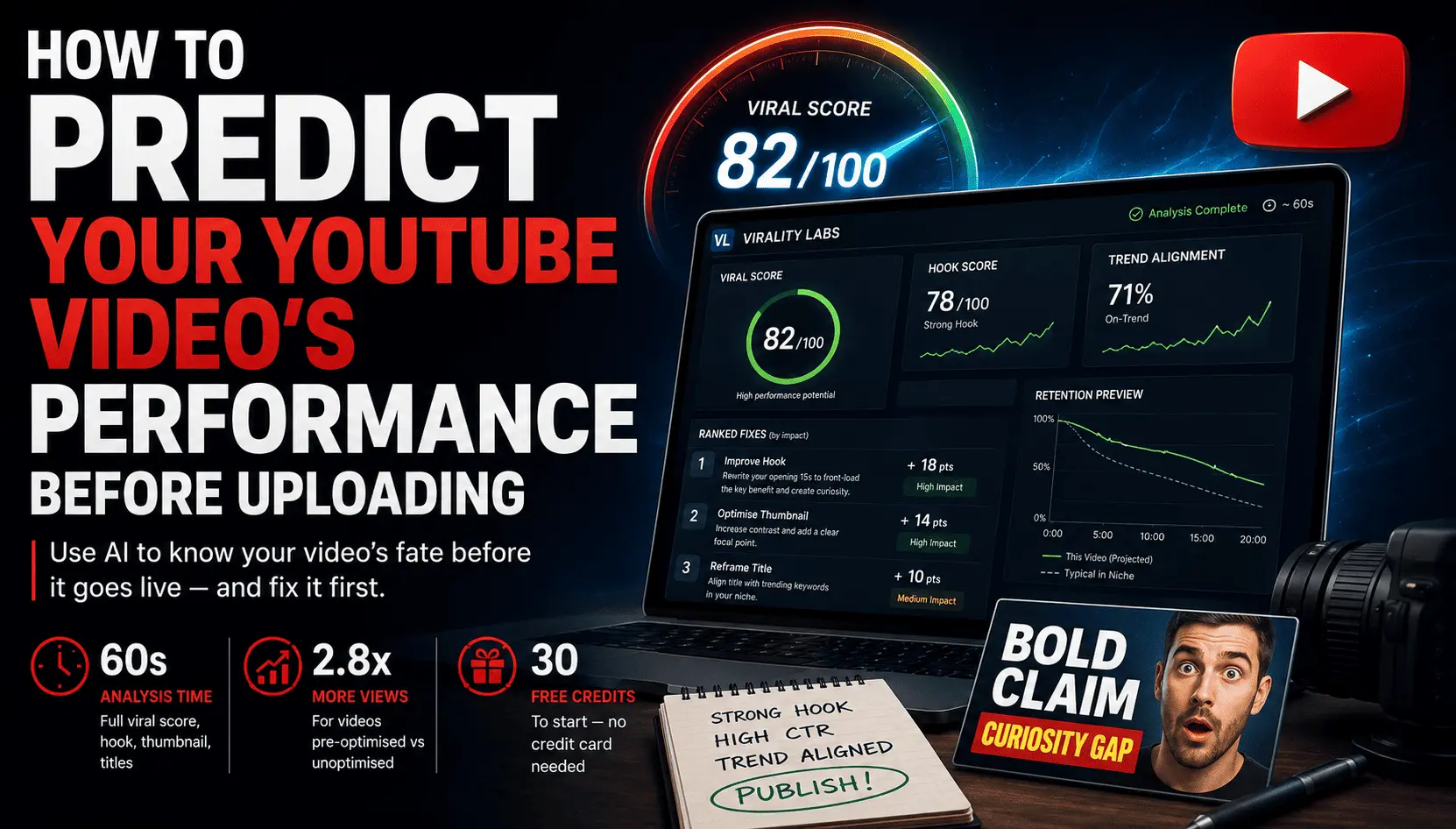
In 2026, that loop no longer needs to exist. AI-powered video analysis has made it possible to predict — and fix — your video's performance before you upload. Here's how it works, and why creators across the USA, UK and Canada are adopting it as a standard pre-publish step.
What Can Actually Be Predicted?
Not everything about video performance is predictable. External events, trending topics, and virality-by-sharing all have unpredictable elements. But the algorithmic signals that determine whether YouTube amplifies or restricts your video? Those are measurable.
| Metric | Predictable Before Upload? | How |
|---|---|---|
| Hook strength | ✅ Yes | AI analyses first 30s for retention patterns |
| Thumbnail CTR potential | ✅ Yes | Visual analysis of focal point, contrast, text overlay |
| Title click appeal | ✅ Yes | Formula matching + curiosity gap scoring |
| Trend alignment | ✅ Yes | Topic matching against currently trending content |
| Pacing / retention curve | ✅ Yes | Audio/visual density analysis against benchmark |
| Total lifetime views | ❌ No | Too many external factors |
| Going viral via shares | ❌ No | Social sharing is not predictable |
How AI Video Analysis Works
When you upload a video to Virality Labs, the analysis engine runs multiple parallel processes:
Audio Transcription
Your video's speech is transcribed and the first 30 seconds are analysed for hook strength — bold claims, curiosity gaps, pattern interrupts, and semantic relevance to the title.
Visual Frame Analysis
Key frames are extracted and analysed. The thumbnail (or uploaded image) is scored for focal point clarity, contrast ratio, emotional signal, and text overlay effectiveness.
Trend Pulse Matching
Your video's topics are matched against YouTube's currently trending content in your niche — refreshed every 5 hours. Higher alignment = more algorithmic surface area.
Retention Pacing Scan
Audio and visual density is measured across the video's timeline. Sections with low information density are flagged as retention drop-off risks.
Viral Score Calculation
All signals are combined into a single Viral Score (0–100) with weighted contributions from each factor, benchmarked against your niche.
Ranked Fix Generation
The AI generates specific, ranked improvements — ordered by estimated impact on the final score — with rewritten hooks, optimised titles, and hashtag sets.
The Pre-Publish Workflow
The creators using AI analysis most effectively have integrated it into a consistent pre-publish workflow. Here's the sequence that takes under 5 minutes and maximises your launch-day performance:
Finish editing — don't publish yet
Export your video at 720p or lower, under 500MB. This is your analysis copy — not your final upload.
Upload to Virality Labs
Drop the file and upload your thumbnail. Analysis takes under 60 seconds.
Review the Viral Score
A score of 70+ means your video is ready. 40–69 means the ranked fixes are worth implementing before upload. Below 40 means significant work is needed.
Apply the ranked fixes
Implement the top 2–3 fixes in order of impact. This typically takes 15–30 minutes and could mean re-recording your hook, updating your thumbnail, or rewriting your title.
Re-analyse (optional)
If you make significant changes, run a second analysis to confirm the score improved.
Publish with confidence
Upload your final video to YouTube with the optimised thumbnail and title — knowing your algorithmic signals are strong going into the launch window.
Real Results: Before and After Analysis
The most consistent pattern we see from creators who use pre-publish analysis: hook rewrites are the single highest-impact fix. A weak opening that loses 60% of viewers in the first 20 seconds can often be transformed with a single sentence change.
| Before Analysis | After Analysis | Outcome |
|---|---|---|
| Hook score: 31 (generic greeting intro) | Hook score: 78 (bold claim + curiosity gap) | +42% retention to 30s |
| Thumbnail CTR score: 38 (low contrast, no focal point) | Thumbnail CTR score: 82 (high contrast, clear subject) | +3.8% CTR improvement |
| Trend alignment: 34% (off-trend topic framing) | Trend alignment: 71% (reframed title around trending keyword) | +2.1x algorithmic surface area |
UK Creator Use Case
What a 70+ Viral Score Actually Predicts
A Viral Score of 70+ doesn't guarantee millions of views — it indicates that your video has the signals required for the algorithm to consider it for broader distribution. It's the difference between giving the algorithm a reason to amplify your content versus leaving it to guess.
Think of it like a job application. A strong CV doesn't guarantee the job — but a weak one almost certainly prevents it. A 70+ score is a strong CV. What happens in the interview (your actual content quality, niche competition, upload timing) determines the final outcome.
After applying ranked fixes: strong hook, high-CTR thumbnail, trend-aligned title. Algorithm-ready.
Before fixes: weak hook, low-contrast thumbnail, off-trend framing. High risk of restricted distribution.
"I used to publish and pray. Now I publish and know. That mental shift alone is worth every credit."
Predict your video's viral score before publishing — 30 free credits, no card needed.