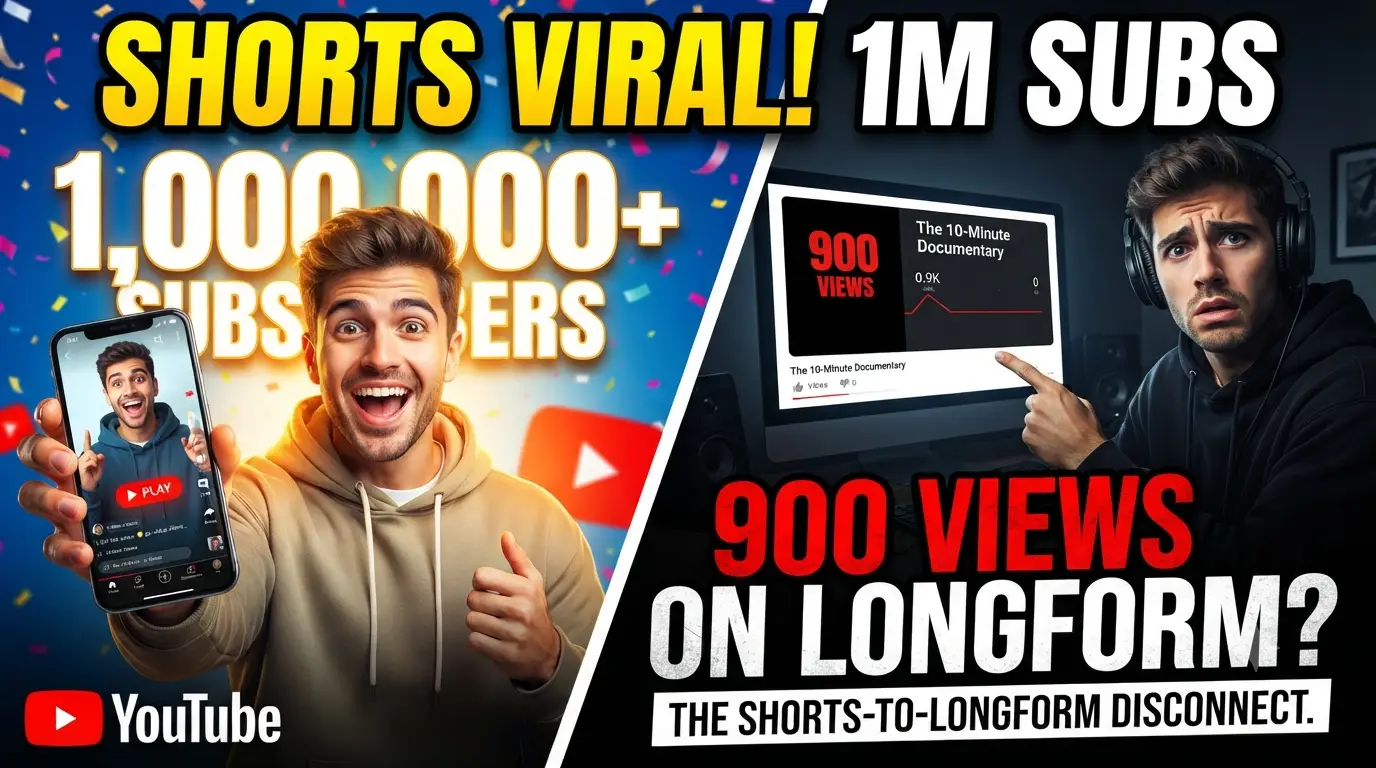
Here is the moment nobody talks about. You post a Short on Monday. By Thursday it has 4 million views. Your subscriber count jumps by 300,000 in a week. Creators in your niche start DMing you for advice. You feel like a celebrity.
Then you upload the thing you actually care about — the 10-minute documentary you spent 60 hours editing. You wait. You refresh. You refresh again.
936 views. Twelve comments. Three of them are your family.
This is the Shorts-to-longform disconnect. And it is quietly the most expensive mistake a creator in the USA or UK can make — because it feels like success while it is silently sinking your channel's algorithm, your click-through rate, and your entire income.
The Illusion of Fame: 400,000 Followers and No One Watching
Let's be brutally honest about what a Shorts subscriber actually is. They are not a fan of your channel. They are not even a fan of you. They are a fan of a 15-second dopamine hit that happened to have your face on it.
When someone subscribes from a Short, they are making an impulse decision — the same impulse that made them pause mid-scroll on TikTok. They tapped subscribe in the same half-second that a cat video could have stolen their attention. They did not watch your content. They watched a glimpse of it.
And when your 10-minute video appears on their home feed, their brain does not think "oh, my favourite creator uploaded something." Their brain thinks "work." A 10-minute video is a commitment. It requires sustained attention, delayed payoff, and patience — the exact three things Shorts conditioning destroys.
"I genuinely believed I'd made it. 2.4 million subscribers and my long-form videos were getting fewer views than when I had 50,000 subs. The Shorts audience wasn't growing my channel — it was teaching the algorithm to show my videos to people who immediately click away."
— UK creator, 2.4M Shorts subscribers, 40K long-form views
Fame That Doesn't Pay
Here is the uncomfortable financial truth: a Shorts subscriber is worth dramatically less than a long-form subscriber — often 50 to 100 times less. A long-form viewer who genuinely follows your work will watch ads, click your links, buy your products, and stick around for years. A Shorts subscriber contributes almost nothing to your revenue because:
- Shorts monetization pays a fraction of long-form CPM — often 3-5x less per 1,000 views
- Shorts viewers rarely click affiliate links, sponsorships, or products — they are mid-scroll, not mid-decision
- Shorts subscribers do not boost your watch time, so they do not lift your long-form recommendations
- Advertisers pay premium CPMs for engaged long-form audiences — and your Shorts subs drag your engagement metrics down
The "fame" of a huge subscriber count is a vanity metric when those subscribers never watch what you actually make. One thousand loyal long-form viewers will make you more money than one million Shorts subscribers.
The Attention Span Problem: Why Shorts Training Kills Long-Form Retention
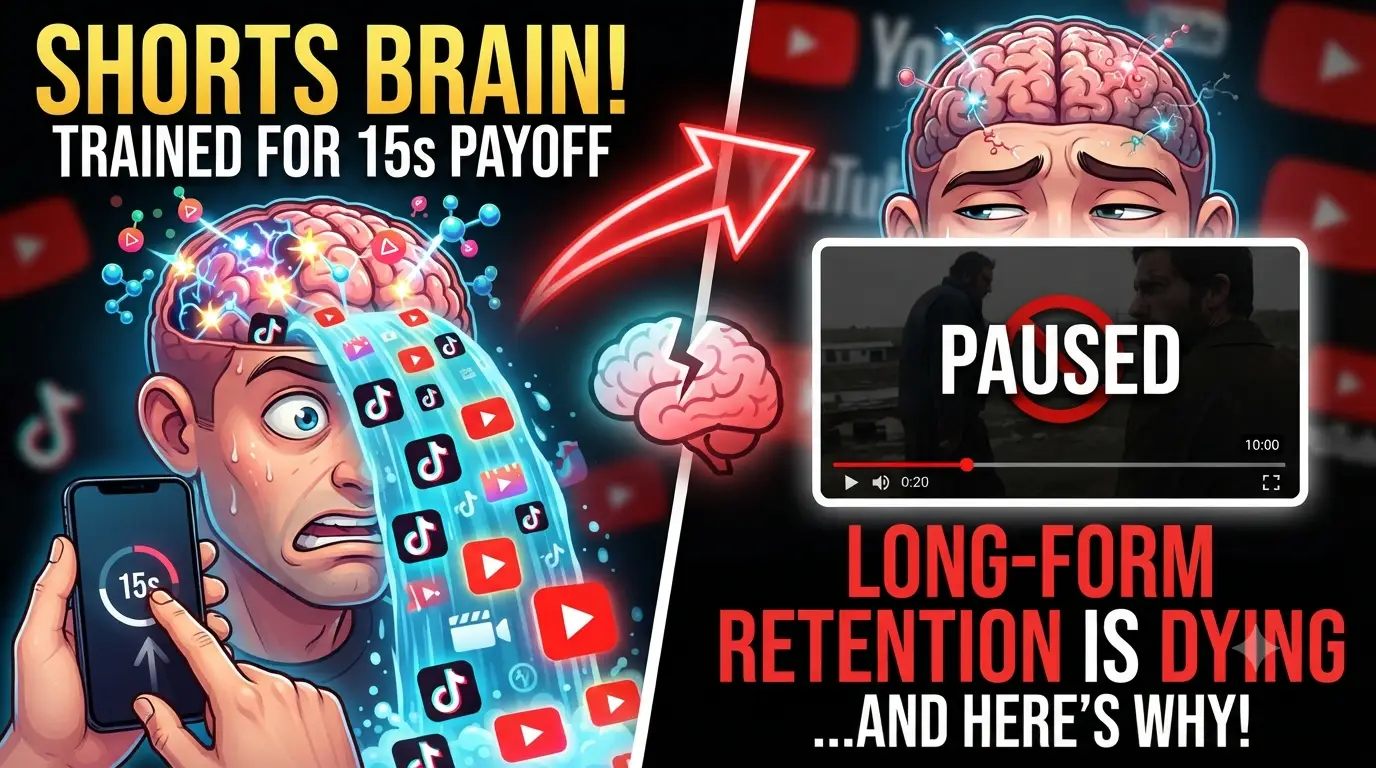
This is not a moral judgment about your audience. It is neurobiology. Every time a viewer consumes a 15-second video, their brain's reward loop is trained to expect a payoff in under 15 seconds. That is the pattern: quick hit, swipe, quick hit, swipe.
When that same brain faces your 10-minute documentary, the reward clock is ticking from second one. By second 20, their brain is screaming for the dopamine fix that the Shorts feed delivers every 15 seconds. Your video has to compete with the entire Shorts/TikTok feed — and it is losing before it starts.
This is why your Shorts subscribers don't "just watch" your long-form. It is not that they don't like you. It is that their attention machinery is no longer calibrated for content longer than a minute. You are asking a brain trained on espresso shots to sit through a three-course meal.
The dopamine threshold
Why Your Old Long-Form Strategy Is Irrelevant Now
Here is the trap. You built a Shorts audience using short-form principles: hook, punchline, repeat. You can't use those same principles for long-form — but you also can't use the traditional long-form playbook either, because the audience you're serving now thinks in 15-second increments.
The creators who successfully convert Shorts audiences are the ones who treat long-form as a series of connected Shorts — a 10-minute video structured so that a reward arrives every 10-15 seconds, each one pulling the viewer toward the next. That is not a stylistic choice. In 2026, it is a survival requirement for any channel that grew on Shorts.
The Algorithm Sabotage: How Shorts Subscribers Destroy Your CTR
Here is the part that surprises most creators. It is not just that Shorts subscribers don't watch your long-form. It is that their reflex to swipe away actively poisons your channel's click-through rate — and your CTR is the single most important distribution signal YouTube uses.
When YouTube shows your long-form video to 100,000 subscribers and 99,400 of them swipe past it, the algorithm logs that as a massive negative signal. YouTube concludes that your content is not what your audience wants. So it stops recommending you to anyone — including the long-form viewers who actually want to watch you.
The Numbers Behind the Poison
- A healthy long-form channel holds a 4-6% CTR — strong distribution signal
- A Shorts-first audience drags your long-form CTR to 1-2% — a signal the algorithm reads as failure
- Low CTR compounds: YouTube reduces impressions, which lowers views, which lowers CTR further — a death spiral
- Meanwhile, your Shorts subscriber count keeps climbing, masking the damage until your long-form revenue is gone
This is why creators who built exclusively on Shorts find themselves trapped. The bigger their Shorts subscriber count gets, the more people the algorithm shows their long-form to — and the more negative signals pile up. Their growth engine becomes their revenue killer.
| Signal | Long-Form First Audience | Shorts-First Audience |
|---|---|---|
| Long-form CTR | 4-6% — healthy | 1-2% — punished |
| Avg. view duration | 8-12 minutes | Under 60 seconds |
| Watch time signal | Strong positive | Active negative |
| Subscriber value | High — buys & watches | Near zero — scrolls past |
| Revenue per 1K views | £20-£60 (UK/USA) | £1-£4 (Shorts) |
| Algorithm verdict | Recommend everywhere | Hide from everyone |
The Vanity Trap: High Metrics, Empty Wallet
Let's talk about money — because that is ultimately what "make money from YouTube Shorts" actually means, and the answer is rarely what you want to hear.
A Shorts view is worth a fraction of a long-form view in ad revenue. But the real damage is opportunity cost. Every hour you spend making a viral Short is an hour you are not spending building the long-form content that actually pays. You are optimising for the wrong currency — chasing view counts that look impressive in screenshots but do not show up in your bank account.
The smartest Shorts-first creators in the USA and UK treat Shorts for what it is: a discovery engine, not a business model. Shorts get you in front of millions. But if those millions never convert into long-form watchers, you have built a billboard that nobody reads — massive impressions, zero sales.
1M Shorts subscribers, 2% long-form CTR, 40-second average duration, near-zero product sales. High vanity, low revenue.
300K Shorts subscribers, 5% long-form CTR, 9-minute average duration, active product and affiliate revenue. Modest vanity, real income.
"I had 1.1 million subscribers and was making about £700 a month. The moment I stopped chasing Shorts views and focused on converting the audience I already had into long-form watchers, my revenue went up 12x in four months. Same audience. Different structure."
— USA educational creator, 1.1M Shorts subs, £9K/month
How to Actually Convert Shorts Subscribers into Long-Form Viewers
The disconnect is real — but it is not inevitable. There is a proven bridge between short-form dopamine and long-form loyalty, and it comes down to four structural shifts:
1. Restructure Long-Form as Connected Shorts
A 10-minute video for a Shorts audience is not one 10-minute story. It is twenty 30-second stories stitched together, each with its own micro-hook, its own mini-payoff, and a thread that makes the next 30-second chapter impossible to skip. This is the pattern used by every creator who successfully converted a Shorts audience. The pacing is short-form; only the length is long-form.
2. Open with the Peak, Not the Setup
Your Shorts subscribers have zero patience for context. Never open long-form with "welcome back" or "before we begin." Open with the single most compelling moment of the entire video, then cut to black and earn the right to explain. If the first 30 seconds do not feel like a Short, you have already lost 70% of your Shorts-born audience.
3. Train the Crossover with a Feed
Do not expect a one-off long-form upload to convert anyone. Build a bridge feed: publish Shorts that explicitly tease a long-form video, then release the long-form the same day. The Short becomes a trailer, and the subscriber who watched the trailer is dramatically more likely to commit to the full video. Every Short should be a gateway, not a dead end.
4. Segment Your Audience in Your Mind
Stop measuring your entire channel by total subscribers. Track long-form viewers separately. When YouTube asks "who does this creator serve?", the answer your data gives matters more than your subscriber count. The channels that win are the ones whose long-form CTR and retention are healthy — regardless of how many Shorts subscribers they have.
Audit your long-form CTR
Open YouTube Studio and check the last 10 long-form videos. If your CTR is under 3%, your Shorts audience is poisoning your distribution. This is your baseline problem.
Rebuild your opening 30 seconds
Rewrite every long-form intro so it delivers a complete, satisfying payoff in the first 15 seconds — then another at 30. Treat the opening like a Short that happens to keep going.
Create a Short-to-long bridge feed
For your next 5 long-form uploads, publish teaser Shorts the same day that end on a question only the full video answers. Measure how much the teaser lifts long-form views.
Optimise pacing before you film
Map out mini-payoffs at 30-second intervals across your script before you record. If a section goes more than 30 seconds without a hook, cut it.
Compare projected vs actual retention
Run your script through a predictive tool before filming, then compare its projection to the real retention graph after publishing. Refine the pattern on every upload.
How Virality Labs Bridges the Gap
Here is where the disconnect becomes an advantage. The bridge between 15-second hooks and 10-minute loyalty is not guesswork — it is a predictable structural pattern, and it can be engineered before you ever hit record.
Virality Labs was built for exactly this problem. It does not just tell you whether your video is good. It analyzes your short-form viral loops — the exact hooks, openings, and payoff structures that earned you millions of Shorts views — and translates them into a predictive blueprint for long-form:
Hook-to-Narrative Expansion
Paste the scripts of your top-performing Shorts into Virality Labs, and the platform identifies the specific hook patterns that made them work. It then shows you how to expand those 15-second hooks into highly engaging 10-minute narratives — preserving the exact dopamine structure your audience already responds to, stretched across a full-length retention curve.
- Viral loop detection: Identifies the hook, pacing, and payoff patterns behind your best Shorts
- Long-form expansion map: Shows how to turn each 15-second hook into a chapter with its own micro-hook and payoff
- Retention projection: Predicts where a Shorts-trained audience will drop off in your long-form script — before you film
- CTR and intro scoring: Scores your thumbnail, title, and first 30 seconds against what actually converts Shorts viewers
- Pacing blueprint: Maps out mini-payoffs at 30-second intervals so your long-form feels like a series of connected Shorts
The result is not a "make it more engaging" critique. It is a measurable, repeatable blueprint for turning the audience you already earned into the revenue you keep missing.
From 40-second views to 9-minute loyalty
The Bridge Is Buildable — Or the Channel Is Sinking
Here is the honest bottom line. A million Shorts subscribers will not save your channel. They will not watch your documentaries. They will not buy your products. And if you keep feeding your long-form to them unprepared, they will actively train the algorithm to hide you.
But the audience is not the problem. The structure is the problem. A Shorts-trained audience will absolutely stay for 10 minutes — if the 10 minutes are built the way their brain has been trained to watch. The gap between 15-second dopamine and long-form loyalty is not a chasm. It is a bridge you can build before you film.
You can keep uploading long-form to a Shorts audience and watching the views trickle in. You can keep feeling famous while your revenue stagnates.
Or you can run your Shorts hooks and your long-form script through Virality Labs, get the predictive blueprint for expanding those 15-second hooks into 10-minute narratives, and turn the million subscribers you already have into the one thing that actually matters: viewers who stay.
The disconnect is not your audience's fault. It is a missing bridge. And in 2026, it is the most fixable problem in YouTube.
Stop losing your Shorts audience to the long-form cliff. Get the predictive blueprint for converting 15-second hooks into 10-minute loyalty — free.