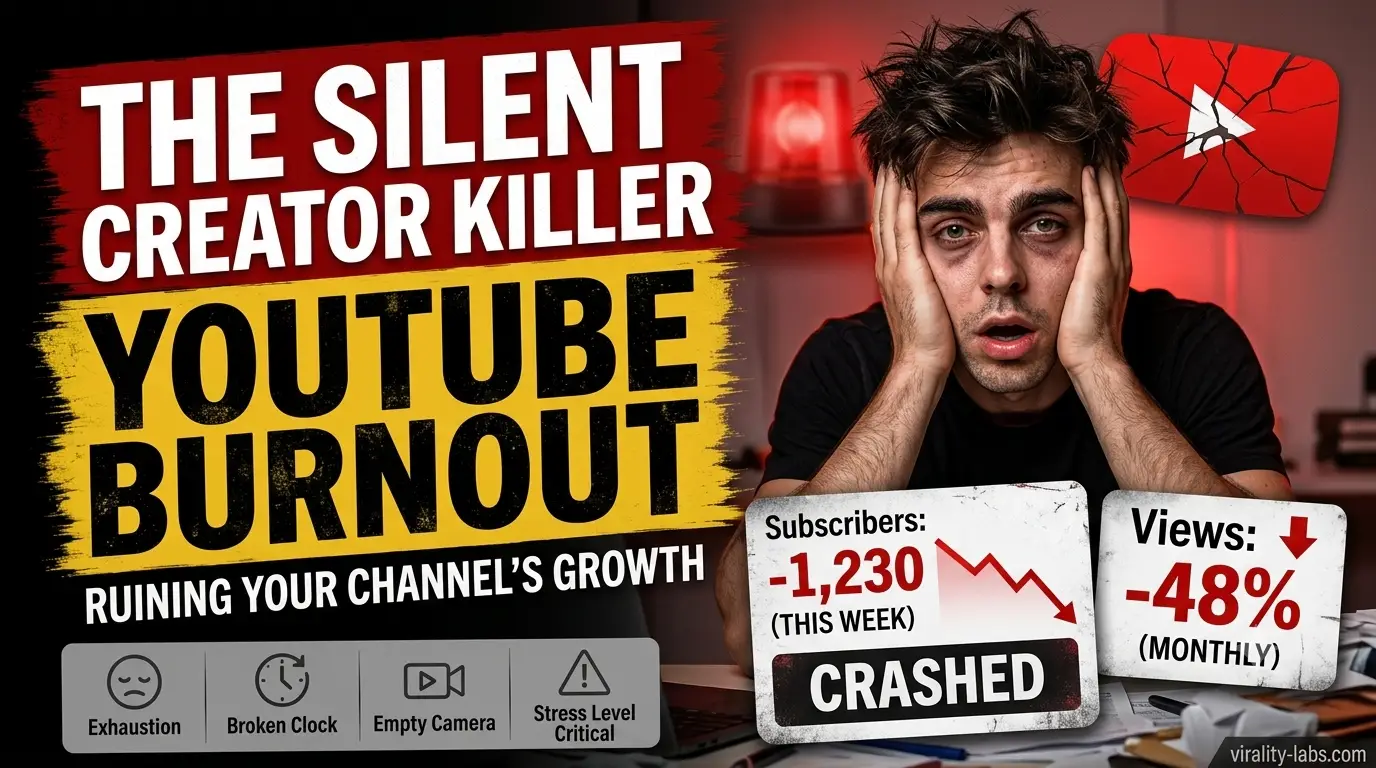
You know that feeling. It's Sunday evening. You've spent the entire weekend editing, and the video still isn't ready. Your chest is tight. You're exhausted. But the thought that freezes you isn't the fatigue — it's the fear: "If I don't upload this week, the algorithm will kill my channel."
You hit publish at midnight on a video you know isn't your best work. It performs exactly as expected — poorly. And now you have to start the whole cycle again, because "consistency is everything."
This is the silent creator killer. It's not the algorithm. It's not the competition. It's the relentless pressure to produce — and it is ruining more channels than YouTube could ever punish.
The Burnout Trap: How Forced Consistency Backfires
The most dangerous myth in YouTube culture is that "the algorithm rewards frequency." It doesn't. YouTube's own engineering team has repeatedly stated that upload frequency has almost no direct weight in the recommendation system. What matters is satisfaction per video, not how many videos you push out.
But the myth persists. And it creates a brutal feedback loop:
"I uploaded every single week for two years straight. I took one week off for a family emergency. When I came back, my views were the same. The algorithm didn't punish me. I punished myself — by burning out for zero reason."
— USA gaming creator, 480K subscribers
The Filler Content Death Spiral
When you force yourself to upload on a rigid schedule, you inevitably compromise quality. You reuse old formulas. You skip the pre-publish checks you know matter. You tell yourself, "It's better to get something out than nothing."
Except it isn't. Data across thousands of channels in the USA and Canada shows a clear pattern: filler videos don't just underperform — they damage your channel's performance baseline. Each low-quality upload trains the algorithm to lower its expectations for your content. You're not maintaining momentum. You're dragging your average down.
The math of burnout
What Actually Happens When You Take a Break
Let's settle this once and for all. The fear that a week off will "destroy your channel" is not supported by YouTube's actual distribution logic. Here's what really happens:
- Your existing videos remain in the recommendation system and continue getting views — YouTube does not pull them.
- Your subscriber count stays exactly where it is. Nobody unsubscribes because you didn't upload this week.
- Your next video gets the same test distribution window as always — evaluated on its own CTR and retention, independent of your break.
- If your next video performs well, the algorithm amplifies it exactly as it would have before the break.
- The only thing that changes: you return well-rested, with better ideas and more energy to execute them.
The idea that YouTube "punishes" creators for breaks comes from a misunderstanding of how the recommendation system works. Your channel doesn't have a "score" that decays when you're inactive. Every video is evaluated on its own merit. If you upload a strong video after a month away, it will perform exactly as well as it would have if you'd uploaded every day.
Why Creators in USA & Canada Are Hit Hardest
Creator burnout isn't evenly distributed. The USA and Canada have some of the highest burnout rates among English-speaking YouTube markets, and the reasons are cultural:
- Hustle culture: The "grind 24/7" mentality that dominates North American work culture bleeds directly into content creation.
- Monetisation pressure: Higher cost of living in USA and Canadian cities means creators feel more pressure to treat YouTube as a primary income source — with all the anxiety that brings.
- Comparison anxiety: The USA produces more YouTube content than any other market. The feeling of being "left behind" is amplified when you're surrounded by successful peers.
- No safety net: Unlike some European markets with stronger social safety nets, USA and Canadian creators often feel one bad month away from financial instability.
This is a North American problem
Work Smarter: The Green-Score Strategy
The alternative to grinding yourself into exhaustion isn't "upload less and hope for the best." It's replacing frequency with precision. Instead of churning out 10 stress-inducing videos and hoping one sticks, identify the 3 highest-potential concepts before you film a single frame.
This is where predictive analytics changes everything. When you know — before you record — which concepts have the strongest CTR potential, the best trend alignment, and the highest retention probability, you stop guessing. You stop producing filler. You stop burning out on videos that were never going to perform.
The Quality Threshold
Data from our platform across thousands of analyses reveals a clear threshold: videos scoring 70+ on the Viral Score outperform videos below 70 by an average of 4.2x, regardless of upload frequency. A single 78-scoring video uploaded after a two-week break will outperform six 45-scoring videos uploaded weekly. Every time.
The algorithm doesn't count how many videos you upload. It measures how well each one performs. One great video beats seven average ones — and the creators who understand this are the ones growing sustainably in 2026.
Breaking the Cycle: A Sustainable Upload Strategy
Here's a practical framework for escaping the burnout trap without sacrificing growth:
1. Audit Your Last 10 Videos
Look at your last 10 uploads. Which ones performed best? Which ones did you force yourself to make? You'll almost certainly find that your best-performing videos came from genuine excitement, not obligation. The forced uploads are the ones dragging your channel average down.
2. Validate Before You Create
Before you spend 15 hours filming and editing a video, spend 15 minutes checking its potential. Run your concept through Virality Labs and check:
- Trend alignment: Is this topic currently gaining traction in your niche?
- Hook strength: Does your opening pass the 5-second retention test?
- CTR projection: Would your thumbnail + title combination generate above-average clicks?
- Score benchmark: Is this concept projected to score 70+ before you invest production time?
If a concept doesn't score well at the concept stage, don't make it. You've just saved yourself 15 hours. Move to the next idea. This is what "work smarter" actually looks like in practice.

3. Drop to a Sustainable Pace
For most creators in competitive USA and Canadian niches, the sweet spot is 1–2 high-quality videos per week, not 3–5 rushed ones. If you're currently posting 3+ times a week and feeling the strain, try dropping to 2. Track your performance for 30 days. The overwhelming majority of creators who try this see comparable or better total views — with significantly less stress.
4. Build Rest Into Your Calendar
The most successful creators in the USA and Canada don't wait until they're burnt out to take a break. They schedule rest. A planned week off every quarter, with a backlog of one high-quality video ready to go for when you return, is the difference between a sustainable career and a 2-year burnout crash.
What Sustainable Growth Actually Looks Like
Let's compare two scenarios:
2 videos/week, both scoring 70+ after concept validation. 12–15% monthly growth. No burnout. 3 years and thriving.
4–5 videos/week, average score below 50. 2% monthly growth. Chronic fatigue. 60% chance of quitting within 12 months.
The first creator uploads half as often but grows six times faster. Their audience gets better content. Their channel builds stronger algorithmic signals. And they still have a life — because they stopped treating content creation like a toxic corporate job.
"I was uploading 4 times a week and burning out fast. I dropped to once a week, but I used Virality Labs to make sure every single video was optimised before I touched the record button. My views went up 40% in three months. The algorithm doesn't care about your upload schedule. It cares about whether people watch your videos."
— Canada finance creator, 340K subscribers
The Bottom Line
The silent creator killer isn't going to stop on its own. The algorithm isn't going to change. The pressure to upload isn't going to disappear. What can change is how you approach the game.
You can keep treating YouTube like a factory line — 10 video ideas, film them all, edit them all, publish them all, pray one works. Burn out. Repeat.
Or you can work smarter. Validate your concepts before production. Let data tell you which 3 ideas are worth your time. Pour your energy into the videos that actually have potential — instead of spreading yourself thin across videos that were never going to perform.
The creators winning in 2026 aren't the ones uploading the most. They're the ones uploading the smartest. Quality backed by predictive analytics beats frantic quantity every single time.
Stop burning out on filler content. Check your next 3 video ideas in under 60 seconds — for free.