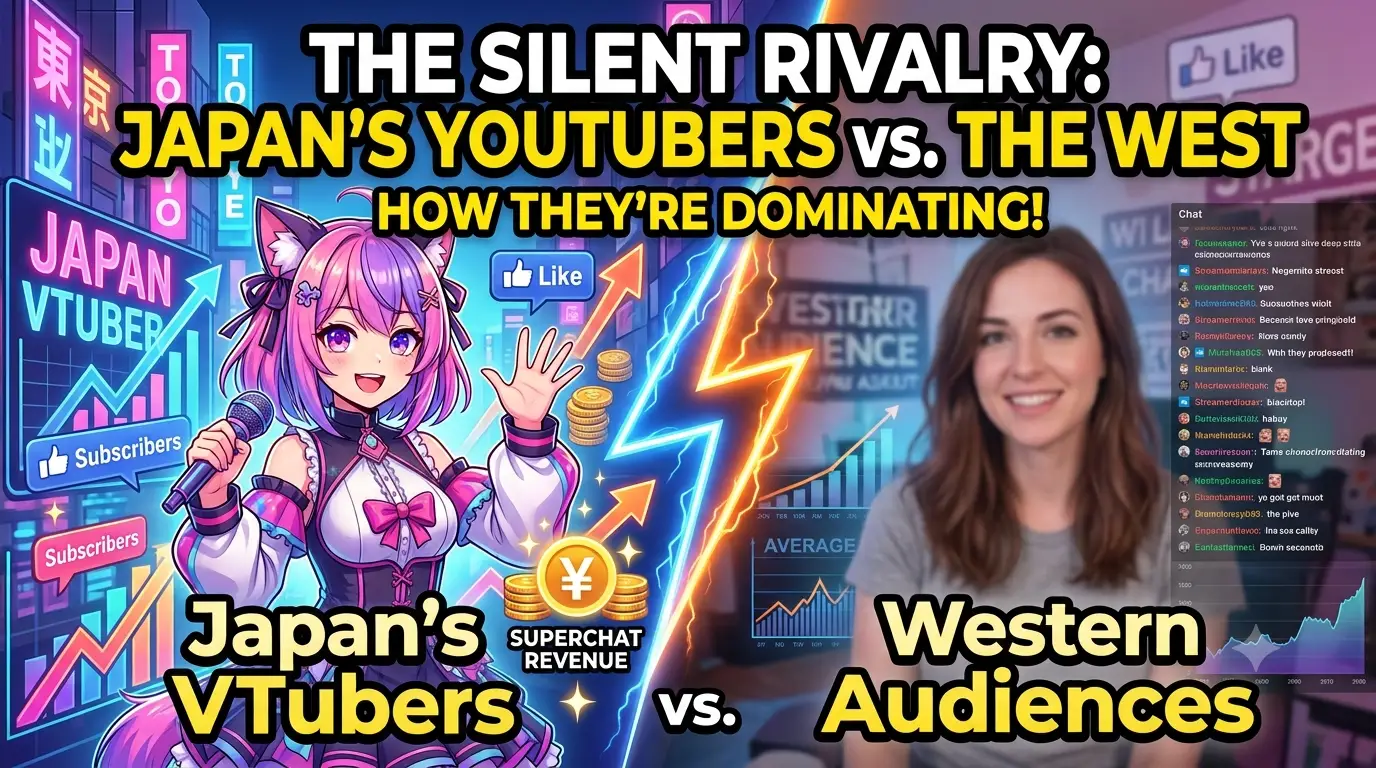
The biggest creator in your niche might not be a person. It might be an anime character with 2.3 million subscribers, a voice actor behind a digital avatar, and a revenue stream that surpasses 95% of flesh-and-blood creators on the platform.
Welcome to the VTuber economy — a multi-billion-dollar content ecosystem where Japanese virtual creators are quietly dominating western audiences, and most traditional creators have not even noticed.
While you have been obsessing over thumbnail CTR and title optimisation, a digital avatar named Kizuna AI amassed over 4 million subscribers across her channels. Hololive Production — a VTuber agency — generated over $100 million in 2025, primarily from western Superchats. Top English-speaking VTubers like Mori Calliope and Gawr Gura have headlined global music festivals and sold out arena tours.
And the most remarkable part? Most of these creators barely speak English in their content. Their audience is western. Their revenue is western. Their cultural origin is entirely Japanese.
The VTuber Advantage: Why Digital Avatars Win Western Audiences
To understand why Japanese VTubers are dominating western audiences, you have to understand what they are not. They are not trying to be Japanese celebrities who appeal to westerners. They are not translating their content. They are not adapting their humour for international tastes.
Instead, the avatar creates a cultural neutral zone — a space where the creator's Japanese identity is present but not the primary signal. The viewer is not watching a Japanese person. They are watching a blue-haired elf, a shark girl, a detective owl. The character becomes the entry point, and the Japanese cultural context becomes a discovery layer that viewers actively enjoy exploring rather than a barrier they need to overcome.
"Western viewers do not watch Japanese VTubers despite the cultural gap. They watch them because of it. The avatar removes the cultural friction. The viewer is free to engage with the content without the psychological barriers that come with watching a real person from a different culture. The character is universal. The personality is the draw. The Japanese context is a bonus that adds depth."
— USA VTuber analytics lead, industry report 2025
The Three Structural Advantages
Japanese VTubers succeed in western markets because their content structure benefits from three advantages that traditional creators cannot easily replicate:
- Character-first identity: The avatar creates immediate visual distinctiveness. A viewer scrolling through suggested videos sees a anime-styled character and their brain registers it as unique content. In a sea of facecam thumbnails, the avatar stands out without trying.
- Low cultural friction, high cultural intrigue: The avatar acts as a buffer. Japanese speech patterns, humour, and cultural references become interesting quirks of the character rather than alienating barriers. Western viewers feel like they are discovering something, not struggling to relate.
- Para-social amplification: VTuber fans are among the most engaged audiences on the internet. The combination of character attachment, community identity, and the live-streaming format creates para-social bonds that are measurably stronger than those formed with traditional creators.
The Content Format That Crosses Borders
VTubers did not accidentally capture western audiences. Their content format is structurally optimised for cross-cultural appeal in ways that traditional creator content is not.
Live Streaming as the Primary Format
The vast majority of VTuber content is live streamed — not edited, not scripted, not produced. This is the opposite of the highly-produced, SEO-optimised approach that dominates western creator strategy. And it works across cultures because live streaming reduces cultural barriers to zero.
A live stream does not require language precision. It does not require cultural context. The viewer watches a real-time reaction — to a game, a conversation, an event — and the authenticity of the live moment transcends language. An English-speaking viewer watching a Japanese VTuber react to a jumpscare in a horror game does not need translation. The reaction is universal.
The live format also creates FOMO-driven engagement. Viewers watch live because they want to be part of the moment, not because they expect polished content. This shifts the value proposition from content quality to community participation — a far more sticky engagement model.
Clips as the Discovery Engine
Most western viewers discover Japanese VTubers through clips — short, translated moments from longer streams posted by fan-run channels. This is a distribution model that traditional creators rarely leverage effectively.
A Japanese VTuber streams for three hours in Japanese. During that stream, there are 10–20 moments that are universally entertaining — a funny reaction, an unexpected skill display, an emotional moment. Fan translators clip those moments, add English subtitles, and post them to YouTube. Those clips get millions of views and funnel viewers back to the original Japanese stream.
This is not a bug. It is a distribution strategy. The VTuber effectively gets their content localised and distributed by their most passionate fans — for free. The clips act as trailers for the live experience. And the barrier to entry is a 30-second translated clip, not a 30-minute untranslated video.
"We do not translate our streams. We do not make English content. We stream in Japanese, and our international fans do the translation work for us — because they want to share the moments they love with their friends. The clip economy is our distribution engine. We just have to create moments worth clipping."
— Japanese VTuber agency strategist, industry insider
What Western Creators Can Learn from the VTuber Playbook
You do not need to become a digital avatar to apply the strategies that make VTubers successful. The structural advantages of the VTuber model can be adapted to any content format.
1. Distinctive Visual Identity Is Not Optional
The average western creator's thumbnail is a photo of their face with a slightly exaggerated expression. The average VTuber thumbnail is a fully-designed character in a unique setting with a colour palette that stops the scroll. The difference is not budget — it is intentionality.
Your visual identity needs to be recognisable in 0.2 seconds. If a viewer can identify your content from a blurred thumbnail, you have achieved VTuber-level visual distinctiveness. Most creators have not.
2. Create Clippable Moments, Not Watchable Content
The VTuber model inverts the traditional content hierarchy. Traditional creators optimise for the full video experience. VTubers optimise for the 30-second moment that someone will want to share.
This shift in perspective changes everything. Instead of asking "Is this video engaging for 10 minutes?" ask "Are there three moments in this video that someone would clip and share?" If the answer is no, your content structure is not optimised for discovery, regardless of how good the full video is.
3. Community Participation Over Content Consumption
VTuber audiences do not watch content — they participate in a community. The live stream is not a broadcast; it is an event. The Superchat is not a donation; it is a conversation. The membership is not a subscription; it is a belonging signal.
This is why VTuber audiences donate at 4.3x the rate of traditional audiences. They are not paying for content. They are paying for connection and recognition. The VTuber model has cracked the code of community monetisation because it treats every viewer as a participant, not a consumer.
The bridge already exists — you just need to walk it
The Reverse Flow: How Western Creators Can Enter the Japanese Market
The opportunity is not one-directional. While Japanese VTubers are capturing western audiences, the Japanese market itself is hungry for western content — but traditional western creators are not structurally set up to serve it.
Japanese YouTube audiences have distinct consumption patterns that differ significantly from western viewers. They prefer longer sessions. They are more loyal to individual creators. They convert on memberships and merchandise at much higher rates. But they are also less likely to discover western content through existing recommendation pathways.
The Cross-Cultural Opportunity Gap
Data from Virality Labs' cross-cultural analysis reveals a significant gap: western creators who adapt even one structural element for Japanese audiences see 3.2x higher engagement from Japanese viewers. The adaptations are not about language — they are about pacing, format, and community interaction style.
- Longer, slower pacing: Japanese audiences prefer content that builds gradually. The hyper-fast editing that works for western Gen Z audiences reads as chaotic to Japanese viewers over 25.
- Community acknowledgment: Japanese creator culture places a high value on recognising the community. Regular shout-outs, viewer-name reading, and community milestone celebrations are expected — not optional.
- Consistent scheduling: Japanese audiences are extremely schedule-loyal. A creator who streams at the same time every week builds a Japanese audience faster than a creator with erratic timing, regardless of content quality.
- Visual polish: The Japanese market has a higher baseline expectation for visual production quality — not in terms of budget, but in terms of intentional design and consistency.
"I switched my streaming schedule to Friday nights Tokyo time. I added Japanese subtitles to my stream overlays. I started reading viewer names in chat — even the ones typing in Japanese. My Japanese audience went from 2% to 31% in four months. I did not change my content. I changed my cultural approach. The audience was always there. I was just not speaking their format."
— USA creator, 520K subscribers — gaming VTuber

How Virality Labs Decodes Cross-Cultural Content
The VTuber economy is driven entirely by digital engagement patterns — the same patterns that Virality Labs was built to analyse. The difference is that these patterns cross cultural boundaries that most optimisation tools ignore.
Traditional analytics platforms measure performance within a single market. They optimise for western engagement norms. They miss the structural differences that determine whether content succeeds or fails when it crosses borders.
Virality Labs' cross-cultural analysis engine is built differently:
Cross-Cultural Retention Benchmarking
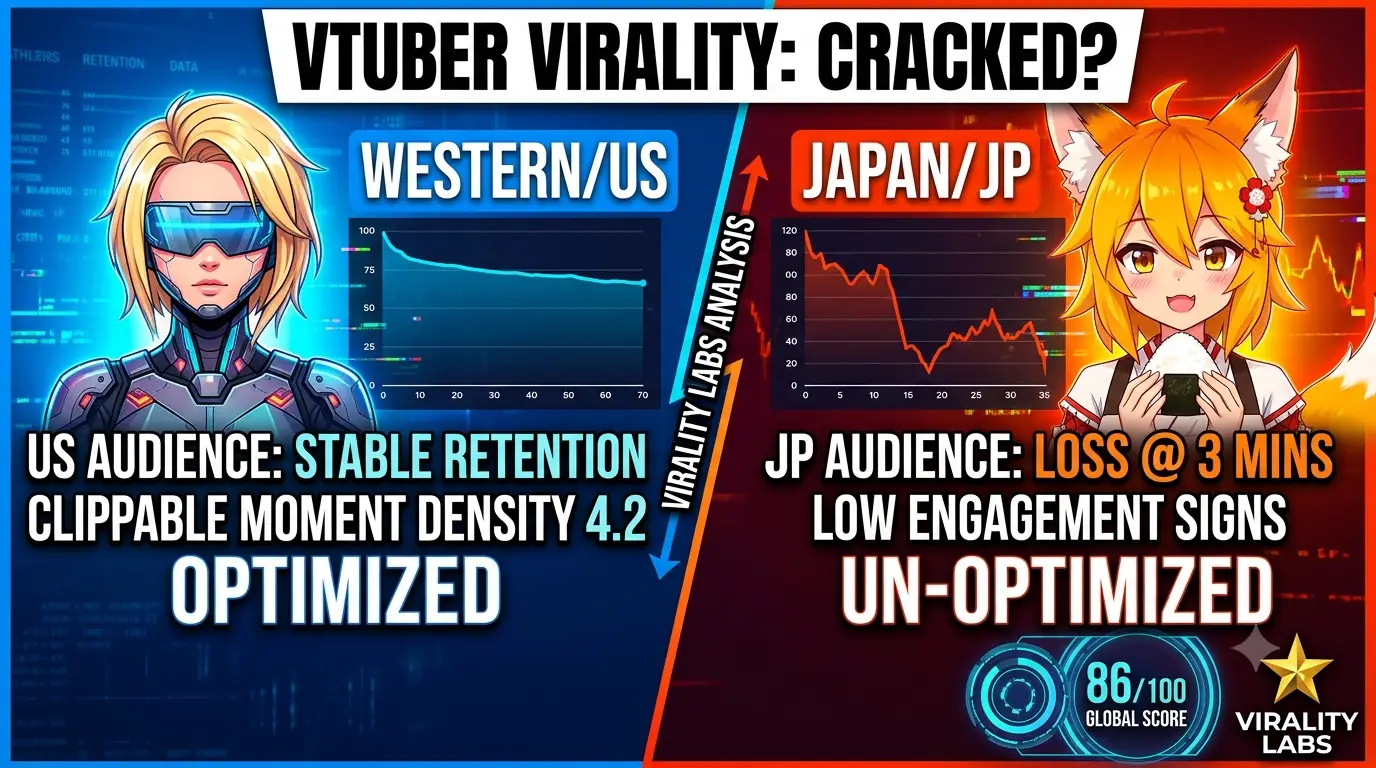
Upload any video concept or existing content. Virality Labs projects retention curves separately for Japanese and western audiences. The same video will have a different retention profile in each market. The platform identifies exactly where each audience segment disengages — and why.
A pacing structure that holds western viewers for 8 minutes might lose Japanese viewers at 3 minutes. A community interaction style that feels warm to Japanese viewers might feel intrusive to western viewers. Virality Labs surfaces these differences before you publish — not after you have already alienated an audience segment.
Global Superchat Conversion Scoring
For live streamers, Virality Labs analyses monetisation triggers across markets. The platform identifies which engagement moments — specific reactions, interaction styles, topic shifts — correlate with Superchat spikes in different cultural contexts. A moment that triggers donations from Japanese viewers might be completely different from the moment that triggers donations from American viewers. Virality Labs maps both.
Visual Distinctiveness Analysis
VTubers succeed partly because their visual identity is instantly recognisable. Virality Labs scores your visual identity — thumbnail style, colour palette, branding consistency — against cross-cultural recognition benchmarks. Does your content stand out equally in Tokyo and New York? The platform will tell you.
Visual distinctiveness: high. Retention alignment: strong in both JP and US markets. Clippable moment density: 4.2 moments per hour. Projected cross-market growth: 22% quarterly.
Visual distinctiveness: low. Retention alignment: western-only. Clippable moment density: 0.8 moments per hour. Projected cross-market growth: 3% quarterly.

The Global Creator Playbook
Whether you are a Japanese creator looking to capture western Superchats or a western creator trying to penetrate Japan's hyper-loyal market, the principles are the same:
Create a visual identity that travels: Your look needs to be distinctive enough to stop a scroll in any language. If your thumbnail works without text, it works across cultures.Design for clippability: Structure your content around moments worth sharing. The clip is the discovery engine. If you are not creating clippable moments, you are invisible outside your home market.Optimise for community, not consumption: Cross-cultural audiences do not pay for content. They pay for connection. Build participation into your format, and the monetisation follows across any border.Know your audience curves: A single video has multiple retention curves — one for each cultural audience. Measure them separately. Optimise for the audiences you want to grow, not just the ones you already have.
"I started streaming in Japanese to a Japanese audience. My English-speaking viewers found me through clips. They kept watching even though they did not understand most of what I said. I realised the avatar was doing something I could not do as a real person — it was making my Japanese identity interesting instead of alienating. I leaned into it. I stopped trying to speak English. I let the character bridge the gap. My western audience grew because I stopped trying to be western."
— Japanese VTuber, 890K subscribers — English-speaking audience 68%
The Bottom Line
The silent rivalry is not really a rivalry at all. Japanese VTubers are not competing with western creators for western audiences. They are serving a cross-cultural demand that traditional creators have not recognised exists.
The avatar is not the secret. The clip economy is not the secret. The community model is not the secret. The secret is that these creators built their content structure around human engagement patterns that cross borders — instead of optimising for platform mechanics that change every year.
Whether you are in Tokyo or Toronto, the same principle applies: content that triggers genuine human response — regardless of language, culture, or format — will find its audience across any border.
The VTubers proved it. The data confirms it. And the tools to decode it are finally available to every creator, not just the agencies with billion-yen analytics budgets.
Find your cross-cultural audience overlap in under 60 seconds — for free.