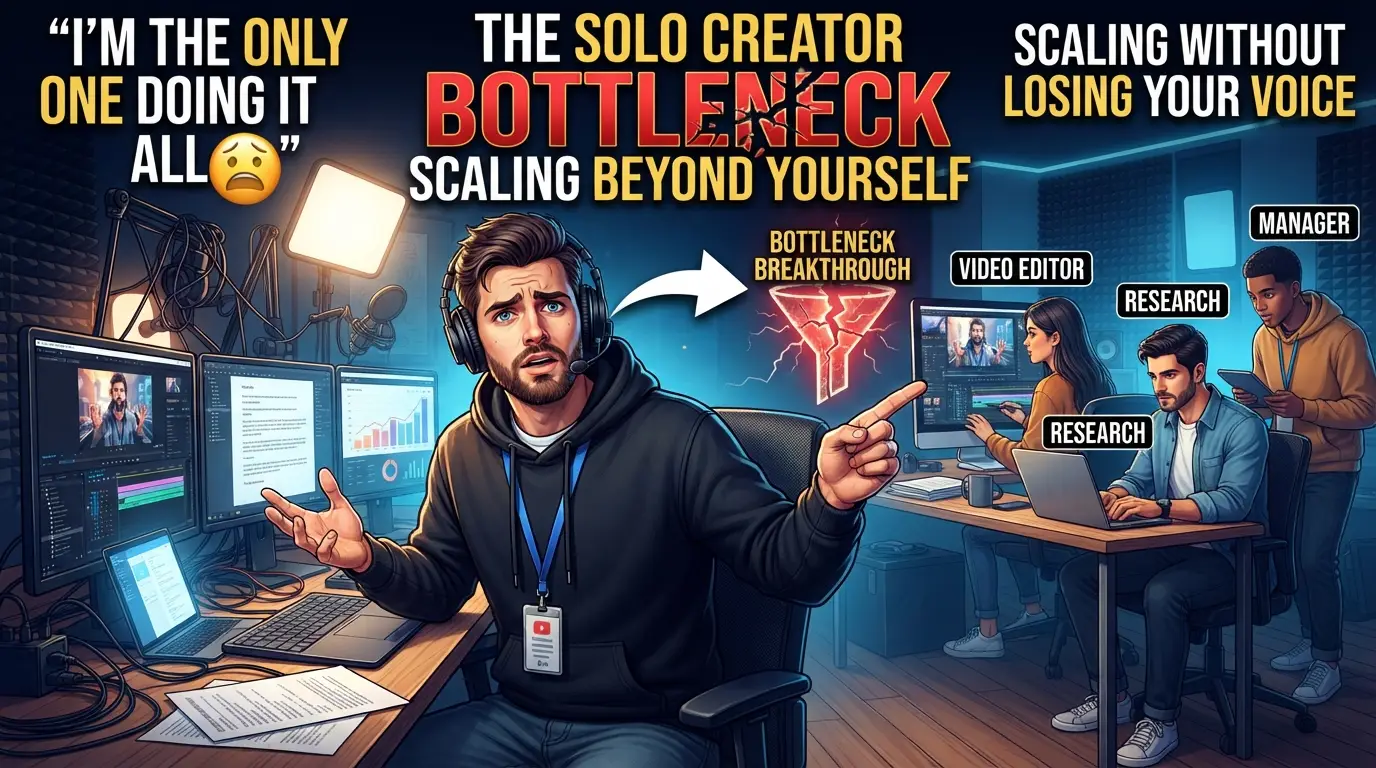
It is 1 AM. You just wrapped the upload. Tomorrow you research the next video. The day after, you write the script. Then you record, edit, thumbnail, title, publish, and reply to comments — and then you do it all over again. Every single week. Forever.
You glance at your subscriber count. It is growing. Your revenue is growing. But you feel something you did not expect: trapped.
Because here is the uncomfortable realization that hits every mid-tier creator in the UK and USA: you are the sole engine of your business. If you stop speaking to the camera for a week, the channel stops. If you get sick, the channel stops. If you take a vacation, the channel stops. Your "business" is not a business at all — it is a treadmill with one person on it, running as fast as they can just to stay in place.
You want to scale. You want a team. But every time you try to hire, you hit the same three walls — and this article is about exactly how to break through them.
The Treadmill Trap: Why Being the Product Is the Ceiling
Here is the honest framing most creators refuse to accept. You have built something that looks like a company, but it is actually a one-person dependency. Every subscriber, every view, every dollar is tied to one throat clearing in front of a microphone. That is not leverage. That is a job — with worse hours and no weekends.
The proof is simple: ask yourself what happens to your channel if you stop for a month. If the honest answer is "everything collapses," you do not own a business. The business owns you.
Scaling requires handing work to other people. But there is a reason most attempts fail — and it is not laziness. It is the voice problem. Your channel works because of you: your opinions, your phrasing, your judgment about what is interesting. Outsourcing that to a stranger is terrifying because it has no quality bar. Until now.
"I hired three writers in eighteen months. All three were technically talented. All three produced scripts that my audience could instantly tell weren't mine. The comments said it within an hour. I fired all three and went back to doing everything myself — because nobody could explain what 'my voice' actually was."
— UK educational creator, 640K subscribers
Wall #1: Hiring Writers Who Don't Understand Your Tone
This is the first wall every creator hits, and it is the most expensive. You post a job for a scriptwriter. You get 200 applicants. You interview five. You hire one. And the first script they send back sounds like a stranger wearing your name.
Why? Because "your tone" is not a thing you can explain in a job posting. It is the rhythm of your sentences, the way you build a hook, the topics you refuse to cover, the jokes you make at the 3-minute mark. You carry it in your head — and nobody else can read your head.
- Job descriptions say "match my style" — but nobody can define what that style is
- Hires over-deliver on research and under-deliver on your point of view
- Every round of feedback teaches the writer, but you are burning hours teaching instead of creating
- Writers who finally "get it" get poached — and you start over from zero
The problem is not the writers. It is that you have no objective baseline for what "good in your voice" means. You are asking people to hit a target they cannot see — and then punishing them for missing it.
Researchers Have the Same Problem
Hiring a researcher sounds safe — "just gather facts." But a researcher who does not know your channel will hand you a Wikipedia article. They do not know what angle you take, what you always skip, or what your audience already knows. Data without your editorial lens is not an asset; it is a chore. You still have to do the thinking — so you have not actually scaled anything.
Wall #2: The Quality Drop-Off When You Outsource
Here is the second wall, and it is the one that scares creators into staying solo forever. You outsource your editing to a professional. The first video comes back. The cuts are clean. The pacing is smooth. And something is wrong.
Not wrong enough for the viewer to say "this editor is bad." Wrong enough for them to say "this doesn't feel like him." The editor does not know that you always pause for a beat after the hook. They do not know that your audience hates the "intro music" trend. They do not know your retention curve should peak at second 45.
Quality drop-off when outsourcing is rarely a skill problem. It is a context problem. The outsourced work is objectively fine — and completely wrong for your channel.
| Creative Task | Solo (current) | Outsourced Blind |
|---|---|---|
| Scriptwriting | Exactly your voice | A stranger impersonating you |
| Editing | Perfectly matched pacing | Technically clean, feels off |
| Research | Your editorial lens | Generic, unfiltered data |
| Quality bar | In your head | No bar at all |
| Turnaround | Burnout pace | Faster — but rework eats the savings |
The rework loop is the hidden killer. You send the edit back, they revise, you revise again, and suddenly the "outsourced" video took more of your time than making it yourself — except now you also paid for the privilege. This is why so many scaling attempts quietly die: outsourcing without a system is not leverage, it is a more expensive treadmill.
Wall #3: The Management Tax
The third wall is the one nobody warns you about: managing people is a full-time job. You did not quit your solo creator job to become a project manager — but that is exactly what scaling makes you.
You now have to write briefs, give feedback, chase deadlines, explain your taste, and handle the emotional reality that a freelancer in another time zone does not care about your channel the way you do. The mental load of managing creative people is heavier than doing the work yourself — because creative work has no objective right answer, and every subjective correction teaches the team less than it drains you.
The result? You spend your days managing instead of creating. Your output drops. Your channel stagnates. And the thing you loved — making videos — becomes the thing you never get to do. You are now trapped on a bigger, more expensive treadmill.
The Missing Piece: A Systematic Data Framework
Here is what the successful channels figured out. The reason you cannot explain your voice, cannot benchmark your editors, and cannot delegate your taste is that you have no objective, repeatable standard for what your content is supposed to be.
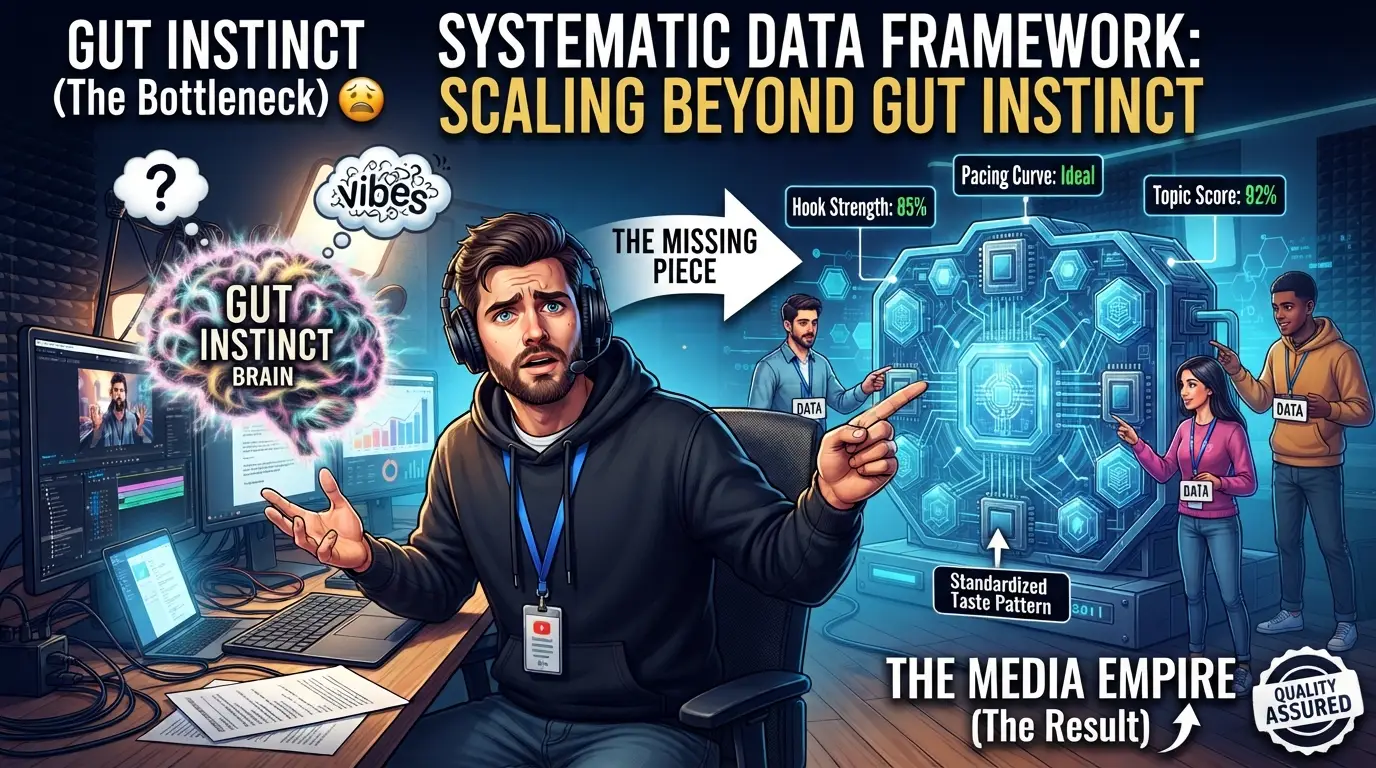
To scale a channel into a media empire, you do not need more people. You need a systematic data framework — a machine that encodes your judgment so that it no longer lives only in your head. The moment your creative standards become a measurable baseline, three impossible things become possible:
- You can explain your voice: not as a vibe, but as a set of measurable patterns — hook structure, pacing, topic angle, retention shape
- You can benchmark hires: a writer or editor can test their work against your baseline before they ever touch your production pipeline
- You can delegate without fear: your taste stops being a mystery, so quality stops dropping the moment you step away
This is the difference between a creator who scales and a creator who hires. One hands their taste to a stranger and hopes. The other hands their taste to a system — and the system keeps it consistent no matter who is doing the work.
How Virality Labs Acts As Your Automated Creative Director
This is exactly what Virality Labs was built for. Think of it as an objective, automated creative director that works for you 24/7 — the thing you cannot be while you are writing, recording, and managing at the same time.
Here is how it breaks the solo creator bottleneck — and why it is the piece that finally lets you build a team without losing your voice:
Your Channel's Baseline Model
Virality Labs analyzes your best-performing videos and establishes your channel's viral baseline model — the exact hook patterns, pacing curves, topic angles, and retention shapes that your audience responds to. This is your taste, extracted into a measurable standard. It is the definition of "your voice" you have never been able to write down.
Testing Hires Before They Touch Your Pipeline
When you bring on a scriptwriter, researcher, or editor, they do not learn your channel by trial and error. They test their work against your Virality Labs baseline:
- For writers: paste a draft script into Virality Labs and see whether the hook, structure, and pacing hit your channel's benchmark scores — before it ever reaches your desk
- For editors: upload a test edit and get a pacing and retention projection against your established curve
- For researchers: validate whether an angle matches what your audience actually engages with
The feedback is not subjective. It is measured against your channel's own data. A hire can iterate on their own — without burning your hours teaching them your taste. You only see work that already passes the bar.
The objective creative director
You Stop Being the Bottleneck
With an objective standard in place, the management tax collapses. You are no longer the only person who can judge quality. Your system can. You become the creative director of the system instead of the only worker in the factory — reviewing work that already passed your benchmarks, instead of hand-holding every draft from zero.
That is the difference between scaling into a media empire and hiring your way into a bigger, more stressful job.
Every task is yours, your voice lives only in your head, and any hire produces off-brand work you have to redo. One engine. One ceiling.
Your baseline is measurable, hires self-check against it, and quality holds whether you are recording, resting, or running the business. Real leverage.
Your Scaling Blueprint
Here is the step-by-step framework for breaking the bottleneck — starting today:
Build your baseline first
Run your top 10 videos through Virality Labs at virality-labs.com and establish your channel's viral baseline — hook patterns, pacing, retention shape, topic angles. This is your voice, made measurable.
Make the baseline your onboarding doc
Hand every new writer, researcher, or editor your baseline scores instead of a vague "match my style" brief. They now have a target they can actually see and hit.
Test before you pay
Require a test script or test edit, run through Virality Labs, before hiring. If their work does not clear your benchmarks, move on — no costly trial-and-error months.
Let hires self-check
Set the rule: nothing reaches your desk until it passes the baseline scores. Your team iterates against the system, not against your patience.
Step out of the factory
With quality held by the system, your job becomes the fun one again — recording, big-picture ideas, and growing the business. The treadmill is off.
Instead of taking on all the headache of defining your voice, teaching every hire, and reviewing every draft yourself — let the data do the judging. That is the entire point of using virality-labs.com.
The Bottom Line
The solo creator bottleneck is real, and it is why so many channels stall at mid-tier. You cannot be the sole engine of your business forever. The moment you scale without a system, you trade one treadmill for an expensive, exhausting one.
But the problem was never hiring. The problem was hiring without an objective standard — no baseline, no quality bar, nothing to protect your voice.
You can keep doing everything yourself until you burn out. You can keep hiring strangers who cannot match your tone and watching your quality drift. You can keep carrying the management tax while your creative fire dies.
Or you can build your channel's baseline at virality-labs.com, turn your taste into a measurable system, and let every script and edit prove itself against your benchmarks before it ever reaches your desk.
Stop taking on all the headache yourself. Scale the channel — not your workload.
Build your channel's viral baseline in under 60 seconds at virality-labs.com — and break the solo creator bottleneck for good.