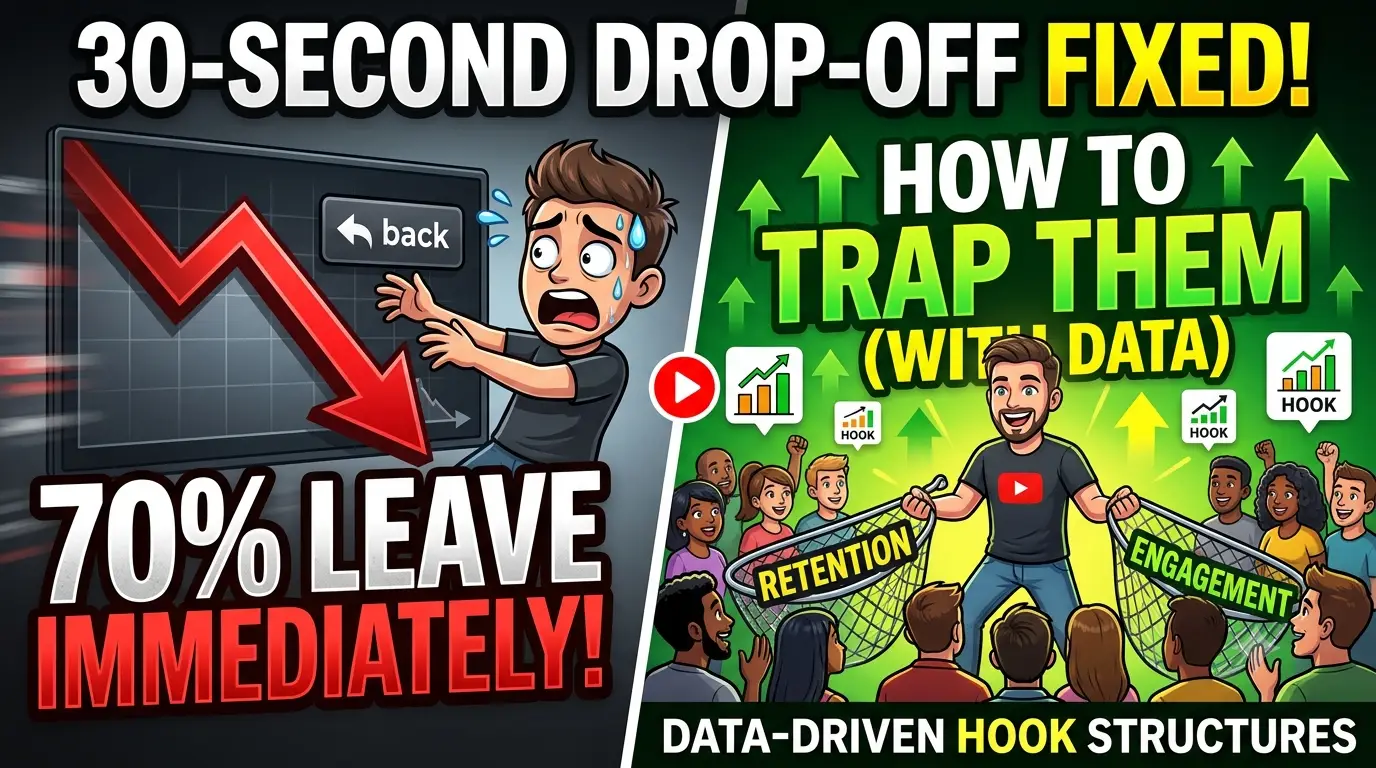
You just published. You refresh the analytics dashboard every 10 minutes like a nervous parent checking on a newborn. The impressions look good. The CTR is solid. You let yourself exhale.
Then you open the retention graph. And your stomach drops.
A steep cliff — straight down in the first 30 seconds. 70% of your viewers are gone before your video has even started. The ones that stayed? They trickle away over the next two minutes. Your beautiful, carefully edited video has an Average View Duration of under 90 seconds.
You had them at the thumbnail. You had them at the title. But the second they pressed play, you lost them. And you have no idea why.
The 30-Second Execution: Why Your Viewers Are Already Gone
Here is the brutal truth that most creators in the USA and Canada refuse to accept: your intro is not for you. It is for a stranger who has zero reason to trust you.
You spent three days editing this video. You know the payoff is incredible. You know the middle section changes everything. You know the ending will blow their minds. But the viewer doesn't know any of that. They have one question: "Why should I stay?" — and if you don't answer it in the first 8 seconds, they're gone.
The problem is that most creators write intros that feel compelling to the creator. You lead with context. You set up the backstory. You explain why this topic matters to you. But the viewer doesn't care about your context. They care about what's in it for them — right now.
"I spent a year writing intros that "set the stage." My retention was at 25% in the first 30 seconds across every video. I switched to opening with the most intense moment of the video — then cutting to black and saying "let me explain how we got here." My average view duration tripled in two months."
— USA gaming & commentary creator, 2.1M subscribers
Context Is The Enemy Of Retention
The single biggest mistake creators make is treating the intro like a handshake. "Hi, welcome back to the channel. Today we're going to talk about X. Before we start, a quick word from our sponsor. First, let me explain the background."
Every word of that is burning your retention graph. Every sentence you add before delivering value is another reason for the viewer to leave. The viewer doesn't need context. They need a reason to stay.
The Ryan Trahan rule
The Pacing Problem: Why MrBeast-Style Editing Works
Creators obsessed with retention metrics study MrBeast and Ryan Trahan not because of their flashy editing — but because of their information density per second. These creators understand a fundamental truth about the YouTube viewing psychology in 2026:
Every second your video contains a slow moment, a pause, a transition, or a setup — you are actively asking the viewer to leave.
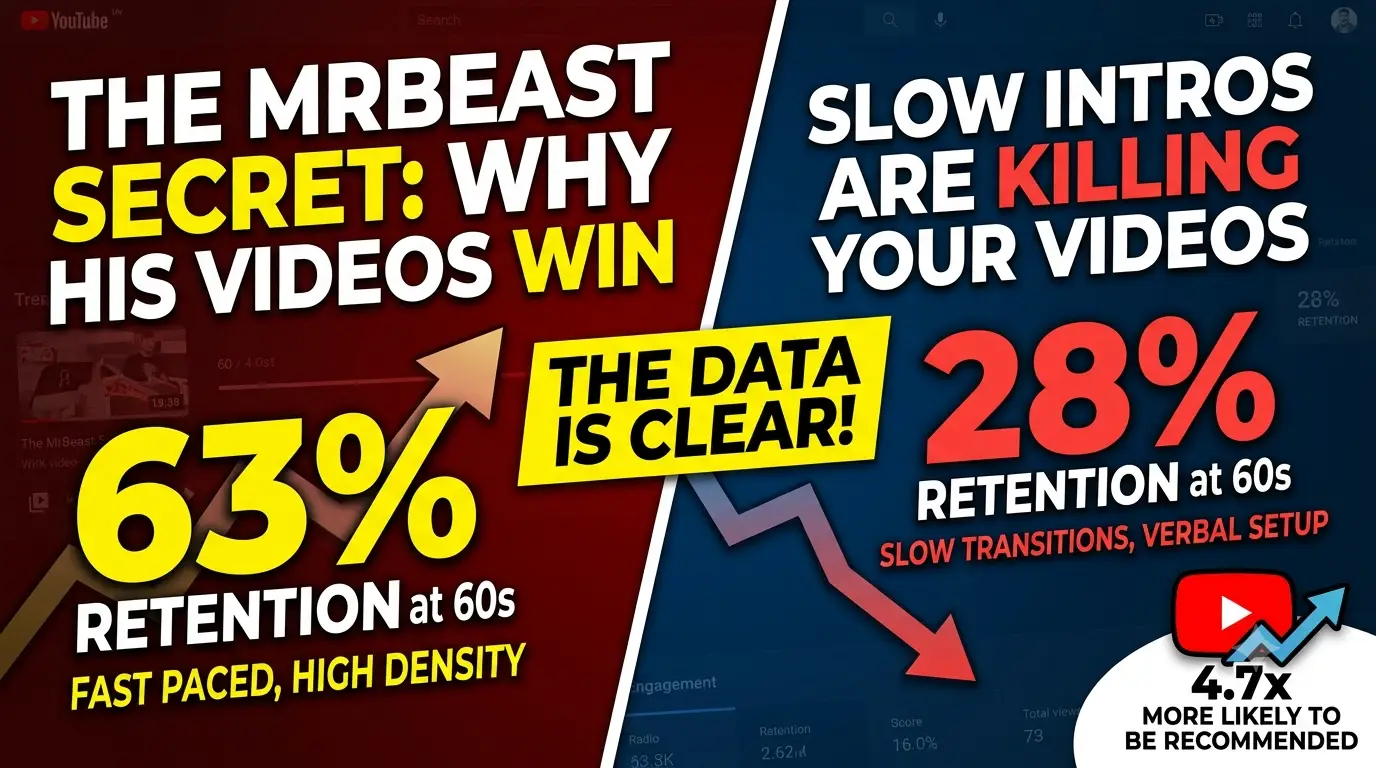
The data is ruthlessly clear. Videos that maintain high information density in the first 30 seconds retain an average of 63% of their audience through the first minute. Videos with slower pacing — establishing shots, slow transitions, verbal explanations — lose an average of 55% of their audience in the same window.
This is not about being loud or flashy. It's about respecting the viewer's time. Every moment of your intro should either intrigue, inform, or entertain. If it doesn't do one of those three things, cut it.
The Three Hook Structures That Actually Hold Viewers
After analyzing thousands of viral intros across USA, UK, and Canadian creator channels, three distinct hook structures consistently outperform everything else. These are not theories. They are patterns extracted from videos that break through the 30-second retention barrier every single time.
1. The Cold Open: Start at the Peak
This is the MrBeat/Ryan Trahan/TechLinked special. You start the video at the most intense, most interesting, most shocking moment of the entire video. Then you cut to black, hit the title card, and spend the rest of the video explaining how you got there.
Why it works: The viewer's brain receives an immediate dopamine hit. They saw something incredible. Now they need to know the context. You've flipped the script — instead of boring them with setup, you've made them demand the setup.
2. The Promise Stack: Three Hooks in One
In the first 15 seconds, you deliver three distinct, specific promises. Not "today we're going to talk about growing your channel." That's one vague promise. Instead:
- "In the next 10 minutes, you will learn the exact hook structure used by every creator with over 1 million subscribers in 2026."
- "You will see the three specific pacing mistakes that are destroying your retention graph — with real examples from real channels."
- "And you will walk away with a repeatable system for testing your intro before you ever hit record — so you never waste 30 hours on a video nobody watches."
Each promise is a separate reason to stay. If the first promise doesn't hook them, the second might. If the second doesn't, the third will. You've given them multiple psychological anchors before they've had time to reach for the back button.
3. The Negative Curiosity Gap
This is the most underrated hook structure in YouTube right now. Instead of promising what they will gain, you highlight what they are currently losing.
"70% of your audience is gone in 30 seconds. You have no idea why. Your retention graph is a cliff, and you don't even know which part of your intro is causing it."
This works because it triggers loss aversion — a psychological principle that is twice as powerful as the desire for gain. The viewer realizes they have a problem they didn't know they had. Now they need to know the solution. You've trapped them before they could leave.
"I switched all my intros to the Negative Curiosity Gap format. I stopped saying "here's how to improve retention" and started saying "here's the exact 8-second moment your viewers decide to leave — and why you're probably making it worse." My 30-second retention went from 38% to 71% in three videos."
— USA tech creator, 890K subscribers
Why Human Psychological Retention Patterns Are Predictable
Here is the most important thing you will read in this entire article: Retention is not mysterious. It is not random. It is not subjective.
Human attention follows predictable psychological patterns. The same brain structures that make someone click away from a slow introduction are the same across 99% of viewers. The same curiosity triggers that keep someone watching are the same across cultures, across niches, across continents.
This means great intros are not art — they are engineering. You don't need to be a naturally entertaining person. You don't need to be a genius editor. You need to understand the structural patterns that hold attention — and then apply them systematically.
Attention is not creative — it is mathematical
The Pacing Audit: How to Diagnose Your Own Retention Leak
Before you can fix your retention, you need to know exactly where your intro is failing. Here is the diagnostic framework used by data-driven creators in the USA and Canada:
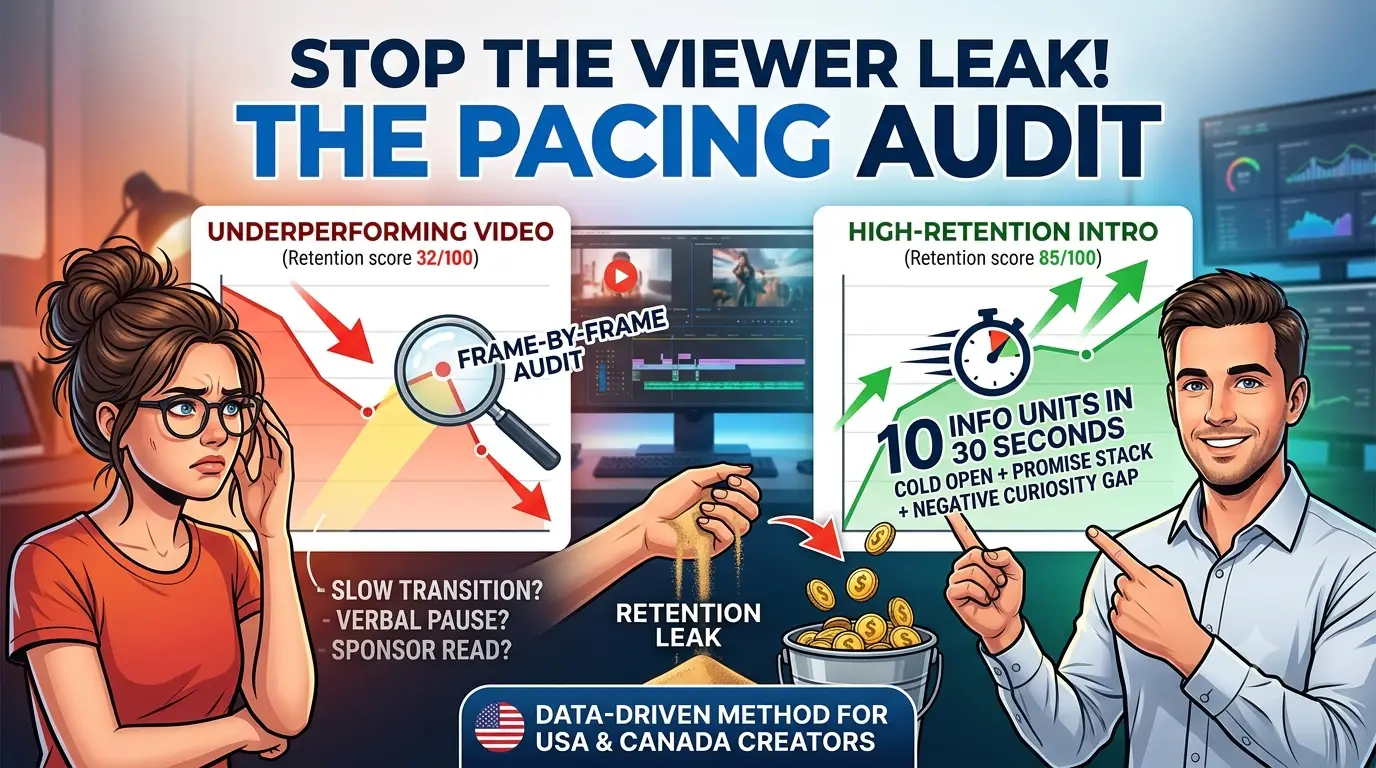
Frame-by-Frame Audit: Seconds 0–30
Open your most recent underperforming video. Go to the retention graph. Find the exact second where the drop-off accelerates. Now watch the video from that second minus 5, to that second plus 5. Ask yourself:
- What is happening in this exact moment? Is it a slow transition? A verbal pause? A sponsor read? A setup statement?
- Is the viewer receiving value — or are they waiting for value to start? Be brutally honest.
- If a stranger with zero context jumped in at this exact second, would they understand why they should keep watching?
- Could this moment be removed entirely without affecting the viewer's understanding of the video? If yes, cut it.
Most creators who do this exercise discover that their retention cliff happens at the exact moment they stop delivering and start explaining. The pattern is almost always the same: they deliver a strong opening statement, then immediately slow down to "set up" the rest of the video. That slowdown is where the audience escapes.
The Information Density Test
Count the number of unique information units in your first 30 seconds. An information unit is anything that makes the viewer think, question, or react: a surprising statistic, a provocative statement, a visual effect, a change in tone, a direct question, a callback.
High-retention intros consistently deliver 8–12 information units in the first 30 seconds. Low-retention intros deliver 2–3. If you're below 5, your intro is too sparse. The viewer's brain has time to wander — and when it wanders, it leaves.
10 information units in 30 seconds. Cold open + promise stack + negative curiosity gap. 76% retention at 60s. This intro traps the viewer before they can escape.
3 information units in 30 seconds. Context + sponsor + slow setup. 22% retention at 60s. The viewer has already left and will not return.
How Virality Labs Eliminates the Guesswork
Here is where everything changes. You now know the patterns that work. But you're still guessing whether your specific intro executes those patterns correctly. You write a hook. It sounds great to you. But you have no way of knowing if it will actually hold an audience — until the retention graph confirms you were wrong.
Virality Labs solves this by replacing guesswork with prediction. Here's exactly how it works for retention:
Script Hook Analysis Before You Film
Before you record a single frame, paste your scripted intro into Virality Labs. The platform analyzes your hook against millions of viral video openings — every successful (and failed) intro from creators in the USA, UK, and Canada across every major niche. It instantly tells you:
- Hook strength score: Does your opening follow one of the 12 proven retention patterns — or are you making a structural mistake that kills retention?
- Pacing density rating: Is your information density high enough to hold attention, or is your intro too sparse and slow?
- Drop-off prediction: At exactly which second will your viewers leave — based on the statistical patterns of millions of similar intros?
- Specific rewrite suggestions: Not vague advice like "make it more engaging" — but exact structural changes that will improve retention by a measurable percentage.
The platform doesn't judge your creativity. It measures your intro against mathematical patterns of human attention. You don't need to be MrBeast to have MrBeast-level retention. You need to follow the same structural patterns he uses.
The 5-minute fix
Retention Pattern Matching
Beyond your script, Virality Labs analyzes the pacing structure of your planned intro. It's not enough to have the right words — the timing, the transitions, the visual density all matter. The platform cross-references your planned structure against the retention profiles of thousands of top-performing videos to predict exactly where your audience will drop off.
The most powerful feature: competitive benchmarking. You can compare your intro's projected retention curve against the average curve of top creators in your niche. If your projected curve drops faster than the benchmark, you know — before filming — that your intro needs work.
Your 30-Second Retention Framework
Here is a repeatable system you can use for every video, starting today:
Step 1: Write Three Openings
Never settle for your first intro. Write three different openings using three different hook structures (Cold Open, Promise Stack, Negative Curiosity Gap). Run all three through Virality Labs. Pick the one with the highest projected retention score. This takes 15 minutes and will improve your average view duration more than any editing technique ever could.
Step 2: Audit Your Information Density
Go through your chosen intro second-by-second. Ensure you have at least 8 information units in the first 30 seconds. If you're below that threshold, restructure. Combine slow moments. Remove transitions. Add visual density. Every second must earn its place.
Step 3: Test Before You Invest
Film your intro — just the first 30 seconds. Upload it as a draft to Virality Labs. Get your retention projection. If the score is below 70, rewrite. Do not proceed to full production until your intro passes the threshold. This one discipline — refusing to film a full video until the intro validates — separates creators who grow from creators who stagnate.
Step 4: Monitor and Iterate
After publishing, compare the actual retention curve against Virality Labs' projection. The closer the match, the more you can trust the platform for future videos. Over time, you will develop an intuitive sense for what works — backed by thousands of data points instead of guesses.
"I used to spend 40 hours editing a video that lost 70% of viewers in the first 30 seconds. Now I spend 15 minutes validating my intro before I film. My average view duration went from 2:14 to 7:48 in 60 days. The editing didn't change. The structure did."
— Canada finance creator, 340K subscribers
The Bottom Line
The 30-second drop-off is not a mystery. It is not bad luck. It is not "the algorithm punishing you." It is a structural failure in your intro — and it is completely fixable.
Seventy percent of your audience is leaving within 30 seconds because your intro does not match the psychological patterns that hold human attention. The good news: those patterns are known, documented, and entirely predictable with the right data.
You can keep creating intros that sound great to you and fail with your audience. You can keep refreshing analytics, watching that retention cliff, and wondering why your hard work isn't paying off.
Or you can run your next three video concepts through Virality Labs, discover exactly which hook structure holds YOUR specific audience, and never waste another 30 hours on a video that loses 70% of viewers in the first 30 seconds again.
The data exists. The patterns exist. The only question is whether you'll use them before your next upload — or after watching another retention graph destroy your confidence.
Stop losing 70% of your audience in 30 seconds. Test your next video's intro hook in under 60 seconds — for free.