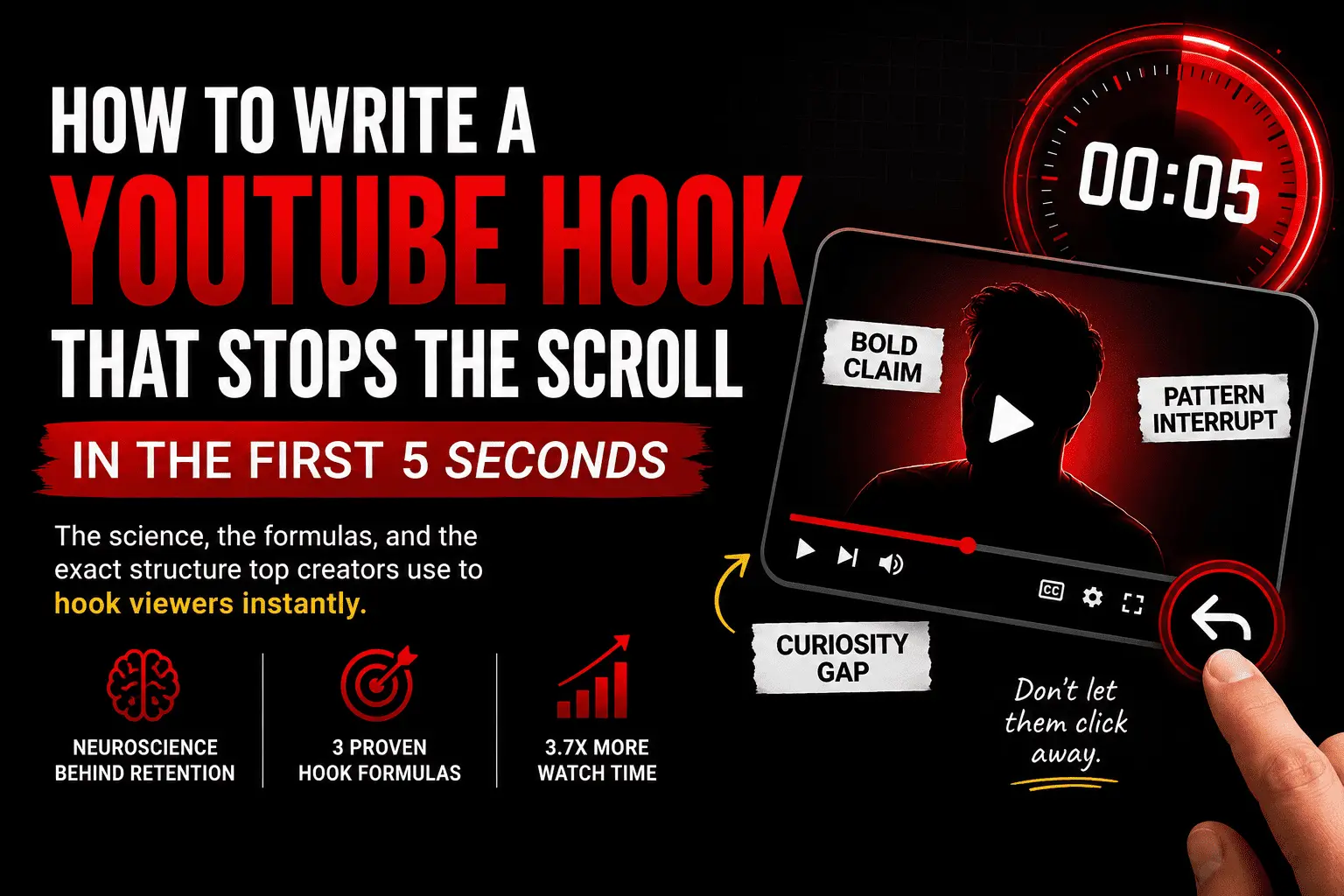
Open YouTube. Click any video. Your finger is already hovering over the back button. That's the mental state of every viewer in the first 5 seconds.
The YouTube algorithm is watching this in real time. If viewers are leaving quickly, it stops distributing your video. If they stay, it amplifies it. This is why your hook — the opening 5–30 seconds — is the most important piece of content you'll ever create.
This guide gives you the exact science and three proven formulas that top creators in the USA, UK and Canada use to make viewers physically unable to click away.
Why the First 5 Seconds Are a Neurological Decision
Here's what's actually happening when a viewer clicks your video: their brain is running a rapid pattern-match. In under 300 milliseconds, it answers: "Is this worth my attention?"
This isn't a conscious choice. It's automatic, driven by three signals:
- Visual novelty — does the first frame look different from what they just watched?
- Audio cue — is there a voice, sound effect, or music that signals energy and pace?
- Semantic relevance — does the opening sentence match the promise of the thumbnail and title?
If you fail all three, they're gone in under 3 seconds. Most tutorials never mention the third one — but it's the most important. If your thumbnail says "I made $10K last month" and your video opens with "Hey guys, welcome back..." — you've already broken trust.
The Expectation-Delivery Contract
The 3 Hook Formulas That Work in 2026
Formula 1: The Bold Claim Hook
Open with a statement so specific and surprising that leaving would mean missing out on the answer.
Examples
- "This one thumbnail mistake is costing UK creators an average of 4,000 views per video."
- "I tested 47 different upload times. One slot beat everything else by 300%."
- "Every piece of advice you've heard about the YouTube algorithm is wrong about this one thing."
The key is specificity. "This mistake costs you views" is weak. "This mistake costs UK creators 4,000 views per video on average" is a bold claim with a number, a market, and a specific cost. You can't leave without knowing what it is.
Formula 2: The Pattern Interrupt Hook
Begin mid-action, mid-conversation, or with a visual or sound that doesn't match viewer expectations. The brain's novelty system fires immediately.
- Start the video mid-sentence: "...and that's exactly why I deleted 2 years of videos."
- Open with the result, not the setup: show the finished product in frame 1
- Cut directly to an unexpected environment: not your normal filming spot
- Start with ambient sound before your voice — a coffee shop, a studio, a street
Formula 3: The Curiosity Gap Hook
Open the information gap — but don't close it. Give enough to make leaving feel like a loss.
Examples
- "I've been doing YouTube for 6 years. I only figured this out last month — and I'm honestly embarrassed it took that long."
- "There are 3 things every viral video has in common. By the end of this, you'll know all of them. But the third one will genuinely surprise you."
- "This channel grew from 0 to 200K in 8 months. The strategy was unusual. Let me show you."
The formula: acknowledge credibility + tease a specific insight + signal that the payoff is worth waiting for. The viewer's brain cannot leave without resolving the open loop.
The Hook Structure That Combines All Three
The highest-performing hooks in the USA, UK and Canada markets don't pick just one formula — they layer two or three in the first 20 seconds:
Second 0–3: Pattern Interrupt
Unusual visual, sound, or mid-sentence opening. Breaks the skip reflex.
Second 3–10: Bold Claim
One specific, surprising statement with a number or concrete detail. Sets the promise.
Second 10–20: Curiosity Gap
"By the end of this, you'll know exactly [specific outcome]. And there's one thing I haven't seen anyone else talk about yet."
Second 20–30: Relevance Confirmation
Confirm you're the right person to deliver this: brief social proof or a quick flash of the result.
Common Hook Mistakes UK & Canadian Creators Make
Having reviewed hundreds of UK and Canadian creator channels specifically, a few patterns come up repeatedly:
- Over-politeness: "Hey guys, hope you're having a great day..." burns 10 seconds of the hook window
- Apologising for anything in the first 60 seconds (common in UK channels) triggers a subconscious trust drop
- Explaining what the video is about instead of making the viewer feel the promise
- Using the same intro music + brand animation for the first 8 seconds of every video — viewers have learned to skip it
- Starting with context before the hook — "So, a few weeks ago I was thinking about..." is not a hook
"The single biggest change I made was cutting my intro entirely. I went straight to the hook. Watch time jumped 22% across all my videos within 2 weeks."
— UK creator, 890K subscribers
Scoring Your Hook Before You Publish
Virality Labs analyses the first 30 seconds of your video and assigns a Hook Score (0–100) based on retention signal patterns. It then rewrites your hook using one or more of the three formulas above.
Pattern interrupt present, bold claim with specific number, curiosity gap open at 20s.
Standard greeting intro, no bold claim, information gap never opened. Algorithm will flag low retention.
Analyse your hook and get a rewritten version — optimised for your niche and market.