
You produce exceptional content. Your editing is precise, your pacing is tight, your visuals are polished. Within Japan, your channel is growing steadily. But when you look at your audience map, 98% of your viewers are in Japan. The rest of the world — the USA, UK, Canada, across Europe and Southeast Asia — barely touches your content.
You are not alone. This is the single most frustrating pattern for Japanese creators aiming for global reach. And it is not a talent problem. It is a structural gap between what works inside Japan's YouTube ecosystem and what the global algorithm rewards.
The Regional Lock: Why the Algorithm Keeps You Inside Japan
YouTube's recommendation system optimises for viewer satisfaction. When a viewer in the USA or UK watches a video, the algorithm measures CTR, average view duration, and retention. If those signals are strong, the video is recommended to similar viewers.
For Japanese creators, the problem is not the quality of the content. It is a mismatch in the signals that Western audiences respond to:
1. Pacing Differences
Japanese YouTube content tends to follow a slower, more deliberate pacing structure. Establishing shots are longer. Context is built gradually. This style works exceptionally well with Japanese audiences, who are accustomed to it. But when a viewer in the USA or Canada encounters the same video, the retention curve drops sharply within the first 15 seconds.
The algorithm interprets this drop as "low quality." It doesn't know the video is well-crafted. It only knows that viewers outside Japan are clicking away early. And so it stops recommending the video beyond the Japanese market.
The 15-second wall
2. Language as a Signal, Not a Barrier
Many Japanese creators assume that producing English-language content is the only path to global reach. This is not entirely true. YouTube's translation and captioning systems have improved dramatically. But the real barrier is not language — it is cultural pacing and hook structure.
Even Japanese creators who speak fluent English often retain the pacing patterns of domestic Japanese content. The algorithm reads the retention curve, not the language. A Japanese-language video with a fast, curiosity-driven hook and strong retention can outperform an English-language video with slow pacing.
3. Thumbnail and Title Norms
Thumbnail conventions differ significantly between markets. Japanese thumbnails tend to be cleaner, with more negative space and softer contrast. Western thumbnails — especially those that perform well in the USA, UK, and Canada — use high contrast, bold text overlays, and emotionally expressive faces as standard.
When a Japanese creator's thumbnail appears in a Western viewer's feed, it generates lower CTR simply because it blends in rather than stopping the scroll. The algorithm sees low CTR and limits distribution. The cycle continues.
The High Saturation Trap Inside Japan
Japan has one of the most densely populated YouTube creator ecosystems in the world, relative to its internet population. The competition for views within Japan is fierce. Domestic CTR benchmarks in Japan are among the lowest globally because viewers are overwhelmed with content from creators in the same niches.
This creates a perverse incentive: the harder you compete within Japan, the more you optimise for domestic norms — and the further you drift from the pacing, thumbnail, and hook styles that would unlock global audiences. You are trapped by your own local success.
"I spent two years trying to grow inside Japan. I was getting 20K views per video but couldn't break past that ceiling. When I changed my hook structure for international audiences — keeping the Japanese language but changing the pacing — my views from the US went from 200 per video to 12K per video in three months. The content was the same. The delivery structure was different."
— Tokyo-based creator, 280K subscribers
What Global Audiences Actually Respond To
Data from cross-border analyses reveals a clear set of patterns that consistently predict whether a Japanese creator's video will resonate outside Japan:
| Factor | Impact on Global Reach | Japanese Norm vs Global Expectation |
|---|---|---|
| Hook speed (first 5s) | Critical | Japan: setup + context / Global: curiosity + conflict immediately |
| Pacing (first 60s) | Very High | Japan: gradual build / Global: information density within 30s |
| Thumbnail contrast | High | Japan: clean, minimal / Global: bold, high-contrast, expressive |
| Title specificity | High | Japan: descriptive / Global: curiosity gap + specific result |
| Visual density | Medium-High | Japan: slower cuts / Global: faster cuts, more variety |
| Use of text overlays | Medium | Japan: minimal / Global: key points reinforced visually |
| English subtitles | Medium | Vital for reach but insufficient without pacing changes |
| Cultural references | Low-Medium | Japan-local references limit global comprehension |
The pattern is consistent: hook speed and pacing are the two highest-leverage changes for Japanese creators seeking global reach. Pacing adapted to international norms — while retaining Japanese language and cultural identity — consistently delivers the strongest cross-border results.
How to Break the Barrier: A Data-Driven Approach
Escaping the regional algorithm lock requires more than intuition. It requires knowing — before you publish — whether your video will resonate beyond Japan. Here is the exact process:
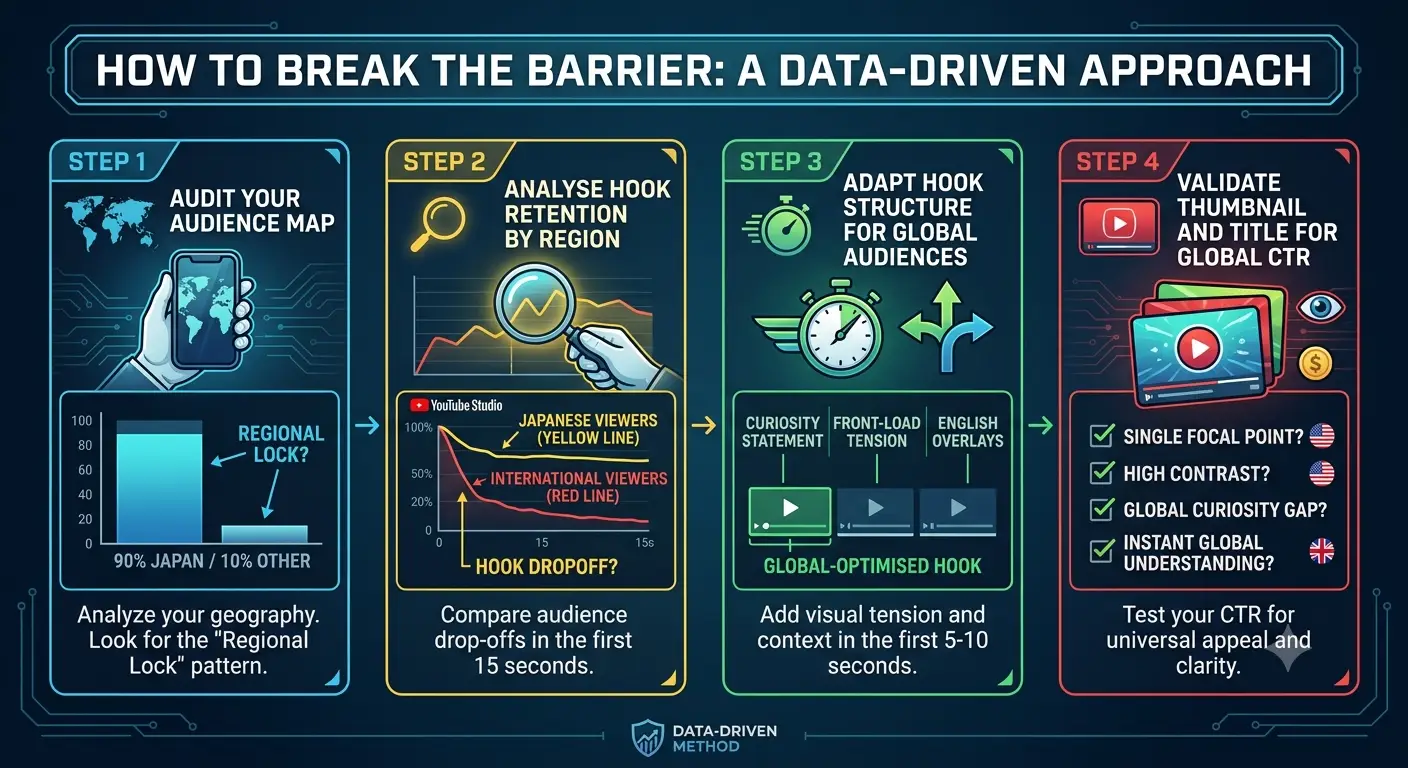
Step 1: Audit Your Current Audience Map
Open your YouTube Studio dashboard and look at your audience geography. If 90%+ of your views are from Japan, you are in the regional lock. Your next step is to understand why — not by guessing, but by measuring your retention curve against global benchmarks.
Step 2: Analyse Your Hook Retention by Region
Look at the first 30 seconds of your recent videos. Compare the retention drop-off between your Japanese viewers and your small international cohort. If international viewers are dropping off faster in the first 15 seconds, your hook pacing is the barrier. This is the single most common pattern for Japanese creators.
Step 3: Adapt Your Hook Structure for Global Audiences
The fix is not to abandon your creative identity. It is to add a global-optimised hook to the first 5–10 seconds of your video. This means:
- Open with a specific, curiosity-driven statement that does not require cultural context.
- Front-load the core tension or question the video will answer.
- Use visual text overlays in English (even if your audio is Japanese) to signal relevance to international viewers.
- Keep the first 5 seconds visually dense and emotionally engaging — save slower establishing shots for after the hook window.
The rest of your video can remain exactly as you want it. Your pacing, your cultural references, your Japanese-language delivery — all of it stays intact. Only the first 5–10 seconds need structural adaptation to pass the global algorithm's initial test.
Step 4: Validate Thumbnail and Title for Global CTR
Before publishing, check whether your thumbnail and title will generate clicks from international audiences. Key questions to ask:
- Does the thumbnail have a single clear focal point that reads at 120×67px?
- Is the contrast high enough to stand out in a mixed-language feed?
- Does the title create a curiosity gap that works without cultural context?
- Would a viewer in the USA or UK understand what this video offers within 2 seconds?
The "Japanese Identity, Global Pacing" Model
The creators who successfully break the regional barrier are not abandoning their Japanese identity. They are adding a global-compatible layer to the opening moments of their content. This is the model:
"I still make content in Japanese. I still talk about topics that matter to Japanese audiences. But I changed my first 5 seconds. Now the algorithm shows my videos to viewers in the US, UK, Canada, and across Southeast Asia — and they stay, because the content after the hook is strong. I didn't change who I am. I changed how I start."
— Japanese creator, 890K subscribers (60% international)
The data confirms this approach. Japanese creators who adapt only their hook and thumbnail structure — while keeping their language, topic focus, and cultural identity — see an average 2.1x increase in international viewership within 60 days.
The Bottom Line
The YouTube algorithm does not ignore Japanese creators because their content is lower quality. It ignores them because there is a structural mismatch between the pacing and hook norms of the Japanese market and the expectations of global viewers.
This is a fixable problem. It does not require changing your language. It does not require abandoning your creative identity. It requires data — knowing exactly where the gap is and exactly what to change to bridge it.
Every Japanese creator with world-class content deserves a global audience. The algorithm is not the barrier. The missing piece is the data blueprint that shows you how your content needs to adapt at the margins — without losing what makes it uniquely yours.
Hook adapted for international pacing, high-contrast thumbnail, curiosity-driven title. Likely to break the regional barrier.
Domestic-optimised pacing and thumbnail. High retention within Japan but algorithm limits global distribution.
Check your video's global readiness score — see exactly where your hook, pacing, and thumbnail need to adapt for international audiences.