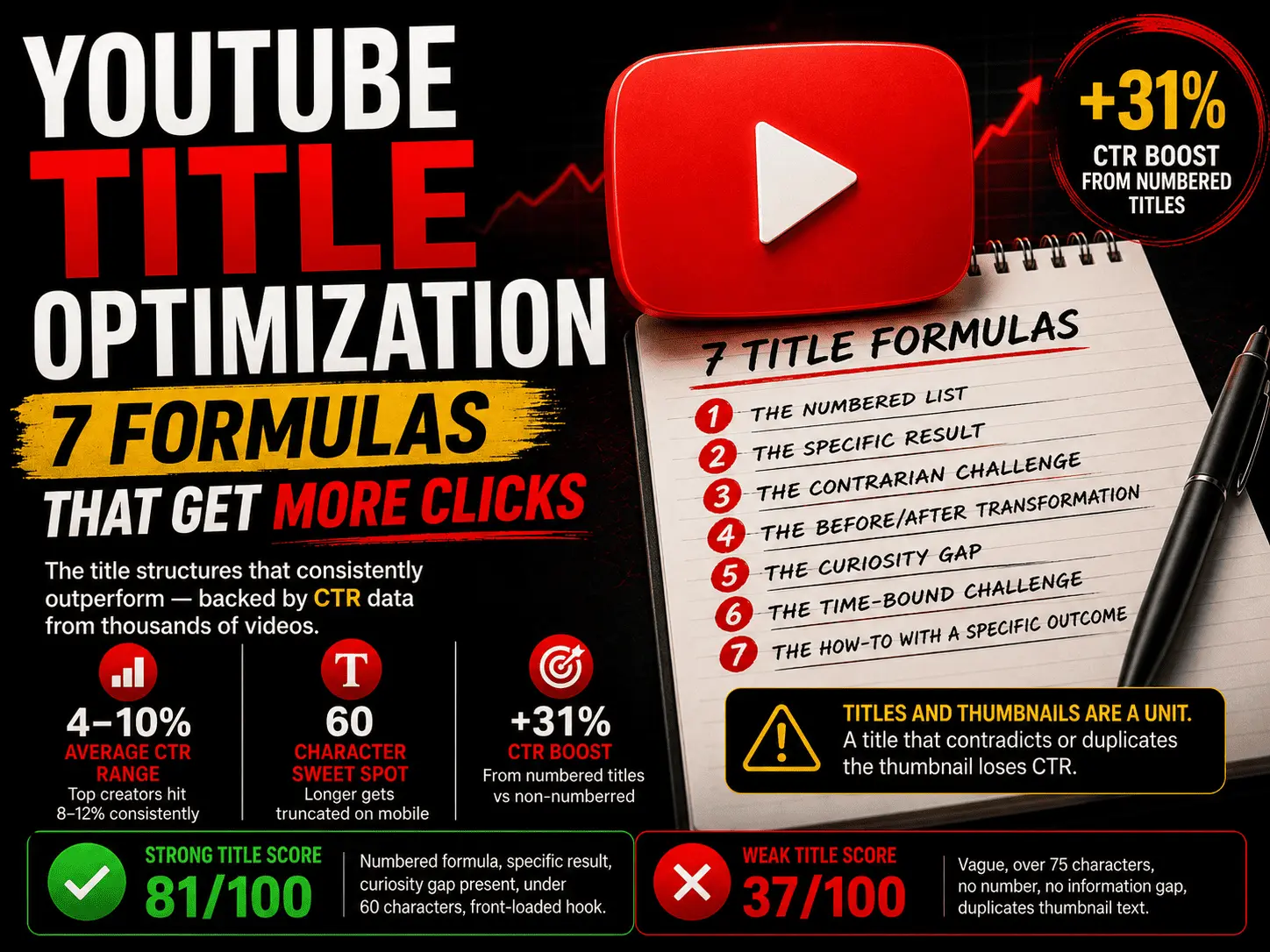
Your YouTube title has one job: make someone who was going to keep scrolling stop and click. That's it. It's not a description. It's not an SEO dump. It's a click trigger.
After analysing CTR data across thousands of YouTube videos from creators in the USA, UK and Canada, we identified seven title structures that consistently outperform everything else. These aren't creative templates — they're psychological formulas with a measurable effect on click-through rate.
Before the Formulas: The 3 Non-Negotiables
Every high-performing title passes three tests before we even look at the formula it uses:
- It contains a specific number, name, result, or timeframe
- It creates an information gap — you need to watch to get the answer
- It matches the thumbnail's emotional promise exactly
Formula 1: The Numbered List
Structure: "[Number] [Things/Ways/Reasons/Mistakes] [Promise]"
| Example Title | Why It Works |
|---|---|
| 7 YouTube mistakes that are killing your growth | Number creates completion contract. "Killing" creates urgency. |
| 12 things every creator should do before uploading | Actionable list with a specific count. Feels thorough. |
| 3 reasons your videos aren't going viral (and the fix) | Numbered diagnosis + promise of resolution in one title. |
Odd numbers (3, 5, 7, 9) consistently outperform even numbers in CTR tests. The psychology: odd numbers feel less manufactured and more curated.
Formula 2: The Specific Result
Structure: "How I [Specific Result] in [Timeframe]"
| Weak Version | Strong Version |
|---|---|
| How I grew my YouTube channel | How I went from 0 to 47K subscribers in 6 months |
| How I make money on YouTube | How I made $11,400 from YouTube last month (breakdown) |
| My YouTube strategy | The exact YouTube strategy that got me 2M views in 90 days |
The key is specificity. "47K" is more credible and compelling than "thousands." "6 months" is more believable than "quickly." Vague results feel like hype. Specific results feel like proof.
Formula 3: The Contrarian Challenge
Structure: "Why [Common Belief] Is Wrong (And What Actually Works)"
- "Why posting every day is destroying your YouTube channel"
- "The thumbnail advice everyone gives is wrong — here's the data"
- "Stop optimising for watch time. Here's what actually moves the algorithm."
This formula works because it creates cognitive dissonance. The viewer either agrees (feels validated, clicks) or disagrees (needs to prove you wrong, clicks). Either way — they click.
UK Market Note
Formula 4: The Before/After Transformation
Structure: "From [Painful Before State] to [Desirable After State]: [How]"
| Title | CTR Score Estimate |
|---|---|
| From 0 views to 1 million: the exact strategy | High — specific numbers on both sides |
| From broke creator to $8K/month on YouTube | Very High — clear financial before/after |
| From shadowbanned to featured on homepage: what I did | High — addresses a specific fear + resolution |
Formula 5: The Curiosity Gap
Structure: "The [Surprising Thing] About [Topic] That [Nobody/Most Creators/YouTube] Won't Tell You"
- "The one thing YouTube's algorithm rewards that nobody talks about"
- "The hidden reason your thumbnails aren't getting clicks"
- "What YouTube actually looks at before recommending your video"
The curiosity gap works because the brain cannot tolerate an open information loop. Once you've named that a gap exists, closing it becomes a compulsion — not a choice.
Formula 6: The Time-Bound Challenge
Structure: "I [Did X] for [Timeframe] — Here's What Happened"
| Example | Why It Works |
|---|---|
| I posted every day for 30 days on YouTube — here's the data | Experiment frame = credibility. Specific timeframe = commitment. |
| I used AI to write all my YouTube titles for 60 days | Novel experiment, specific duration, clear promise of result. |
| I uploaded only Shorts for 3 months — this is what happened to my channel | Addresses a common creator question through personal experiment. |
Formula 7: The How-To With a Specific Outcome
Structure: "How to [Specific Action] Without [Common Obstacle]"
- "How to grow on YouTube without showing your face"
- "How to make YouTube thumbnails without Photoshop (free tools only)"
- "How to get your first 1,000 subscribers without spending a penny"
The "without" removes the most common objection before the viewer even forms it. It's a pre-emptive answer to "But I can't do that because..."
Title Length and Character Limits
YouTube displays approximately 60 characters on desktop and fewer on mobile before truncating. Your most important words — the number, the result, the hook — must appear in the first 40–50 characters.
"I never write a title longer than 60 characters anymore. Whatever I cut usually wasn't adding to the click — it was adding to my own sense of completeness."
Numbered formula, specific result, curiosity gap present, under 60 characters, front-loaded hook.
Vague, over 75 characters, no number, no information gap, duplicates thumbnail text.
Get AI-optimised title suggestions for your next video — based on your specific niche and content.